Immediate potential for Boxwood Blight 3/24 and 3/25 – First infection potentials

There is a potential for new boxwood blight infections this FRIDAY and SATURDAY throughout much of NJ – especially central regions. Increased temperatures and prolonged periods of leaf wetness will contribute to the spread of boxwood blight infections.

  • It is time to begin protective fungicide applications in high value areas if you have not already done so! 

  • Protective fungicide applications should remain in effect or be initiated immediately for Boxwood Blight in “Infection risk or High Risk areas”. 
  • If your area is not listed (throughout all of NJ please visit the USPEST.ORG Boxwood Blight Risk Model – CLICK HERE TO CHECK YOUR LOCAL PREDICTIONS

Boxwood Blight risk-model information, considerations, and links:

Boxwood Blight Risk Assessment as of 3/22/2023
Region Location CODE 22-Mar 23-Mar 24-Mar 25-Mar 26-Mar 27-Mar NOTES
Southern Upper Deerfield NJ50 Very Low  Low Low  Infection Risk Very Low  Very Low 
Central Howell / Freehold NJ10 Very Low  Low HIGH Risk HIGH Risk Very Low  Very Low  High prob. of first BWB infections
Northern High Point NJ59 Very Low  Very Low   Infection Risk Very Low Very Low  Very Low 
 Please check YOUR LOCAL risk (click here)

(input your area code – select closest weather station – check 7-14 prediction – click on graph / table)

These advisories are general in nature, change rapidly over time, are site-specific…therefore  Someone from your business should be using this risk model daily if boxwood is important to your financial stability– In 30 seconds you can have a better idea of boxwood blight (and other pathogen) activity in your immediate area! Please contact Tim Waller if you need help using this service (twaller@njaes.rutgers.edu), we want to help! 

Fungicides; 

  1. You very well may have these materials already applied as ‘cover-sprays’ – But – be mindful that protectant fungicides loose efficacy the more rain (or overhead irrigation) they are subjected to, and reapplication may be warranted.
  2. ROTATE between Fungicide Resistance Action Committee (FRAC codes) to avoid this pathogen becoming resistant to specific chemicals

Format: [FRAC code]: Chemical name (Trade names * no endorsement implied, other options exist)  

  • [M05]: Chlorothalonil (Daconil WS)
  • [M05 + 1] Chlorothalonil + Thiophanate methyl (Spectro 90WDG)
  • [11] Trifloxystrobin + [7] Fluopyram  (Broadform)
  • [11] Trifloxystrobin + [3] Triadimefon (Armada 50WDG)
  • [M03] Mancozeb
  • [12] Fludioxonil (Medallion WDG)
  • [3] Tebuconazole (Torque)BW

DISCLAIMER: The label is the law, always refer to it for allowable host crops, use-restrictions, application rates, reapplication intervals, re-entry intervals (REI), and mix compatibility information. Production and pesticide information on this site are for private/commercial pesticide applicators and landscape professionals only, and are NOT for home gardener use. Provided materials represent examples and do not cover all possible control scenarios. Trade-names listed do not imply endorsement and are used as examples only. Please contact your local agent or chemical sales representative for more information or to discuss additional pest management options.

Resources 

Background on the pathogen: 

NJDEP Bureau of Water Allocation and Well Permitting Workshops Held

The New Jersey Department of Environmental Protection coordinated workshops in the past two weeks to assist farmers with Agricultural Water Certifications/Registrations who needed 5-year renewals. Those farmers with certifications expiring in 2023 were invited by NJDEP to attend the scheduled workshops. NJDEP Staff visited the 4 counties: Gloucester, Salem, Burlington, and Cumberland to complete renewals for 2023. These workshops are an efficient way to make sure forms are accurate, complete, and acceptable to NJDEP – avoiding the need to mail back paperwork to correct any information. If a farmer receives an invitation in the future to attend these NJDEP coordinated workshops, it is really important to attend and update your forms.

If a farmer was unable to attend workshops, or their county did not have a workshop, they must complete the 5-year renewal form mailed by DEP and make an appointment with the County Agricultural Agent in their county to finalize the forms in order to keep their status current. County Agricultural Agents do not have access to obtaining the renewal packets and farmers must bring them completed to the appointment or contact NJDEP for another copy, if they cannot locate their copy.

As per the NJDEP’s instruction, Agricultural Agents are to complete an “agent irrigation calculations sheet” and sign off on the form prior the forms are submitted to DEP. The forms can also be reviewed during an appointment with the Agricultural Agent. All other portions of the form are the responsibility of the farmer to complete. Also, it is important to read all instructions – that includes having a written daily log of the last month water was used in the past year to submit with the 5-year renewal application.

If a farmer does not have an Agricultural Water Use Certification or Registration, they can contact the NJDEP using the information below to obtain the forms.

If a farmer has any questions, NJDEP asks they contact staff at:

NJ Department of Environmental Protection, Division of Water Supply and Geoscience, Bureau of Water Allocation and Well Permitting, Mail Code 401-04Q, P.O. Box 420, Trenton, NJ 08625-0420, 609-984-6831. Also see the website at http://www.nj.gov/dep/watersupply/


Rutgers Soil Testing Laboratory adds Sulfur to Soil Fertility Analysis

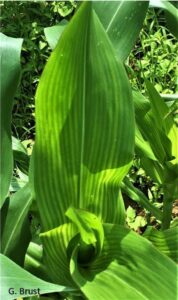
Plant-available sulfur (sulfate) values have been added to Rutgers Soil Testing Laboratory fertility reports in the micronutrient reporting line. There are four interpretive categories: Low, Medium-low, Sufficient, and High. An explanatory paragraph follows near the end of the report to help interpret the reported value.

Photo illustrating sulfur deficiency in sweet corn.

Symptoms of sulfur deficiency include yellowing or light green coloring on youngest tissue, thin stems and petioles, slow growth, and delayed maturity. Photo Credit: G. Brust, University of Maryland.

As the interpretative statements within the reports explain, sulfur analysis/interpretation is very complicated (similar to nitrogen) due to the many factors influencing it. Also, there is not full consensus among soil fertility experts on a best extraction method and critical values. Still, the sulfur value on the revised reports will provide an extra degree of information for understanding the soil & plant health. As with all micronutrient interpretations on the reports, the relevant RCE publication is referenced for further information; in the case of sulfur, RCE bulletin E365.

[Read more…]

Mild winter, what does it mean for overseeding of turf or dormant seeding?

Typically, turf management isn’t on top of the to-do list in mid-February. But winter in New Jersey isn’t typical typical this year. The statewide average temperature in January 2023 was 41.0°, which was 9.3° above the 1991–2020 normal and ties with 1932 as the mildest January since records commenced in 1895. For more details on […]

Plants sprouting through dead leaves
  

Japanese Stiltgrass Control in Turf

Japanese stiltgrass (Microstegium vimineum) is a C4 summer annual grassy weed commonly invasive to forests. It can be problematic in lawns. Often it is problematic in shaded areas adjacent to an infested forest. But we have observed infestations in full sun turfgrass areas where you would normally expect crabgrass to be the predominant summer annual. […]

Japanese still grass

2x Nursery Sessions in Atlantic City Next Tuesday – 2023 New Jersey Agricultural Convention (ACTS) & Trade Show

I am happy to remind that Tim Waller (Cumberland) and Bill Errickson (Monmouth) will be holding two Nursery Sessions next Tuesday (Feb 7th) at the 2023 New Jersey Agricultural Convention & Trade Show (ACTS) hosted by the Vegetable Growers Association (VGA). The meeting is held at Harrah’s Resort Atlantic City.

This is a relatively new session for the nursery and green industries that Tim and Bill really pushed for, so PLEASE join us at this important agricultural event alongside many of the other commodities in NJ. Urge your friends and other growers to join as well so we can continue to bring in great speakers for this event.

Specifics:

  • Click here to register and for more information
  • February 7th (Tuesday)
  • Harrah’s Atlantic City
  • 2 Sessions with Pesticide CEU’s in 1A, PP2, 10
  • Cost: $75 for 1-day pass (1 person), $120 for 3-day (2 people ($60 each)) + additional guest in your group $25 (cheaper option for multiple folks = grab a friend to come with).

Speaker highlight – View full schedule here get the full schedule here

Adam J. Kantrovich – Clemson (Extension Associate Professor of Agribusiness)

Dr. Kantrovich is an Associate Professor and Extension Economist with Clemson University and is located at the Sandhill Research and Education Center in Columbia, SC. Major responsibilities are programming activities in the areas of farm financials, ACA compliance for agribusiness, agribusiness succession and transition planning and agricultural and timber taxation management. Dr. Kantrovich conducts programs around the state and nationally to various agricultural groups and organizations. Click here for Dr. Kantrovich bio

  • Speaking on: “What’s the Political, Policy, and Economic Landscape” (1-h afternoon session)
  • Followed by a NRCS and FSA panel to speak about federal monies available to implement some of these ideas

Other speakers: 

  • Bill Errickson (RCE Monmouth Agent) – Native Trees for Low Input Landscapes
  • Raul Cabrera (Nursery Extension Specialist) – Irrigation Management of Nursery Crops
  • Steve Rettke (Nursery IPM) – Backyard Beneficials: Inviting Insects into the Landscape
  • Lauren Errickson (Director of Rutgers Gardens) – Women in Horticulture Panel
  • Aly Dyson and Stephanie Bouchelle (FSA), Fran Deficcio (NRCS) – Available NRCS and FSA Programs for Nurseries
  • Tim Waller (RCE Cumberland Agent) – Management of Oomycete Root Diseases (with treatment regime handouts!)


Upcoming Events:

  • Rutgers Speakers (and Educational Committee Planning) – TotalPro Expo (NJNLA)(Jan. 31st – Feb 1st)
  • Rutgers Speakers (and Educational Committee Planning) – Landscape New Jersey (NJLCA) (March 1st)
  • Tim Waller will be speaking about Phytophthora at Chesapeake Green 2023 (February 15 – 16th)
  • Many more to come including Nursery IPM Training Sessions