It’s Here!
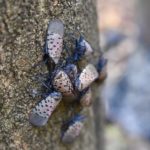
Spotted lanternfly was found on Friday August 10 on a commercial Hunterdon County fruit and vegetable farm. The insect was found in a Tree of Heaven being used as a trap tree with a plastic catch basin placed around the base of the tree, and the first 5-6 feet of the trunk sprayed with dinotefuran to kill any insects that land on the tree. The dead insects were supposed to fall into the catch basin. They did not. The find was made by looking up into the foliage and seeing the adult stage. To our knowledge this is the first sighting of this insect on a commercial farm in NJ. Growers should be particularly aware of any possible activity in trees of heaven that border cultivated plantings. These trees are common in poor and disturbed soil. This capture was made from trees on a hillside that line the border of a powerline which runs through the farm. With the amount of spraying that normally goes on in tree fruit, it is not likely that this insect will cause a major problem at this time of the season. However, if these insects are found on trees in close proximity to grapes it can be more problematic. See the July 18 Plant and Pest for an article by Anne Nielsen here https://plant-pest-advisory.rutgers.edu/?s=spotted+lanternfly
The photos taken by Karlton Neidigh and Atanas Atanassov are below:
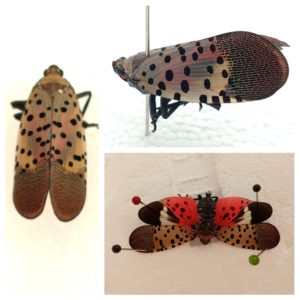
Figure 1. Spotted lanternfly adult from Hunterdon County farm. Photo – Karlton Neidigh & Atanas Atanassov.
Peach:
Oriental Fruit Moth (OFM): Third flight adults are present and trap counts are low on most farms, except in isolated areas in northern counties. The timing for 3rd generation treatments is done in southern counties, but ongoing in northern counties. Please see table below for timing:
| OFM 3rd Generation Timing | ||||
| Insecticide Type | ||||
| County/Region | Degree Days by 8/12 base 45
|
Conventional
Target – 2100-2200, 2450-2500 |
Intrepid / IGRs
Target -2050-2100, 2400-2450 |
Diamides (Altacor, Exirel
Target – 2025-2150, 2375-2450 |
| Gloucester –
Southern Biofix-4/27 |
2976 | 1st – past
2nd – past |
1st – past
2nd – past |
1st – past
2nd – past |
| Hunterdon – Northern
Biofix May1 |
2619 | 1st – past
2nd – 8/7-8/8 |
1st – past
2nd – 8/5-8/6 |
1st – past
2nd – 8/4-8/6 |
Brown Marmorated Stink Bug (BMSB): BMSB pressure as seen in pheromone traps has increased over the past week, but is still very spotty. The highest counts are in Hunterdon County with 1 farm having over 13 BMSB per trap. There is no trap or treatment threshold in peaches. Growers with positive counts should be on a BMSB protective schedule or using border sprays every 7 days. Growers are encouraged to use highly effective materials, and follow with Venom or Scorpion up to 3 days preharvest.
| Brown Marmorated Stink Bug Trap Counts – Southern Counties | ||||
| Week Ending | Average of Adults | Average of Nymphs | Max of Adults | Max of Nymphs |
| 7/7 | 1.5 | 0.5 | 5 | 1 |
| 7/14 | 1.25 | 0.0 | 4 | 0 |
| 7/21 | 0.67 | 0.0 | 2 | 0 |
| 7/28 | 0.0 | 0.0 | 0 | 0 |
| 8/4 | 1.44 | 0.00 | 5 | 0 |
San Jose Scale: Second generation scale crawlers appeared last week in southern counties. Crawler emergence will continue throughout August. In blocks where scale activity is observed on green fruit or at harvest should receive applications of either Esteem or Centaur either within the preharvest interval listed for the product, or in blocks that are harvested in early August, right after harvest. Belay and Actara also have good scale efficacy against crawlers. Refer to the product label for preharvest intervals and seasonal application limits.
Brown Rot: Brown Rot pressure has increased after the past few weeks of wet weather. Nothing can be done other than to stay diligent with preharvest fungicide applications starting about 3 weeks prior to harvest. Some of the rot problems may be a result of environmental problems such as streaking and “cooked flesh” that resulted from the very hot and dry weather in June.
Apple (and Pear):
Codling Moth (CM) and Oriental Fruit Moth (OFM): These two “worms” together can cause problems for apple growers late in the season. The timing for Oriental Fruit Moth in peaches is earlier than in apples. Any treatments applied for codling moth now, will also control oriental fruit moth. Codling Moth trap captures have increased on a number of farms. Trap counts range from 12-43 moths per trap in many North Jersey orchards. The treatment threshold is 5 moths per trap. As you can see from the trap count table, the averages in both North and South Jersey orchards is well above 5 moths per trap. In southern orchards, 3rd generation treatments are due now. If using Madex, then continue treatments every 5-6 days.
| Codling Moth Degree Day Timing – Model Predictions 3rd Generation Treatments | |||||||||
| Application and Insecticide Type | |||||||||
| County Area | Biofix | DD by
8/12 |
Rimon:
1150-1200 DD + 14-17 days later, or 1450-1500 DD 3rd Gen. Target at 2200 |
Intrepid and
Diamides – Altacor, Exirel, Voliam mixes: 1200-1250 DD + 1550-1600 (14-21 days later) 3rd Gen. Start Target at 2200 |
Cyd-X, Madex, Carpovirusine
1250 DD + every 5-6 days during brood hatch (later if first spray is an IGR) 3rd Gen. Start Target at 2200 |
Standard Insecticides – Delegate, Avaunt, OP’s, carbamates, pyrethroids
1250-1300 DD + 1600-1650 DD 3rd Gen. Start Target at 2300 |
|||
| DD | 2200 | 2300 | 2200 | 2300 | 2200 | 2300 | |||
| Southern | May 5 | 2336 | 8/8-10 | 8/12-13 | 8/8-10 | 8/12-13 | 8/8-10 | 8/12-13 | |
| Northern | May 9 | 1975 | Continue Treatments for CM if trap counts above 5, Otherwise target 8/21-22 for 3rd generation treatments | Continue Treatments for CM if trap counts above 5, Otherwise target 8/21-22 for 3rd generation treatments | Continue Treatments for CM if trap counts above 5, Otherwise target 8/21-22 for 3rd generation treatments | Continue Treatments for CM if trap counts above 5, Otherwise target 8/25-26th for 3rd generation treatments | |||
Grape:
Grape Berry Moth (GBM): Timing for the 4th generation will be due roughly around August 20-21in southern counties. Growers are advised to consider treatments only if pest pressure is high, especially around the edges of vineyards. GBM pressure along with various drosophila activity can combine to aggravate late season rot pressure.
Grape Root Borer (GRB): So far in our counts this year in 8 vineyards, we have not found any with populations that are high enough to merit treatment. Most of the adult activity seen in the pheromone traps is from mostly wild sources.
| Grape Insect Trap Counts: 8 Grape blocks in southern counties. | ||
| Average # Males for Week Ending | GBM – Grape Berry Moth | GRB – Grape Root Borer |
| 6/2 | 8 | — |
| 6/9 | 3 | — |
| 6/16 | 3 | — |
| 6/23 | 3 | 3 |
| 6/30 | 11 | 0 |
| 7/7 | 11 | 0 |
| 7/14 | 11 | 2 |
| 7/21 | 3 | 1 |
| 7/28 | 5 | 2 |
| 8/4 | 1 | 5 |
Scouting Calendar Tree Fruit Southern Counties
The following table is intended as an aid for orchard scouting. It should not be used to time pesticide applications. Median dates for pest events and crop phenology are displayed. These dates are compiled from observations made since 1995 in Gloucester County. Events in northern New Jersey should occur 7-10 days later.
Pest Event or Growth Stage |
Approximate Date | 2018 Observed Date |
| Bud Swell (Redhaven) | March 23 +/- 15 Days | March 26 |
1/4″ Green Tip Red Delicious |
March 31 +/- 13 Days | April 2 |
Pink Peach (Redhaven) |
April 4 +/- 15 Days | April 10 |
Tight Cluster Red Delicious |
April 9 +/- 13 Days | April 16 |
Oriental Fruit Moth Biofix |
April 9 +/- 13 Days | April 27 |
Full Bloom Peach (Redhaven) |
April 9 +/- 14 Days | April 20 |
Pink Apple (Red Delicious) |
April 14 +/- 12 Days | April 30 |
Codling Moth Biofix |
April 27 +/- 13 Days | May 5 |
Green Peach Aphid Observed |
April 16 +/- 16 Days | May 21 |
Full Bloom Apple (Red Delicious) |
April 22 +/- 11 Days | May 3 |
Petal Fall (Redhaven) |
April 22 +/- 10 Days | May 1 |
Petal Fall (Red Delicious) |
April 27 +/- 14 Days | May 7 |
Shuck Split (Redhaven) |
April 30+/- 11 Days | May 7 |
First PC Oviposition Scars Observed |
May 3 +/- 18 Days | May 14 |
Tufted Apple Bud Moth Biofix |
May 4 +/- 10 Days | May 12 |
San Jose Scale Crawlers |
June 2 +/- 8 Days | June 1 |
Pit Hardening Peach |
June 16 +/- 8 Days | June 12 |
Tree Fruit Trap Counts – Southern Counties
| Weekending | STLM | TABM-A | CM | OFM-A | DWB | OFM-P | TABM-P | LPTB | PTB | BMSB | |
| 5/12 | 2 | 2 | 10 | 117 | 32 | ||||||
| 5/19 | 8 | 5 | 10 | 53 | 3 | 7 | |||||
| 5/26 | 0 | 8 | 28 | 53 | 3 | 6 | 45 | ||||
| 6/2 | 2 | 11 | 1 | 19 | 0 | 10 | 27 | ||||
| 6/9 | 4 | 10 | 9 | 39 | 42 | 4 | 19 | 55 | |||
| 6/16 | 11 | 11 | 8 | 14 | 181 | 5 | 10 | 4 | 0 | ||
| 6/23 | 17 | 4 | 5 | 9 | 98 | 2 | 8 | 27 | 11 | ||
| 6/30 | 10 | 3 | 3 | 12 | 173 | 1 | 1 | 8 | 20 | ||
| 7/7 | 19 | 1 | 4 | 68 | 94 | 0 | 2 | 19 | 2 | 3 | |
| 7/14 | 3 | 1 | 3 | 38 | 109 | 1 | 0 | 3 | 4 | 1 | |
| 7/21 | 8 | 1 | 6 | 32 | 3 | 0 | 3 | 4 | 1 | ||
| 7/28 | 5 | 1 | 6 | 12 | 116 | 2 | 0 | 1 | 13 | 0 | |
| 8/4 | 10 | 2 | 7 | 19 | 15 | 3 | 1 | 0 | 2 | ||
Tree Fruit Trap Counts – Northern Counties
| Weekending | STLM | TABM-A | CM | OFM-A | DWB | OBLR | OFM-P | TABM-P | LPTB | PTB | BMSB |
| 4/7 | 0 | ||||||||||
| 4/14 | 4 | ||||||||||
| 4/21 | 11 | 0 | 0 | ||||||||
| 4/28 | 15 | 0 | 0 | 0 | |||||||
| 5/5 | 17 | 0 | 0 | 0 | 1 | ||||||
| 5/12 | 30 | 0 | 0.2 | 7 | 16.9 | 0 | 0 | ||||
| 5/19 | 26 | 0.3 | 1.8 | 3.7 | 0 | 0 | 4.5 | 0.4 | 1.1 | 0 | |
| 5/26 | 43 | 2.2 | 2.5 | 4.6 | 0 | 0 | 6.1 | 1.4 | 11.8 | 2 | |
| 6/2 | 4 | 7.2 | 2.4 | 4 | 0.7 | 0 | 5.1 | 11.3 | 14.9 | 0 | |
| 6/9 | 10 | 20.8 | 5 | 3.3 | 1.2 | 12 | 6.6 | 22.2 | 18.5 | 0.8 | |
| 6/16 | 13 | 42.3 | 4.6 | 7.4 | 0.3 | 31 | 2.9 | 96 | 12.7 | 0.3 | |
| 6/23 | 54 | 42.8 | 5.8 | 3 | 0.6 | 17 | 4.7 | 60.5 | 9.3 | 0.4 | |
| 6/30 | 45 | 29.3 | 2.5 | 2.2 | 1.3 | 12 | 3.2 | 29.8 | 7.8 | 4.5 | |
| 7/7 | 61 | 13.7 | 1.5 | 2.3 | 1 | 7 | 2.9 | 10.3 | 8.5 | 2.7 | |
| 7/14 | 20 | 5.9 | 0.9 | 2.8 | 2.4 | 8 | 2.7 | 4.7 | 5.8 | 4.5 | |
| 7/21 | 40 | 1.2 | 2.7 | 2.9 | 1.9 | 0 | 5.9 | 0.8 | 6.3 | 4.2 | |
| 7/28 | 51 | 0.9 | 5.6 | 1.3 | 2.2 | 0 | 3.2 | 1.6 | 3.3 | 1 | 3.1 |
| 8/4 | 108 | 1.7 | 6.9 | 1.8 | 0.8 | 1 | 1.7 | 3.5 | 2.2 | 5.8 | 3 |
| 8/11 | 144 | 1.7 | 7.5 | 1 | 0.5 | 2 | 4.6 | 2 | 3.1 | 6.5 | 7.3 |
Blueberry
Putnam Scale: Second generation crawlers are active. Anybody who had any fruit infested with scale should treat those fields now. The keys to scale control are 1) High Volume sprays, 2) Timing, and 3) the correct material. Use plenty of spray volume for this spray. The two best choices for materials are Esteem and Diazinon. Diazinon can only be once post bloom, and it is still too early for the second generation Sharpnosed Leafhopper treatment. Therefore, if you plan to use Diazinon later for SNLH, then you have to use Esteem now. It’s the better material for this anyway.
Spotted Wing Drosophila (SWD): Trap counts continue to increase. The highest counts this past week were 50 in Atlantic County and 68 in Burlington County. Treatments are over for most growers, but if you still have any Elliott still on the bushes, then treatments are still required. At the end of July we did get a positive fruit reading in a salt test. Spraying and picking had just stopped in this field.
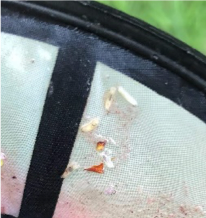
Figure 2. SWD larvae on filter screening – Photo Brendan Branca
Sharpnosed Leafhopper (SNLH): Trap captures have increased, but this is still too early to define this as the second generation flight. Treatments are still Not suggested at this time.
Summary of insect counts seen during the week of July 23rd – July 27th
| Leafroller % Inj. Shoots | Aphids % Inf. Shoots | CBFW % Inf. Fruit | Leafrollers
% Fruit injury |
PC % Fruit Injury | Scale % Fruit Injury | |
| Average | 0.96 | 5.98 | 0 | 0.010 | 0 | 0.02 |
| High | 26 | 32 | 0 | 0.2 | 0 | 0.7 |
Blueberry Trap Captures – Atlantic County
| Week Ending | PC | CBFW | OB | SWD | BBM | SNLH | Putnam Scale |
| 5/26 | 0.43 | 0.0 | |||||
| 6/2 | 0.43 | 0.0 | |||||
| 6/9 | 0.09 | 0.43 | 5.4 | ||||
| 6/16 | 0 | 0.015 | 31.75 | 0.02 | 0 | 0.072 | |
| 6/23 | 0.285 | 0.015 | 1436 | 0.176 | 0.024 | 0.104 | |
| 6/30 | 0.28 | 0 | 2583 | 2.78 | 0.012 | 0.1333 | |
| 7/7 | 0.428 | 0.016 | 3469 | 3.16 | 0.09 | 0.09 | 24.5 |
| 7/14 | 0.142 | 0.02 | 2827 | 8.235 | 0.011 | 0.253 | 1 |
| 7/21 | 0.142 | 0 | 827 | 10.42 | 0.101 | 0 | 0.714 |
| 7/28 | 0 | 0 | 96.43 | 15.21 | 0.125 | 0.02 | 0.29 |
| 8/4 | 0 | 0.05 | 68.48 | 8.7 | 0.15 | 0.02 | 7.71 |
Blueberry Trap Captures – Burlington County
| Week Ending | PC | CBFW | OB | SWD | BBM | SNLH | Putnam Scale |
| 5/26 | 1.67 | 0.18 | |||||
| 6/2 | 0.67 | 0.16 | |||||
| 6/9 | 0.0 | 0.1 | 0.6 | ||||
| 6/16 | 0 | 0.5 | 38.52 | 0.15 | 0 | 0 | |
| 6/23 | 0 | 0 | 1016 | 0.5 | 0 | 0 | |
| 6/30 | 0 | 0.25 | 2463 | 4.63 | 0 | 0.5517 | |
| 7/7 | 0 | 0.105 | 3741 | 4.8 | 0.25 | 0.143 | 0 |
| 7/14 | 0 | 0 | 1980 | 26.45 | 0 | 0.071 | 0.5 |
| 7/21 | 0 | 0 | 1002 | 15.5 | 0 | 0 | 0.333 |
| 7/28 | 0 | 0 | 485.5 | 8.35 | 0.49 | 0.07 | 0.67 |
| 8/4 | 0 | 0.1 | 206.47 | 11.1 | 0.38 | 0.11 | 0.67 |