Landscape, Ornamentals, Nursery, and Turf Edition

Seasonal updates on ornamental, nursery, and turf pests.
Subscriptions are available via EMAIL and RSS.


Companion Website Links:

Rutgers Turf Blog - Articles on turfgrass diseases and cultural practices for the commercial turfgrass industry. Subscription available via RSS.


Rutgers Weather Forecasting - Meteorological Information important to commercial agriculture.

Slow Growth This Spring

By Jim Murphy

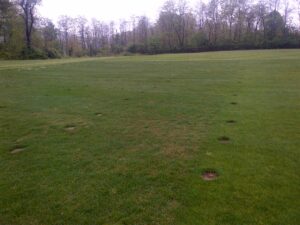
Slow growth of grasses has been a common complaint this spring. There are many factors that can cause this but cool dry weather has been a major factor this year.

Slow growth of turf can be due to many factors but cool dry weather has been important this spring.

But this is changing as I type. The abundant rains of this week will stimulate a lot of shoot growth. Be on the watch for large surges of growth from turfs that have been fertilized with relatively large amounts of nitrogen fertilizer. Water, warmer weather, and nitrogen can stimulate plenty of shoot growth.

Moreover, rains could interrupt mowing schedules. Sharp blades and bedknives will be very helpful in cutting fast growing, dense turfs. Overgrown turf will present the greatest challenge to mulching mowers.  Raise the cutting height if rains significantly delays mowing and turf becomes severely overgrown. Double cutting may be another useful practice to reduce clipping debris.

Avoid mowing turf areas that are squishy wet. Operating equipment under these conditions can cause significant traffic damage to the turf and soil.
Source: Read More on the Rutgers Turf Blog

Downy Mildew in Ornamental Crops

Although the disease “downy mildew” sounds similar to the more familiar disease called “powdery mildew,” the downy mildews are caused by fungal relatives called Oomycetes.  These fungal-like organisms, troublesome in during cool, moist weather, attack tender, above-ground plant parts, dispersing rapidly in films of water.  In susceptible ornamental plants, downy mildews are most often caused by species of Peronospora, although species of Plasmopara, Pseudoperonospora, Sclerospora, and Bremia also cause this disease.  [Read more…]

Leaf Spot Diseases in Landscape Turf

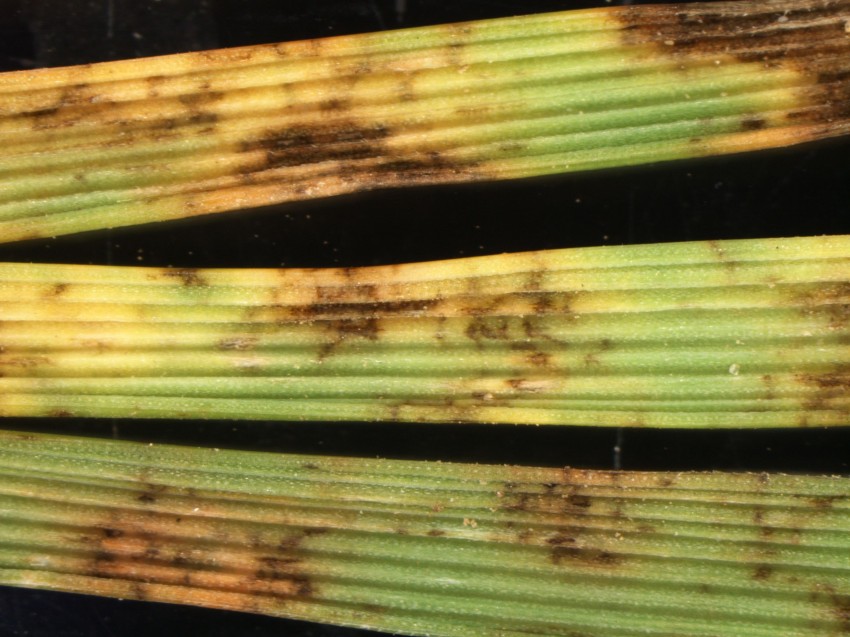
An unexpected sample walked into the laboratory at the end of last week. Net blotch, which is caused by the fungus Drechslera dictyoides, was subsequently diagnosed on a sample of turf-type tall fescue.

net blotch leaf lesions on tall fescue

Net blotch leaf lesions on tall fescue. Photo: Sabrina Tirpak, Rutgers PDL

[Read more…]

Take Off Your Rose Colored Glasses

Downy mildew was identified in Knock Out® rose samples submitted to the Plant Diagnostic Lab from a south-Jersey nursery this week. Knock Outs®, which have few problems, have been a favorite in New Jersey landscapes in recent years. Unfortunately, it seems this plant has met its Achilles’ heel.

downy mildew on double knock out rose

Downy mildew on Double Knock Out® rose. Photo: Sabrina Tirpak, Rutgers PDL

[Read more…]

April showers bring May….diseases?

Although the weather this weekend promises to be lovely, recent rains and the likelihood of more to come is ideal for the development of foliar diseases in the landscape.  The most common diseases on trees and shrubs affect the foliage as spots, blotches, and blisters.  Although unsightly, most foliar diseases do not greatly impact the health of the plant, and chemical inputs are rarely necessary.  [Read more…]

Just a Bud or Another Bug?

Unfortunately, this one is another bug.

Pine Sawfly Larval Case

Pine Sawfly Larval Case
Photo by Jim Johnson

The pine sawfly is normally kept under control by natural predators so I rarely see them. This, however, was my second sighting in the last 4 months so I guess environmental conditions have not be optimal for predator survival.

Keep a lookout for these insects. The larvae are voracious eaters that completely devour the needles and can totally defoliate pine trees. The first site I visited had a block of about 25 trees more than 20 feet tall that were without needles.


If treatment is necessary, first generation control will need to occur from mid-May to mid-June. The second generation is active in the July to August time period. Cornell University Cooperative Extension of Suffolk County put together a good review of pine sawflies. It can be found at:
http://ccesuffolk.org/assets/Horticulture-Leaflets/Pine-Sawflies.pdf
