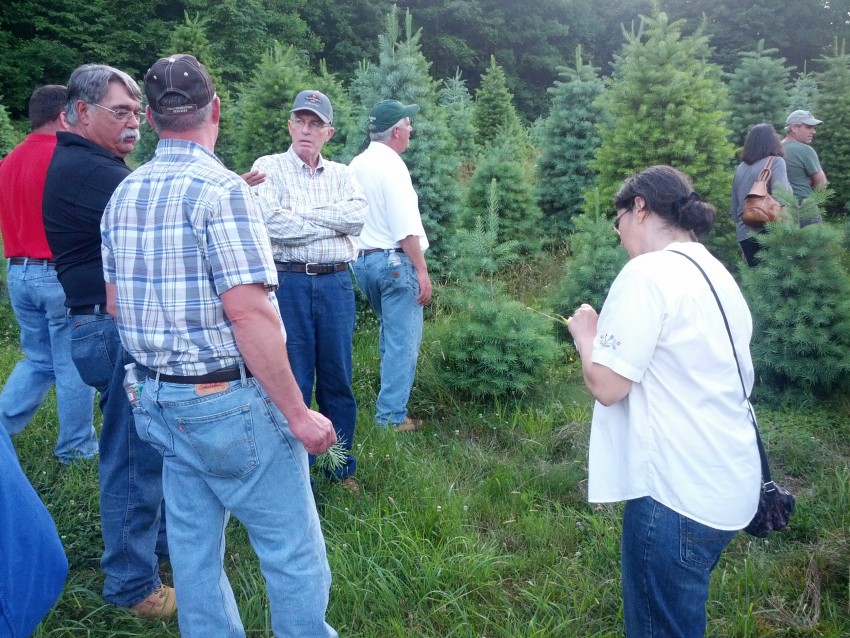
Last week I had the pleasure of attending New Jersey Christmas Tree Growers’ Association Annual Twilight Meeting at Black Oak Farm in Asbury, New Jersey.
Landscape, Ornamentals, Nursery, and Turf Edition
Seasonal updates on ornamental, nursery, and turf pests.
Subscriptions are available via EMAIL and RSS.
Companion Website Links:
Rutgers Turf Blog - Articles on turfgrass diseases and cultural practices for the commercial turfgrass industry. Subscription available via RSS.
Rutgers Weather Forecasting - Meteorological Information important to commercial agriculture.
Practical Management Responses to Emerald Ash Borer in NJ
The announcement that the invasive pest Emerald Ash Borer (EAB) is present in NJ will lead to many discussions between professionals and concerned clients on what to do about their ash trees. EAB represents a broad threat – it attacks all true ash (Fraxinus) species. In the U.S., trees die within a few years without treatment. Research out of Ohio by Dan Herms points to the need for long term control efforts – possibly 15 to 20 years. Feasibility of treatment on an individual basis balances the cost of effective treatment vs the cost of removal of trees killed by EAB – which is not small.
Landscape Options for EAB
Confusion arises when discussing management of ash tree populations (forest or landscape) at risk due to EAB. Any discussion involving treatment does not apply to whole forests because methods and treatment costs make that impossible. Specific options available to landscaped areas include: elimination, preservation, and conservation.
![]() |
![]() |
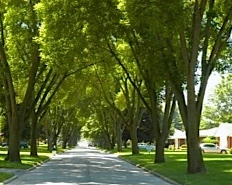
| June 2006 Urban Ash Trees Pre-EAB |
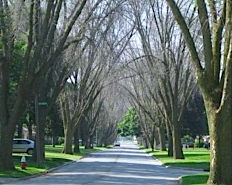
August 2009 Urban Ash Trees Post-EAB |
| Photos by D. Herms, Ohio State University | |
Black Vine Weevil Best Treatment Window Nearing End in NJ

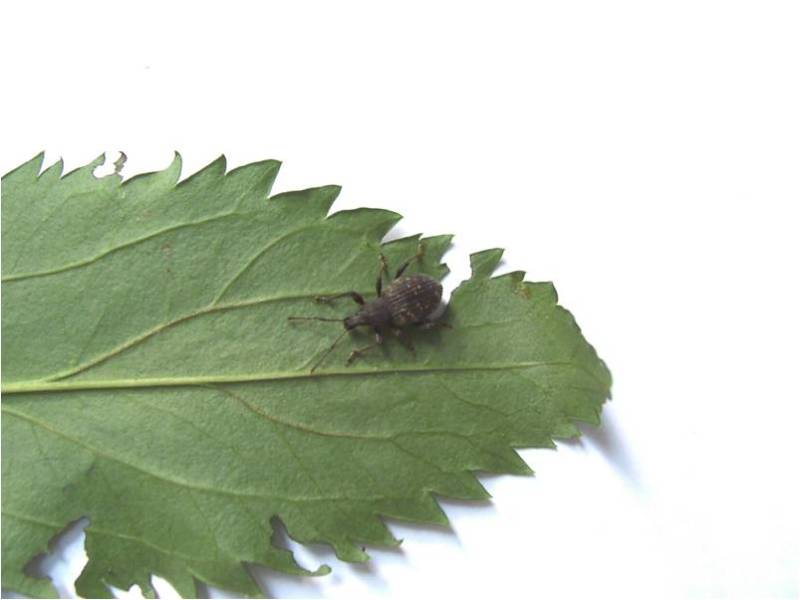
Black Vine Weevil Adults Are Noctural and Cause Feeding Damage at Night. Proto Credit: Steven K. Rettke of RCE
Many landscape & nursery managers consistently state that attempting to manage the black vine weevil insect (Otiorhynchus subcatus) as one of the most problematic pests they encounter. These leaf notching weevils feed on many kinds of ornamental plants including yews, rhododendrons, azaleas, laurels, leucothoe, forsythia, euonymus, hollies, viburnum, most deciduous and evergreen shrubs, ground covers and many kinds of perennials and annuals.
Controlling Black Vine Weevil adults during the month of June will prevent egg laying during the weeks of July. This beetle only has one generation a year.
Crabgrass Emerging
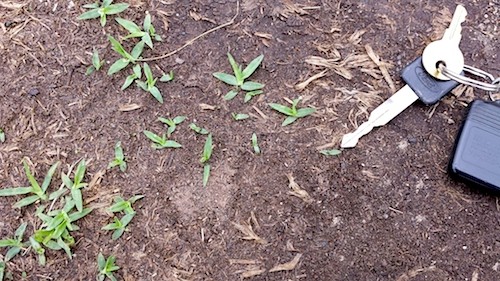
Crabgrass has been emerging for several weeks now, depending on the exposure. Warmer and more open turfs will likely have more advanced (larger) plants while cooler and denser turfs will have smaller plants.
Management options for this weed at this point in the season range from doing nothing to postemergence herbicide applications.
Tis the Season for Summer Stress
Optimum growth of cool season grasses occurs within the temperature range of 60 to 75°F. Yesterday, the New Brunswick weather station indicated that soil temperature at 2 inches exceeded 75°F for more than 12 hours and peaked at 82°F.
This doesn’t mean that grasses will soon be dead. But it is a signal to be watchful for summer stress problems.
Summer stress is often a combination of multiple stresses. Localized drought, ponding of water, diseases, insect pests, poor culture (mowing, fertilization, and irrigation) and other stresses combined with high temperature stress can challenge the health and persistence of cool season turfs from now through the end of summer. It is important to avoid situations that compound too many stress at the same time. [Read more…]
They’re Everywhere! They’re Everywhere!
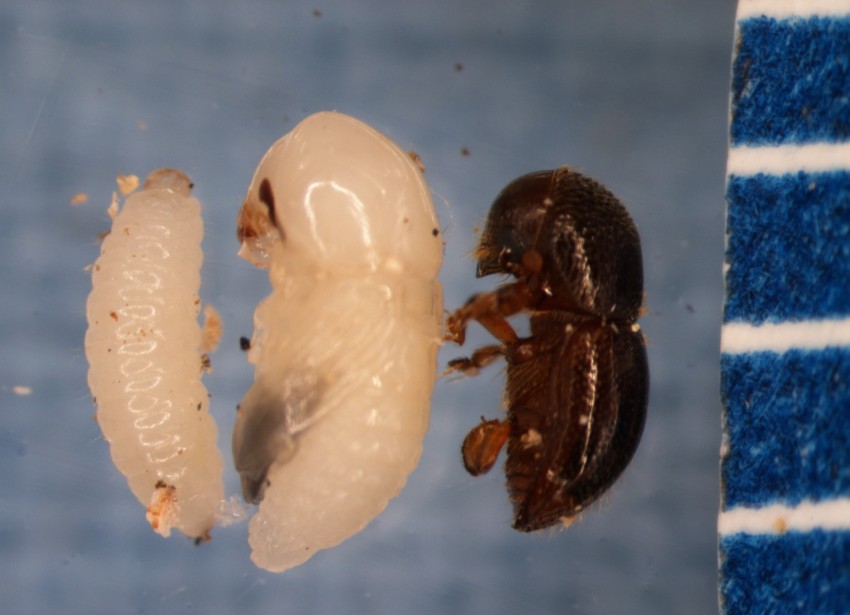
Asian Longhorned Beetle and now the Emerald Ash Borer garner all the attention, but a group of tiny exotic wood boring beetles, known as “Asian Ambrosia Beetles,” has been quietly invading the state for the last decade. First appearing in our laboratory database in 2006, by 2008 these beetles had found widespread distribution in the mid-Atlantic and Northeast region.