Please use below links for the audio and video recordings of Webinar – Ask the Expert Series -V held on May 5th. The recording includes lively discussion on various aspects of orchard soil fertility and plant nutrition, including Q &A from growers, with, Dr. Robert Crassweller from PSU; and Dr. Joseph Heckman, Dr. Megan Muehlbauer and Dr. Hemant Gohil from Rutgers NJAES. Some of the information is also applicable to other crops. [Read more…]
May 12, 2021 Hemant Gohil
Recordings of Webinar – Ask the Expert: Orchard Soil Fertility and Tree Nutiriton
May 5, 2021 Tim Waller
Nursery and Conifer Pest Scouting Guide: 250-600 GDD & Boxwood Blight Information & Request for Collaborators
Please print or download these resources (click on them):
General Nursery Scouting (contains conifer information within range)
- Printable Nursery Pest Scouting 250-600 GDD
- Expanded Nursery Pest Scouting Guide 250-600 with CLICKABLE LINKS
- (Zoom in and click directly on the links within this document)
Conifer / Christmas Tree Specific Pest Scouting Guides
- Conifer/Christmas Tree Specific Pest Scouting Guide 0-600 GDD – PRINTABLE
- Conifer/Christmas Tree Specific Pest Scouting Guide 0-600 GDD – CLICKABLE LINKS
- (Zoom in and click directly on the links within this document)
To determine your local growing degree-days, please review this post “Obtaining your local growing degree-day information”
| Projected GDD50 accumulation as of 5/5/2021 | ||||||
| Region | Location | 5-May | 1-Jun | 1-Jul | 1-Aug | 1-Sep |
| Southern | Upper Deerfield (NJ50) | 308 | 665 | 1342 | 2184 | 2970 |
| Central | Howell / Freehold (NJ10) | 208 | 511 | 1132 | 1926 | 2660 |
| Northern | High Point (NJ59) | 127 | 315 | 767 | 1373 | 1928 |
| Forecast: NOAA NCEP Coupled Forecast System model version 2 (CFSv2) forecast system (3.5 months) (USPEST.ORG) | ||||||
| Pest Scouting – Growing Degree-day Ranges | (240-600 GDD50) | |||||
| CROP TYPE | Common Name | Scientific Name | GDD Min (50F) | GDD Max (95F) | Reference | Developmental / Target Stage |
| Many | Redheaded flea beetle | Systena frontalis | 242 | 600 | Unv. Del | First control target – egg hatch / larval activity |
| Conifer | Arborvitae leafminer | Argyresthia thuiella | 245 | 360 | RU | Larvae Treatments (1st generation) |
| Prunus | American plum borer | Euzophera semifuneralis | 245 | 440 | 5 | Adult flight, egg laying |
| Boxwood | Boxwood mites | Eurytetranychus buxi | 245 | 600 | RU | All Stages |
| Lilac | Lilac leafminer | Caloptilia syringella | 246 | 363 | 5 | Larvae Treatments |
| Holly | Holly leafminer | Phytomyza ilicis | 246 | 448 | RU | Larvae Treatment |
| Yew | Taxus mealybug | Dysmicoccus wistariae | 246 | 618 | RU | Adults/Crawlers |
| Conifer | Pine sawflies (Red-headed) | Neodiprion lecontei | 246 | 1388 | RU | Larvae (1st generation) |
| Boxwood | Boxwood leafminer | Monarthropalpusi flavus | 249 | – | 6 | Adult emergence |
| Conifer | Eastern spruce gall adelgid | Adelges abietis | 250 | 310 | 5 | Egg hatch, galls begin forming (not a control target) |
| Birch | Birch Leafminer | Fenusa pusilla | 275 | 375 | 4 | Adults laying eggs |
| Boxwood | Boxwood Psyllid | Cacopsylla busi | 290 | 440 | RU | Nymphs |
| Conifer | Pine Needle Scale | Chionaspis pinifoliae | 298 | 448 | RU | Crawlers (1st generation) – control target |
| Locust | Locust leafminer | Odontota dorsalis | 298 | 533 | 5 | Typical treatment window |
| Conifer | Pine eriophyid mites | Eriophyidae | 298 | 533 | 5 | Typical treatment window |
| Malus | Redbanded leafroller | Argyrotaenia velutinana | 298 | 618 | 5 | Typical treatment window |
| Privet | Privet Rust Mites | Aculus ligustri | 298 | 802 | RU | All stages |
| Oaks | Kermes oak scale | Allokermes spp. | 298 | 912 | 5 | Typical treatment window |
| Conifer | Pine root collar weevil | Hylobius radicis | 300 | 350 | 4 | 1st adults active |
| Conifer | Turpentine beetle | Dendroctonus terebrans | 300 | 350 | 4 | Parent beetles colonizing brood material |
| Spirea | Spirea aphid | Aphis spiraecola | 326 | – | 6 | Adults/nymphs |
| Conifer | Hemlock Woolly Adelgid | Adelges tsugae | 350 | 350 | RU | Eggs and 50% hatch |
| Malus, Prunus, many | Lesser peach tree borer | Synanthedon pictipes | 350 | 375 | 4 | Adult flight, egg laying |
| Rhododendron | Azalea Lacebug | Stephanitis pyrioides | 350 | 646 | RU | Adults (1st generation) |
| Dogwood, apple, pecan, elm, hickory, willow | Dogwood borer | Synanthedon scitula | 350 | 850 | 4 | adults, eggs, caterpillars |
| Conifer | Elongate Hemlock Scale | Fiorinia externa | 360 | 700 | RU | Crawlers (1st generation) |
| Elm | Elm Leaf Beetle | Xanthogaleruca luteola | 363 | 530 | RU | Larvae treatment (1st generation) |
| Conifer | Larch casebearer | Coleophora laricella | 363 | 618 | 2,4 | Nymphs active – typical treatment window |
| Many | Oystershell Scale | Lepidosaphes ulmi | 363 | 707 | RU | Crawlers |
| Walnut | Walnut blister mite | Eriophyes erinea | 363 | 707 | 5 | Typical treatment window |
| Beech | Woolly beech aphids | Grylloprociphilus imbricator & Phyllaphis fagi | 363 | 7070 | 5 | Typical treatment window |
| Conifer | Striped pine scale | Toumeyella sp. | 400 | 500 | 3 | Crawlers (1st generation) |
| Conifer | Pine needle midge | Thecodiplosis brachynteroides | 400 | 500 | 7 | Adults (1st generation) |
| Conifer | Pine tortoise scale | Toumeyella parvicornis | 400 | 1000 | 4 | Crawlers |
| Yews, Rhododendrons, many | Black Vine Weevil | Otiorhynchus sulcatus | 400 | 2800 | RU | Adults treatment |
| Basswood | Basswood lacebug | Gargaphia tiliae | 415 | – | 6 | Adults/nymphs |
| MANY | Fourlined plant bug | Poecilocapsus lineatus | 435 | – | 6 | Egg hatch / early instars |
| Many | Two-Spotted Mite | Tetranychus urticae | 437 | 997 | RU | Adults (build-up activity) |
| Birch | Bronze Birch Borer | Agrilus anxius | 440 | 880 | RU | Adults (egg laying) |
| Boxwood | Boxwood Leafminer | Monarthropalpusi flavus | 448 | 700 | RU | Larvae treatment |
| Rhododendron | Azalea whitefly | Pealius azaleae | 448 | 700 | 5 | Adults/nymphs |
| Oak | Oak skeletonizer | Bucculatrix ainsliella | 448 | 707 | 5 | Typical treatment window |
| Conifer | Hemlock looper | Lambdina fiscellaria | 448 | 707 | 5 | Typical treatment window |
| Conifer | Pine shoot beetle | Tomicus piniperda | 450 | 500 | 4 | Adults emerge; begin shoot feeding – control target |
| Conifer | Pine Chafer (Anomela Beetle) | Anomala oblivia | 450 | 600 | 7 | Adults (1st generation) |
| Many | Gypsy moth | Lymanttria dispar | 450 | 900 | 4 | Caterpillar to pupation – control target missed |
| Juniper | Maskell scale | Lepidosaphes pallida | 470 | – | 6 | Crawlers (1st generation) |
| Conifer | European pine shoot moth | Rhyacionia buoliana | 480 | 710 | 5 | Larvae Treatment |
| Malus, Prunus, many | Peach Tree Borer | Synanthedon sp. | 500 | 600 | RU | Adults – emerge (1st treatment both types) |
| Rhododendron | Rhododendron Borer | Synanthedon rhododendri | 509 | 696 | RU | Adults emerge |
| Many | White prunicola scale | Psedaulacaspis prunicola | 513 | – | 6 | Crawlers (1st generation) |
| Many | Redheaded flea beetle | Systena frontalis | 517 | 1028 | Unv. Del | Adults – feeding / laying eggs |
| Many | Cottony camellia / taxus scale | Pulvinaria floccifera | 520 | – | 6 | Crawlers (1st generation) |
| Birch | Birch Leafminer | Fenusa pusilla | 530 | 700 | RU | Larvae (2nd generation) |
| Conifer | Arborvitae Leafminer | Argyresthia thuiella | 533 | 700 | RU | Adults (egg laying) – larvae treatments |
| Euonymus | Euonymus Scale | Unaspis euonymil | 533 | 820 | RU | Crawlers (1st generation) |
| Oak | Oak blotch leafminers | Cameraria spp. ; Tisheria spp. | 533 | 912 | 5 | Typical treatment window |
| Maple | Greenstriped mapleworm | Dryocampa rubicunda | 533 | 1645 | 5 | Control target |
| Conifer | Balsam gall midge | Paradiplosis tumifex | 550 | 700 | 4 | Galls apparent |
| Conifer | Juniper scale | Carulaspis juniperi | 550 | 700 | 7 | Egg hatch |
| Malus, Prunus, many | Greater peach tree borer | Synanthedon exitiosa | 575 | 710 | 4 | Adult emergence |
| Conifer | Cryptomeria scale | Aspidiotus cryptomeriae | 600 | 800 | 3 | First crawler emergence |
| Conifer | Bagworm | Thyridopteryx ephemeraeformis | 600 | 900 | RU | Larvae (early instars) – ONLY CONTROL WINDOW |
| Conifer | Cooley spruce gall adelgid | Adelges cooleyi | 600 | 1000 | 7 | Nymphs active – Douglas fir (control target) |
| RU | Rutgers Cooperative Extension – Landscape IPM Notes | |||||
| 2 | http://ccetompkins.org/resources/using-growing-degree-days-for-insect-management | |||||
| 3 | https://extension.psu.edu/ipm-basics-for-christmas-trees#section-2 | |||||
| 4 | https://www.canr.msu.edu/ipm/agriculture/christmas_trees/gdd_of_conifer_insects | |||||
| 5 | https://www.agriculture.nh.gov/publications-forms/documents/landscape-pests.pdf | |||||
| 6 | https://extension.umd.edu/ipm/pest-predictive-calendar-landscapenursery | |||||
| 7 | https://www.canr.msu.edu/ipm/agriculture/christmas_trees/gdd_of_landscape_insects | |||||
| Unv. Del. | Coorespondance with Dr. Kunkel (University of Delaware) | |||||
Boxwood Blight risk-model information, considerations, and links:
| Boxwood Blight Risk Assessment as of 5/5/2021 | ||||||||
| Region | Location | CODE | 4-May | 5-May | 6-May | 7-May | 8-May | 9-May |
| Southern | Upper Deerfield | NJ50 | Infection Risk | Infection Risk | Very Low | Very Low | Very Low | Very Low |
| Central | Howell / Freehold | NJ10 | Low | Low | Very Low | Very Low | Very Low | Very Low |
| Northern | High Point | NJ59 | Very Low | Very Low | Very Low | Very Low | Very Low | Very Low |
| Please check your local boxwood blight risk here (click here and type in your area code – select closest station) | ||||||||
Wednesday 5/4/21 -PPA Post regarding boxwood blight activity (click here)
- These advisories are general in nature and change rapidly so someone from your business should be using this risk model (CLICK HERE) daily if boxwood is important to your financial stability – In 30 seconds you can have a better idea of boxwood blight (and other pathogen) activity in your immediate area!
- (click on the link – input area code – select closest weather station – check 7-14 prediction – click on graph / table)
Phytophthora sampling and Redheaded Flea Beetle survey requests (5-minutes to take both)
Contact – Timothy J. Waller – twaller@njaes.rutgers.edu for more information
May 4, 2021 Tim Waller
Infection potential for Boxwood Blight in the next 48h – PROTECTANT fungicide applications should remain in effect
There is a potential for new boxwood blight infections today and tomorrow with the rain/humidity and higher temperatures
– Protective fungicide applications should remain in effect or be initiated immediately for Boxwood Blight (nursery and landscape settings) –
Boxwood Blight risk-model information, considerations, and links:
| Boxwood Blight Risk Assessment as of 5/4/2021 | ||||||||
| Region | Location | CODE | 3-May | 4-May | 5-May | 6-May | 7-May | 8-May |
| Southern | Upper Deerfield | NJ50 | Very Low | Infection Risk | Infection Risk | Very Low | Very Low | Very Low |
| Central | Howell / Freehold | NJ10 | Very Low | Low | Low | Very Low | Very Low | Very Low |
| Northern | High Point | NJ59 | Very Low | Very Low | Low | Very Low | Very Low | Very Low |
| Please check your local boxwood blight risk here (click here and type in your area code – select closest station) | ||||||||
- These advisories are general in nature and change rapidly so someone from your business should be using this risk model (CLICK HERE) daily if boxwood is important to your financial stability – In 30 seconds you can have a better idea of boxwood blight (and other pathogen) activity in your immediate area!
- (click on the link – input area code – select closest weather station – check 7-14 prediction – click on graph / table)
Fungicides;
- You very well may have these materials already applied as ‘cover-sprays’ – But – be mindful that protectant fungicides loose efficacy the more rain they are subjected to, and reapplication may be warranted.
- ROTATE between Fungicide Resistance Action Committee (FRAC codes) whenever possible
Format: [FRAC code]: Chemical name (Trade names)
- [M05]: Chlorothalonil (Daconil WS)
- [M05 + 1] Chlorothalonil + Thiophanate methyl (Spectro 90WDG)
- [11] Trifloxystrobin + [7] Fluopyram (Broadform)
- [11] Trifloxystrobin + [3] Triadimefon (Armada 50WDG)
- [M03] Mancozeb
- [12] Fludioxonil (Medallion WDG)
- [3] Tebuconazole (Torque)
DISCLAIMER: The label is the law, always refer to it for allowable host crops, use-restrictions, application rates, reapplication intervals, re-entry intervals (REI), and mix compatibility information. Production and pesticide information on this site are for private/commercial pesticide applicators and landscape professionals only, and are NOT for home gardener use. Provided materials represent examples and do not cover all possible control scenarios. Trade-names listed do not imply endorsement and are used as examples only. Please contact your local agent or chemical sales representative for more information or to discuss additional pest management options.
Resources
- Become a Boxwood Blight Advocate to receive quarterly updates (through the Horticultural Research Institution) – Email to join: bboxwood-advocate-g+subscribe@vt.edu
- Click here for additional BWB research updates
- CLICK HERE FOR A FREE DOWNLOAD – BOXWOOD HEALTH, Best Management Practices Production and Landscape Management (18 pages – Version 3.0)
- Click here for more BWB initiatives
April 26, 2021 Steven K. Rettke
Landscape Pest Notes: Some Mid-Spring Insects/Mites
As we enter the last week of April, many of our mid-spring landscape insect/mite pests continue to awaken & cause feeding symptoms on our ornamentals. This blog only talks over some of the typical mid-spring pests that plague our landscapes. Those discussed within include: Southern Red Spider Mites; Gypsy Moths; Evergreen Lace Bugs (e.g., rhododendron, azalea, & andromeda lace bugs); Nantucket Pine Tip Moth; Birch Leaf Miner; Hemlock Woolly Adelgid; Plant Leaf Galls (eriophyid mites).
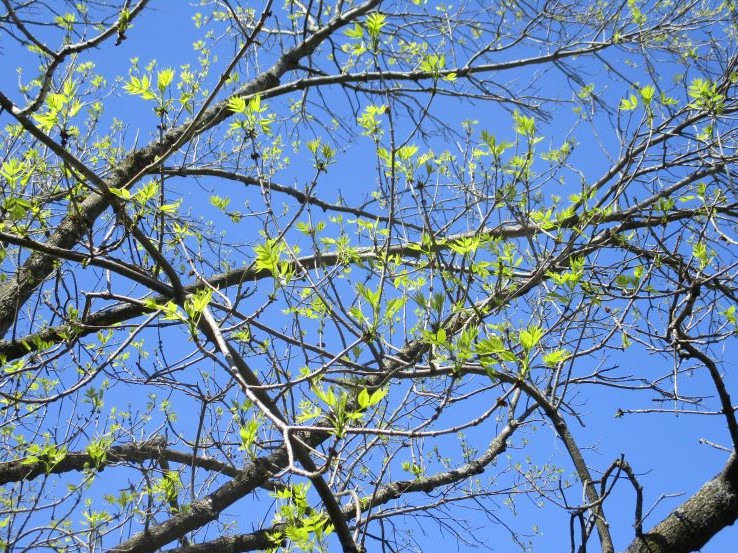
Mid-Spring weeks have arrived & shade trees like this green ash have begun leaf expansion. (Photo Credit: Steven K. Rettke, Rutgers Coop. Ext.)
April 26, 2021 Tim Waller
IMPORTANT NOTICE – Considerations for systemic and contact material control of Redheaded Flea Beetle – now
If you are unfamiliar with this pest
- Dr. Kunkel presenting “Seeing red? Redheaded flea beetle” Seeing red? Redheaded flea beetle (scroll to the bottom of the webpage)
- NC State: Red-headed flea beetle biology and management
- Nursery Mag: Don’t get foiled by the flea beetle
- If you do not know how to calculate Growing Degree-days (GDD50): Obtaining your local growing degree-day information
If you are interested in donating infested plant material or conducting on-farm RHFB research. Please contact twaller@njaes.rutger.edu (856-451-2800 ext.1)
Redheaded Flea Beetle (RHFB) Considerations
Ideally when controlling high-density populations of RHFB, fall applications of long-lasting systemic materials can provide a strong knock-down of larvae populations destined to emerge in the following spring. Establishing a reserve of systemic materials in the soil and root zone late-season or early this season will greatly increase control efforts made later and can reduce the number of overall applications made specifically for RHFB. A two-pronged approach of systemic and contact insecticides can manage active adults and larvae throughout the season. For current season control: systemic insecticide drench or ‘sprench’ (*consider backpack units) near planting / potting-up, or a month prior to adult emergence (now for southern NJ), will provide the reserve of systemic activity required to reduce larvae and adult populations later. Contact material applications should also be considered for adult and larval treatments but must be made at sufficient volumes to guarantee ‘contact’. Contact-only driven spray regimes can provide good results, however the need to protect new growth will be ever present. When choosing materials, also consider the other pests targeted by that compound to maximize the value of your investment. Targeting the larval stage will reduce the number of adults present to lay the next generation of eggs.
Timeline for New Jersey growers and landscape professionals
- NOTE: Calendar date predictions based on USPEST.ORG using weather-stations for Upper Deerfield (NJ50), Howell/Freehold (NJ10), and High Point (NJ59). These are predictions and scouting should commence at least 2 weeks prior to listed dates
Please download this RHFB quick-look guide of the information provided below (click here)
| Projected GDD50 accumulation as of 4/26/2021 | ||||||
| Region | Location | 26-Apr | 1-May | 1-Jun | 1-Jul | Aug. 1st |
| Southern | Upper Deerfield (NJ50) | 163 | 231 | 638 | 1315 | 2158 |
| Central | Howell / Freehold (NJ10) | 110 | 166 | 514 | 1135 | 1929 |
| Northern | High Point (NJ59) | 61 | 99 | 313 | 765 | 1327 |
| Forecast: NOAA NCEP Coupled Forecast System model version 2 (CFSv2) forecast system (3.5 months) (USPEST.ORG) | ||||||
| Redheaded flea beetle – life stage predictions for South, Central, and Northern New Jersey with material considerations | |||||||||
| TARGET RANGE | TARGET RANGE | Upper Deerfield (NJ50) | Howell (NJ10) | High Point (NJ59) | |||||
| Growth Stage | Gen. | GDD50 LOW | GDD50 HIGH | LOW (DATE) | HIGH (DATE) | LOW (DATE) | HIGH (DATE) | LOW (DATE) | HIGH (DATE) |
| Egg hatch – larvae | 1st | 242 | 600 | 2-May | 29-May | 10-May | 6-Jun | 24-May | 21-Jun |
| Adults (feeding / laying eggs) | 1st | 517 | 1028 | 24-May | 20-Jun | 1-Jun | 27-Jun | 16-Jun | 14-Jul |
| POTENTIAL OVERLAP OF GENERATIONS / STAGES | |||||||||
| Egg hatch – larvae | 2nd | 1570 | 1860 | 10-Jul | 21-Jul | 17-Jul | 29-Jul | 11-Aug | 27-Aug |
| Adults (feeding / laying eggs) | 2nd | 1878 | 2318 | 22-Jul | 7-Aug | 30-Jul | 16-Aug | 28-Aug | 1-Oct |
Note: Updated 4/26/2021 – Estimated using USPEST.org, 3.5-month CFSv2 based seasonal climate forecast, simple average growing degree-days, min temp: 50F, max temp: 95F. Growing degree-day ranges based on Dr. Kunkel’s work out of the University of Delaware.
- 1st generation larvae: 242-600 GDD50
- Observation of larval activity on the outside of root balls occurs during this timeframe, meaning they may be active earlier
- Systemic treatments should be initiated late fall or immediately on susceptible hosts (southern NJ)to guard plants from adult feeding later this season.
- Materials containing neonicotinoids [4A] and cyantraniliprole [28] (Mainspring) are considered particularly fast and effective, however lack the staying power of similar chemistries such as Chlorantraniliprole [28] (Acelepryn) that takes longer to translocate from soil reserves.
- Organophosphates (1B) Acephate (Orthene, Acephate 97UP) are also a systemic options.
- During larval development contact materials containing bifenthrin, azadirachtin, tolfenpyrad, cyclaniliprole + flonicamid, entomopathogenic fungi (Beauveria bassiana) or beneficial nematodes should be seriously considered when attempting to knock-down forthcoming adult populations.
- 1st generation adults: 517-1028 GDD50
- Feeding damages will be apparent on susceptible hosts, scout to determine best time of day for applications, materials such as Captiva Prime or another agitator may be useful in driving the beetles out of hiding (which they do EXTREMELY well).
- Continuation of systemic materials, use contact materials to directly target the adults.
- Keep weed populations to a minimum, adults may feed on nearby weed species such as dog fennel, pigweed, and knotweed, thus avoiding pest control efforts on susceptible crops
- 2nd gen. larvae: 1570-1860 GDD50
- Potential for considerable overlap of larval-adult developmental stages
- Continuation of systemic materials, use contact materials to directly target the larvae and adults.
- 2nd gen. adults: 1878-2318 GDD50
- Continuation of systemic materials, use contact materials to directly target the larvae and adults.
- Keep weed populations to a minimum
- A third generation is suspected to be possible in the southern and central regions of New Jersey
IT IS CRITICAL TO ROTATE AS MUCH AS POSSIBLE BETWEEN IRAC GROUPS DUE TO THE NUMBER OF POTENTIAL APPLICATIONS
DISCLAIMER: The label is the law, always refer to it for allowable host crops, use-restrictions, application rates, reapplication intervals, re-entry intervals (REI), and mix compatibility information. Production and pesticide information on this site are for private/commercial pesticide applicators and landscape professionals only, and are NOT for home gardener use. Provided materials represent examples and do not cover all possible control scenarios. Trade-names listed do not imply endorsement and are used as examples only. Please contact your local agent or chemical sales representative for more information or to discuss additional pest management options.
Boxwood Blight risk model update (4/26 – 5/1)
| Boxwood Blight Risk Assessment as of 4/26/2021 | ||||||||
| Region | Location | CODE | 26-Apr | 27-Apr | 28-Apr | 29-Apr | 30-Apr | 1-May |
| Southern | Upper Deerfield | NJ50 | Very Low | Very Low | Very Low | Very Low | Very Low | Very Low |
| Central | Howell / Freehold | NJ10 | Very Low | Very Low | Very Low | Very Low | Low | Very Low |
| Northern | High Point | NJ59 | Very Low | Very Low | Very Low | Low | Low | Very Low |
| Please check your local boxwood blight risk here (click here) | ||||||||
Please contact Tim Waller – Cumberland Co. – RCE for more information – twaller@njaes.rutgers.edu – 856-451-2800 ext. 1
April 23, 2021 Tim Waller
Do you have Phytophthora concerns in your conifer nursery? We are looking for participants in a statewide study
Tim Waller (Cumberland Co.) and Bill Errickson (Monmouth Co.) of Rutgers Cooperative Extension are looking for 30 conifer producers to collaborate in a statewide Phytophthora sampling project, as part of a Specialty Crop Block Grant. This study will focus on identifying the species of Phytophthora limiting conifer production in New Jersey.
- If your operation is selected, the agents will schedule one to three visits this growing season to collect samples from roots, bark, soil, irrigation systems, and will perform soil testing (Year 1).
- During years 2 and 3, we will be performing chemical, biological, and cultural disease management trials in addition to conifer variety trials, at Rutgers-NJAES experiment stations. The aim is to generate local data – using local isolates in order to develop a more wholistic set of recommendations when targeting this disease in our NJ nurseries.
The agents also look forward to developing stronger relationships throughout New Jersey in the post-COVID19 era
This project is open to nurseries and Christmas tree farms producing conifers in NJ
If you are interested in this project – please respond via this brief survey (click here)
Please print and share this PDF survey with anyone not online (click here)
Please contact Tim Waller – twaller@njaes.rutgers.edu – (856-451-2800) – for more information
