Vegetable Crops Edition

Seasonal updates and alerts on insects, diseases, and weeds impacting vegetable crops. New Jersey Commercial Vegetable Production Recommendations updates between annual publication issues are included.
 
Subscriptions are available via EMAIL and RSS.
 
Quick Links:

NJ Commercial Vegetable Production Recommendations

Rutgers Weather Forecasting - Meteorological Information important to commercial agriculture.

Corn Earworm Alert 8/11/23

Corn earworm (CEW) activity has increased significantly as of this Tuesday (8/9/23).  While some trap numbers (blacklight and pheromone) in the northern counties are not excessively high, there have been much higher counts almost everywhere, with a number of very high trap catches.  The number of pheromone traps reporting since the beginning of the week is low, but what we have indicates that silk spray schedules should tighten at this time.  Blacklight catches in parts of Middlesex, Mercer and northern Burlington counties are all indicating 3 day silk spray schedules at this time.  Areas south of this should adjust to that interval as well.  Northern areas, with the exception of some parts of Hunterdon and Somerset counties are somewhat lower.  Morris, Warren and Sussex counties should manage with 4 day schedules for now.  All is subject to change and will be updated when we have further trap catch information.


The highest nightly pheromone trap catches of CEW for the period ending 8/10/23 are as follows:

Tabernacle   275 Georgetown   16
Elm   71 Dayton   11
South Branch   44
Snyder Farm (Hunterdon)   32

Silking Spray Schedules*:
South – 3 days

Central – 3  days

North – 4 days

*These recommendations are based on regional catches.  Adhere to tighter spray schedules if indicated by local trap catches.  Synthetic pyrethroids alone should NOT be used for corn earworm (CEW) protection on silking corn, or for fall armyworm (FAW) management at any stage.  Control with these materials is very inconsistent.


Vegetable IPM Update 8/09/23

Sweet Corn

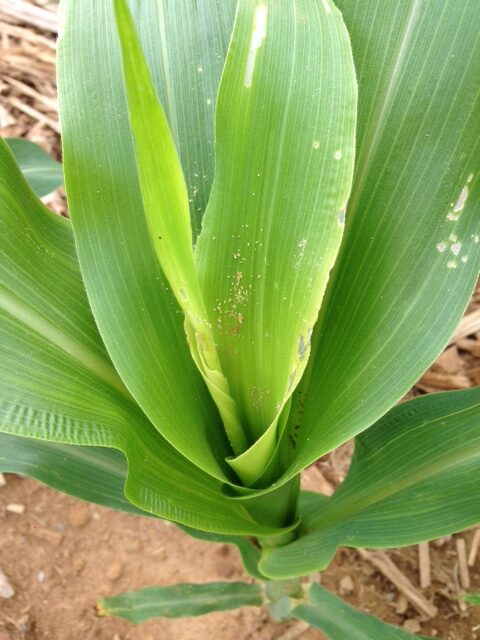
 Fall armyworm (FAW) infestations in whorl stage plantings are increasingly reaching threshold levels, and although they are not found in every field, FAW damage is in all corn growing areas at this time.  In scouted fields, some infestations in whorl corn are in excess of 20%, and are likely much higher in the southern coastal areas.   Growers are advised to check whorl and seedling stage corn plantings weekly for signs of FAW.  Consider treating if infestation rates exceed 10%.  This pest is capable of significant injury to sweet corn plants, resulting in severe stunting and failure to produce viable ears.  Note that growers of Attribute II type genetically engineered corn are unlikely to see damage from FAW.

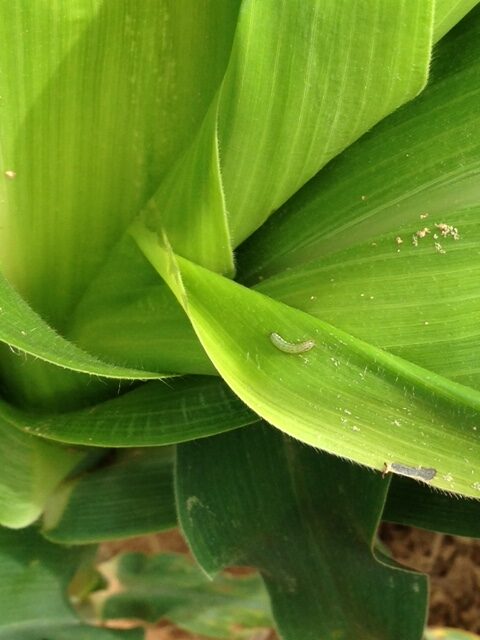
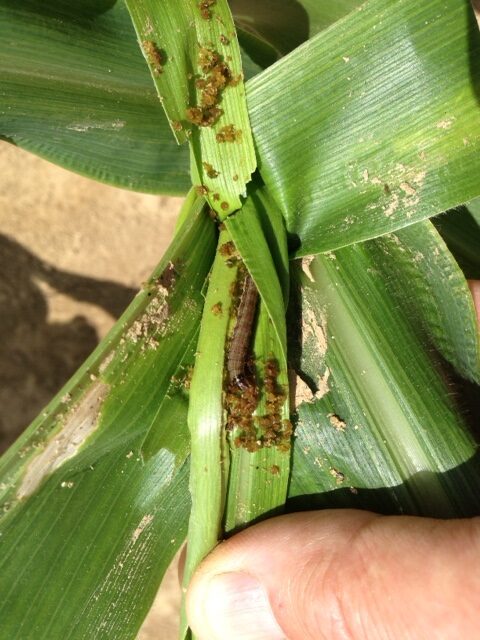
Infested plantNewly hatched FAW larvae cause holes and scratches on leaves that are similar to European corn borer (ECB) feeding, except that they tend to be more concentrated and always lead down into the whorl  (see photos at left).  As the larvae grow, the feeding becomes more destructive, with large ragged holes and obvious droppings deposited in the whorl (see photo at right)Infested plant

We will provide updates on new FAW appearances and severity as reports come in.  FAW are resistant to synthetic pyrethroids.  Effective sprays should include IRAC grp. 5 (spinosyns) or IRAC grp. 28 (diamides).  The carbamate (IRAC grp. 1A) Lannate is also still effective.  Sufficient water should be used in the applications to allow the solution to penetrate the layer of droppings that may have formed above the caterpillar.


European corn borer (ECB) moth activity remains extremely low in areas where blacklight traps are operating in the northern and central counties.  Many plantings exhibiting no ECB injury at all.  We will report on ECB activity should numbers rebound to potentially damaging levels during the second flight.  In recent years, this later flight has not required targeted control in sweet corn.

[Read more…]

Bilingual Labeling: Parts of Pesticide Labels Will be Required to Also Be In Spanish

EPA Seeks Public Comments to Ensure Information on Bilingual (Spanish) Pesticide Labels Reaches the Hands of America’s Farmworkers [Posted to EPA OPP Update August 3, 2023]. The U.S. Environmental Protection Agency (EPA) is seeking public comments on how to make bilingual pesticide labeling accessible to farmworkers. As part of the Pesticide Registration Improvement Act of […]

Vegetable IPM Update 8/02/23

Sweet Corn

Occurrences of Fall armyworm (FAW) injury are becoming more common, with infestations discovered as far north as Warren County this week.  Some infestations in whorl corn are in excess of 20%.  It is likely that economic infestations are present in much of southern New Jersey now, and could occur anywhere.  Growers are advised to check whorl and seedling stage corn plantings weekly for signs of FAW.  Consider treating if infestation rates exceed 10%.  This pest is capable of significant injury to sweet corn plants, resulting in severe stunting and failure to produce viable ears.

Newly hatched FAW larvae cause holes and scratches on leaves that are similar to European corn borer (ECB) feeding, except that they tend to be more concentrated and always lead down into the whorl  (see photos at left).  As the larvae grow, the feeding becomes more destructive, with large ragged holes and obvious droppings deposited in the whorl (see photo at right)

We will provide updates on new FAW appearances and severity as reports come in.  FAW are resistant to synthetic pyrethroids.  Effective sprays should include IRAC grp. 5 (spinosyns) or IRAC grp. 28 (diamides).  The carbamate (IRAC grp. 1A) Lannate is also still effective.  Sufficient water should be used in the applications to allow the solution to penetrate the layer of droppings that may have formed above the caterpillar.


European corn borer (ECB) moth activity remains extremely low in areas where blacklight traps are operating in the northern and central counties.  Many plantings exhibiting no ECB injury at all.  We will report on ECB activity should numbers rebound to potentially damaging levels during the second flight.  In recent years, this later flight has not required targeted control in sweet corn.

[Read more…]

Vegetable Disease Update: 07-29-23

Understanding and controlling Rhizoctonia root rot

Even though much of New Jersey has had wet weather recently, which is more favorable to Pythium and Phytophthora development, Rhizoctonia root rot has been reported over the past few weeks in a number of crops. Rhizoctonia root rot, caused by Rhizoctonia solani, is an important soil-borne fungal pathogen with a very large host range. The pathogen can survive saprophytically on living or dead plant material (organic matter) or as sclerotia in the soil (for more than 3 years). Disease development is favored by warm temperatures, dry (or very well drained) soils and stressed plants. Symptoms of Rhizoctonia root rot may begin as stunted plant growth (with poor root systems) with the appearance of brown lesions at the base of the stem causing wilting with lesions eventually girdling the stem and killing the infected plant. Rhizoctonia root rot infections only extend about an inch above the soil surface (Figure 1), unlike Phytophthora blight infection which can extend much farther up the stem. [Read more…]