- Cucurbit downy mildew has been reported as far north as Eastern Maryland and southern Delaware on watermelon. It was also reported on cucumber in Ohio this past week. All cucurbit growers should scout on a regular basis and consider including downy mildew specific fungicide(s) to their weekly maintenance programs. Wet weather is predicted every day this upcoming week making conditions ideal for downy mildew development around the state and region. For more information on the control of downy mildew on specific cucurbit crops please see the 2015 Commercial Fungicides Recommendations Guide. To track the progress of CDM in the US please visit http://cdm.ipmpipe.org/
- Bacterial brown spot has been reported on lima bean in southern New Jersey.
- Anthracnose has been reported on snap bean in southern New Jersey.
- Phytophthora blight on pepper and cucurbit crops have been reported. The heavy rains that have been around lately have been ideal for P. capsici development. All growers need to scout on a regular basis and applied preventative fungicides on a regular basis as well as remain proactive by removing infected plants from field, making sure water is able to drain away from beds/fields, and cutting plastic to help dry out beds.
- A new, more aggressive form of Black leg has been reported in potato in southern New Jersey.
- Bacterial leaf spot is being reported on pepper and tomato.
- Basil downy mildew remains active. All basil growers should continue to scout and be proactive.
- Late blight has been reported on potato as far north as North Carolina near the Virginia border. There have been no reports of late blight in the region to date. To track late blight in the US please visit http://usablight.org/
Vegetable Crops Edition
Seasonal updates and alerts on insects, diseases, and weeds impacting vegetable crops. New Jersey Commercial Vegetable Production Recommendations updates between annual publication issues are included.
Subscriptions are available via EMAIL and RSS.
Quick Links:
 NJ Commercial Vegetable Production Recommendations
Rutgers Weather Forecasting - Meteorological Information important to commercial agriculture.
July 4, 2015 Andy Wyenandt
Vegetable Disease Briefs – 7/4/15
July 3, 2015 Andy Wyenandt
Quintec: Now Registered for Bacterial Leaf Spot in Tomato
Quintec is now registered for suppression of bacterial leaf spot in tomatoes.
See label for details.
ATTENTION
• This recommendation is made as permitted under FIFRA Section 2(ee) and has not been submitted to or approved by EPA.
• It is a violation of federal law to use this product in a manner inconsistent with its labeling.
• Read the label affixed to the container for Quintec® fungicide before applying. Carefully follow all precautionary statements and applicable use directions except as specified below.
• Use of Quintec according to this Section 2(ee) recommendation is subject to all use precautions and limitations imposed by the label affixed to the container for Quintec.
• This recommendation is made as permitted under FIFRA Section 2(ee) and has not been submitted to or approved by EPA.
• It is a violation of federal law to use this product in a manner inconsistent with its labeling.
• Read the label affixed to the container for Quintec® fungicide before applying. Carefully follow all precautionary statements and applicable use directions except as specified below.
• Use of Quintec according to this Section 2(ee) recommendation is subject to all use precautions and limitations imposed by the label affixed to the container for Quintec.
Quintec 2ee Product Bulletin (not for use in CA,TX not accepted in NY) issued 5/13/2015
July 3, 2015 Andy Wyenandt
Vegetable Disease Briefs – Cucurbit downy mildew ALERT – 7/3/15
Cucurbit downy mildew was reported on watermelon in Dorchester County, Maryland and Sussex County, DE on 7/2.
This is the first report of cucurbit downy mildew in the region to date. The most recent reports of cucurbit downy mildew on the east coast have been in cucumber and watermelon. There are at least 5 or 6 reported races of downy mildew on cucurbit in the US with each affecting a different set of cucurbit hosts. Unfortunately, very little is known about what races may be present in our region.
All cucurbit growers need to scout on a daily basis and consider adding a downy mildew specific fungicide to their regular maintenance programs. To track the progress of CDM in the US please visit http://cdm.ipmpipe.org/. For more information on the control of cucurbit downy mildew please see the 2015 Commercial Vegetable Production Guide.
July 1, 2015 Kris Holmstrom and Joe Ingerson-Mahar
Veg IPM Update: Week Ending 7/1/15
Click to View
Sweet Corn
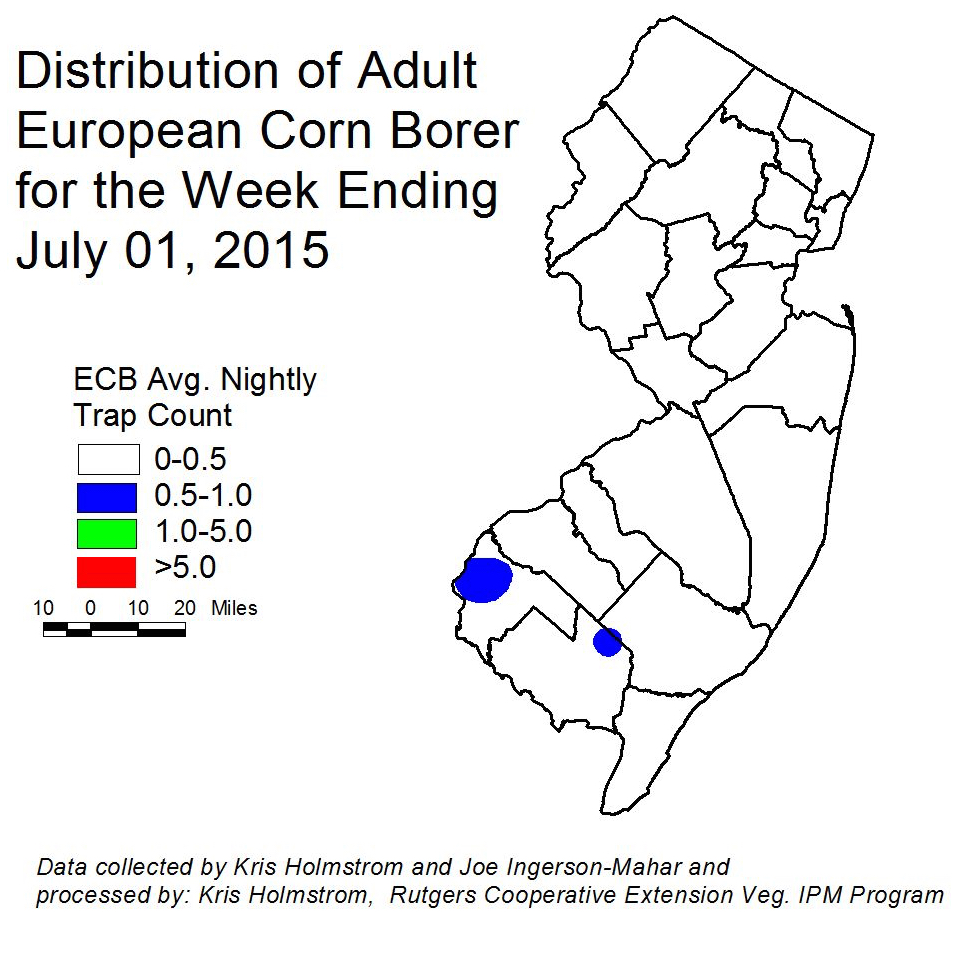
We are between European corn borer (ECB) adult generations at this time. Only scattered individuals are being captured throughout NJ (see ECB map). ECB infestations are still present in some sweet corn plantings, but whorl stage corn is now largely free of ECB injury.
As always, consider treating when the number of infested plants in a 50 plant sample exceeds 12%. Any planting remaining at or above threshold as it proceeds to full tassel should be treated, as this is the last stage at which ECB larvae will be exposed and vulnerable to insecticidal sprays.
See the 2015 Commercial Vegetable Recommendations Guide for insecticide choices.
[Read more…]
June 28, 2015 Andy Wyenandt
Phytophthora Control During Wet Weather
Most of New Jersey has been plagued by heavy rains and pop-up thunderstorms these past few weeks making conditions ideal for pathogens such as Phytophthora blight (P. capsici) on pepper, eggplant, tomato, and cucurbit crops. Unfortunately, Phytophthora blight can be found on most farms in the southern part of the state. Poor crop rotations with susceptible hosts only make matters worse. The pathogen has an increasing host range that also includes snap and lima beans, and all crops, other than a few resistant bell pepper cultivars, lack any resistance to the pathogen. [Read more…]
June 28, 2015 Andy Wyenandt
Preparing for Pepper Anthracnose
Heavy rain and wind can cause pepper anthracnose to flare up quickly!
Growers with peppers in fields with a history of pepper anthracnose should scout on a daily basis and initiate a fungicide program as soon as small fruit begin to develop. Pepper anthracnose can be very difficult to control once established. All bell and non-bell peppers are susceptible. Strip picking and removing all fruit from ‘hot spots’ when they first appear may help suppress spread of the pathogen.
Preventative fungicide applications should begin at flowering or fruit set. Use a heavy volume of water and make sure coverage is extremely good. Apply high rates of chlorothalonil or Manzate weekly and tank mix and/or rotate weekly with one of the following FRAC group 11 fungicides: Priaxor (fluxapyroxad + pyraclostrobin, 11), Quadris (azoxystrobin, 11), or Cabrio (pyracolostrobin, 11).
Please see the 2015 New Jersey Commercial Vegetable Production Recommendations Guide for more information.
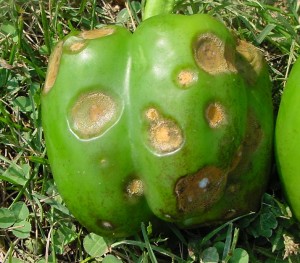
Mature bell pepper fruit infected by pepper anthracnose.

