Vegetable Crops Edition

Seasonal updates and alerts on insects, diseases, and weeds impacting vegetable crops. New Jersey Commercial Vegetable Production Recommendations updates between annual publication issues are included.
 
Subscriptions are available via EMAIL and RSS.
 
Quick Links:

NJ Commercial Vegetable Production Recommendations

Rutgers Weather Forecasting - Meteorological Information important to commercial agriculture.

Veg IPM Update: Week Ending 6/07/17

Sweet Corn

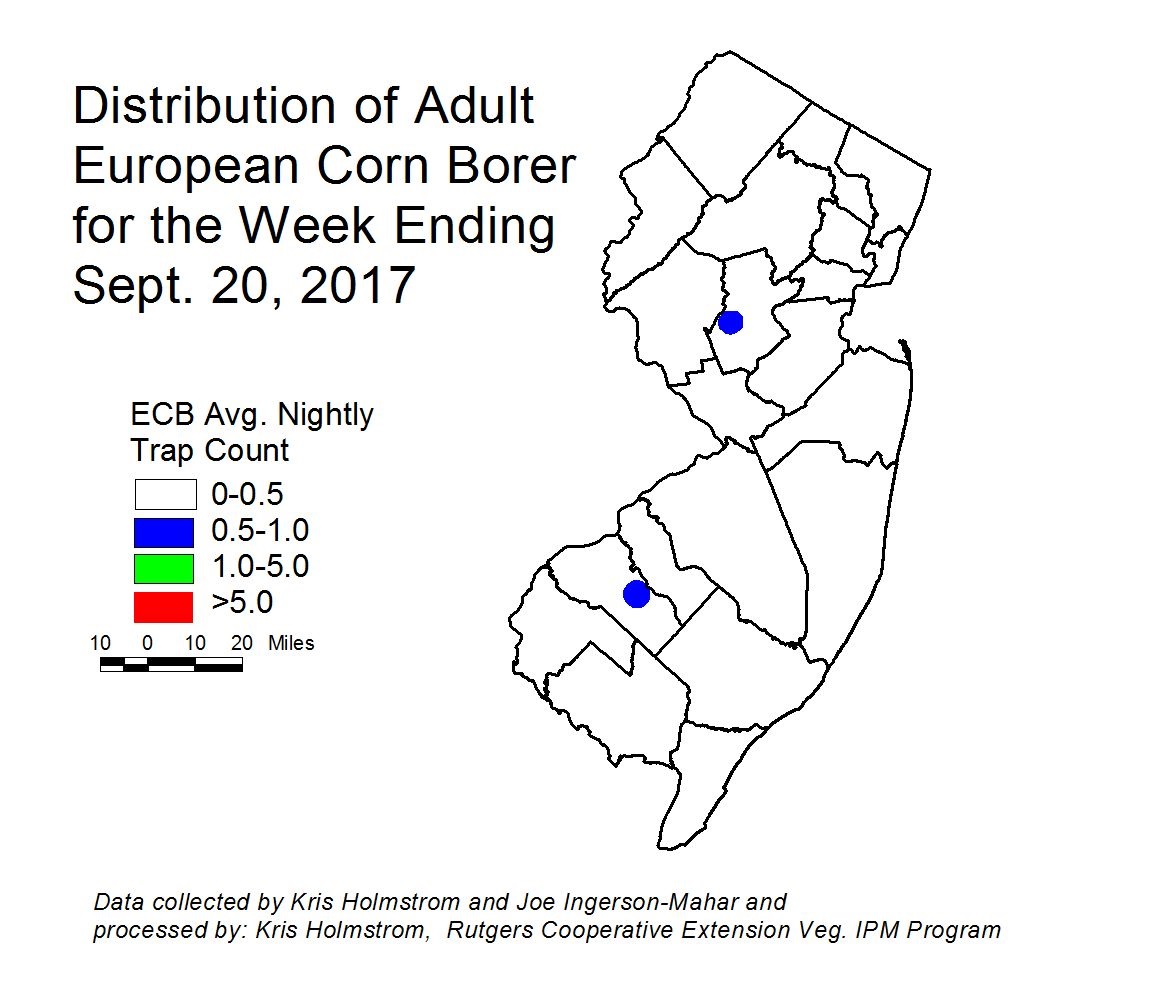
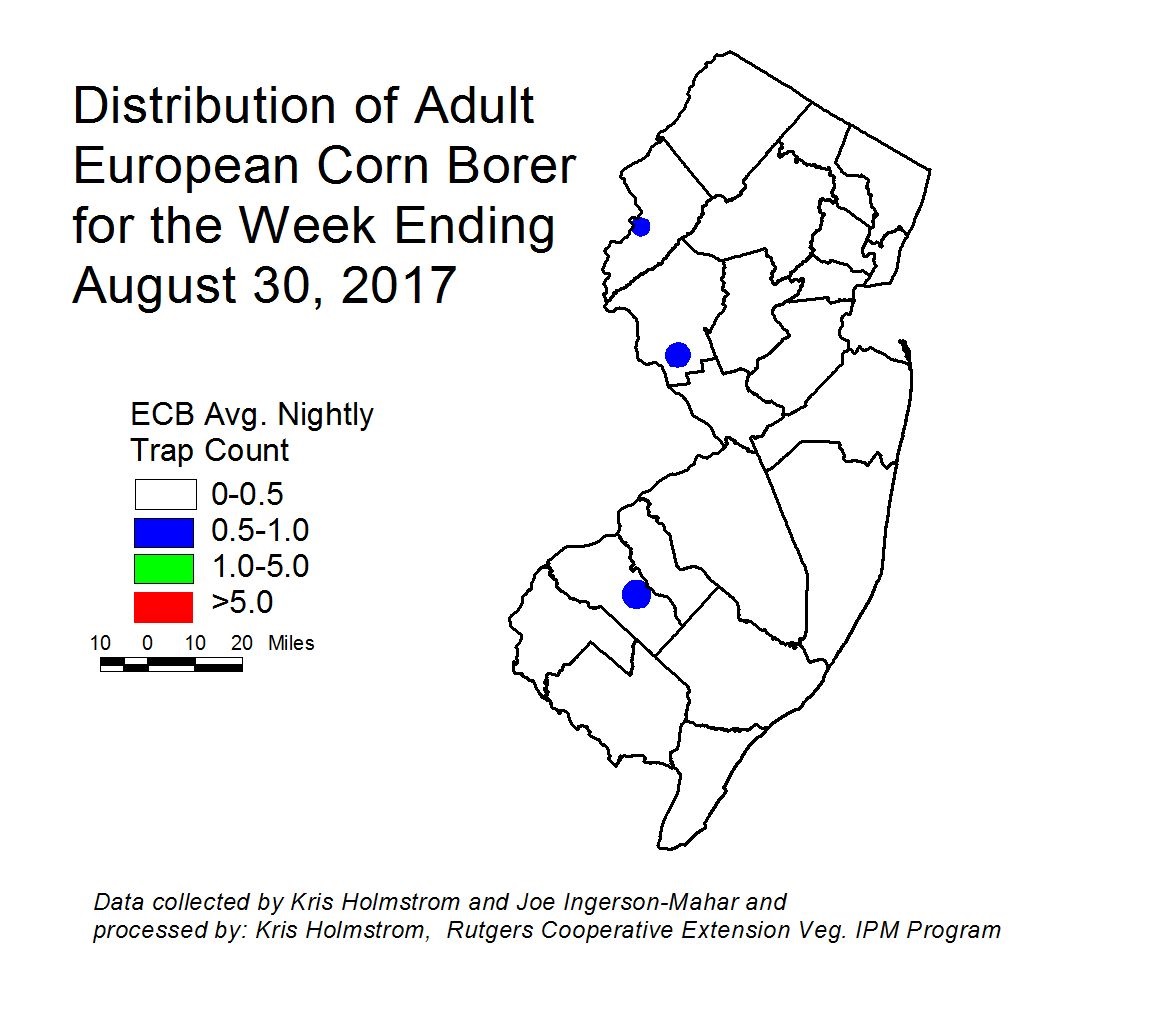
European corn borer (ECB) catches have declined somewhat over the past week.  As this has happened, feeding signs in NJ sweet corn plantings have increased.  Overall, activity is lower than expected this year, likely due to adverse weather conditions.  The highest catches remain in southern Hunterdon County (see map at left), with lower activity elsewhere.  At present, infestation rates of 30% have been discovered in the Sergeantsville area of Hunterdon County, with rates of 16 – 22% from Somerset through Camden counties.  Feeding is likely to be occurring throughout the central and southern counties at this time, and will appear within the next few days in the northernmost areas.    Check 5 plants each in 10 random locations for a 50 plant sample.  Look  for “shot-hole” injury (see top photo at right, ), and  consider treating when the number of infested plants in a 50 plant sample exceeds 12%.  As infested plants proceed to the pre-tassel stage, live larvae and damage may be found in the emerging tassels (see bottom photo at right).  Once plants hit full tassel, ECB larvae will move downward on the stalk and re-enter the plant near the area where ears are forming.  This can result in direct injury to the ear.  Growers should consider an insecticide application at the full tassel stage to target ECB larvae as they migrate downward.  This application can eliminate larvae that have escaped any earlier insecticide applications. [Read more…]

Vegetable Disease Update – 6/7/17

  • Pythium root rot has been reported in multiple crops across the state. Unfortunately, the prolonged, wet weather across most of New Jersey has been ideal for its development. There are a number of options for early-season control of pre- and post emergent damping-off pathogens. For more information click here.
  • Downy mildew has been reported as far north as Northern Florida on multiple cucurbit crops and on cucumber in South Carolina and North Carolina on 6/6/17.
  • There have been no new reports of Late blight in the Southeast.

Veg IPM Update: Week Ending 5/31/17

Sweet Corn

There has been little change in European corn borer (ECB) catches over the past week.  We would have expected some increase throughout the state, but prolonged wet weather has likely slowed their activity.  The highest catches remain in southern Hunterdon County (see map at left), although there have been low, but steady catches elsewhere, including northern Cumberland and central Morris counties.  Feeding continues to  be very limited, but should increase with drier conditions later this week.  Check 5 plants each in 10 random locations for a 50 plant sample.  Look  for “shot-hole” injury (see photo at right), and  consider treating when the number of infested plants in a 50 plant sample exceeds 12%.  [Read more…]

Veg IPM Update: Week Ending 5/24/17

Sweet Corn

Warmer weather has resulted in the first consistent European corn borer (ECB) catches.  The highest catches have occurred in southern Hunterdon County (see map at left), although there have been low, but steady catches elsewhere, including northern Cumberland and central Morris counties.  As yet, feeding has been very limited, with only single-digit infestation rates on whorl corn found in Mercer County.  With continued moderate temperatures, expect feeding in whorl stage corn to increase significantly over the next week.  Check 5 plants each in 10 random locations for a 50 plant sample.  Look  for “shot-hole” injury (see photo at right), and  consider treating when the number of infested plants in a 50 plant sample exceeds 12%.


The highest nightly ECB catches for the previous week are as follows:

Sergeantsville  4 Denville   1
South Branch   3 East Vineland  1
Allentown  1 Eldora   1


A few corn earworm (CEW) continue to appear in blacklights throughout the state. These individuals indicate that there was limited overwintering of this pest in NJ, but are of little concern in the absence of silking sweet corn.

Cole Crops

IPM personnel continue to observe infestations of crucifer flea beetle.  These beetles can build to high populations quickly, especially where wild mustard and related cruciferous weeds are common.  Extreme feeding on small transplants can cause irreversible damage if not controlled promptly. [Read more…]

Vegetable Disease Update – 5/20/17

  • Sunscald injury is being reported on newly transplanted crops with the excess heat this past week.
  • Downy mildew has been reported as far north as Northern Florida on multiple cucurbit crops.
  • Dickeya dianthicola has been confirmed in Dark Red Norland potato seed in New Jersey. This is the first report of Dickeya in NJ this growing season. Dickeya diathicola has also been reported in potato in VA and FL this year.
  • Pectobacterium wasabiae (soft rot or Blackleg) has been confirmed in ‘Red Pontiac’, ‘Kennebec’, and ‘Adirondack Blue’ potato seed in New Jersey this spring.

Veg IPM Update: Week Ending 5/17/17

Sweet Corn

The arrival of warmer temperatures should improve corn growth considerably.  This same weather could bring on the first consistent European corn borer (ECB) catches, although this has not yet happened.  No ECB were captured in blacklight traps this week.  As the population develops, look for maps to be published in the weekly IPM Update.  There were several corn earworm (CEW) captured in blacklights located in New Egypt, Folsom and Woodstown this past week, however these individuals are of little concern in the absence of silking sweet corn.

Cole Crops

IPM personnel continue to observe infestations of crucifer flea beetle.  These beetles can build to high populations quickly, especially where wild mustard and related cruciferous weeds are common.  Extreme feeding on small transplants can cause irreversible damage if not controlled promptly. [Read more…]