For cucurbit growers who have been using the CDMpipe website the past few years to track the progress of cucurbit downy mildew in the US, a new website has been relaunched for the 2020 growing season. Importantly, for those you have signed up in the past you should be receiving an email in the near future asking you to sign up for the new website. You can visit the new website by clicking here. Click on the Alerts tab at the top of the page and fill out the form to receive alerts!
Vegetable Crops Edition
Seasonal updates and alerts on insects, diseases, and weeds impacting vegetable crops. New Jersey Commercial Vegetable Production Recommendations updates between annual publication issues are included.
Subscriptions are available via EMAIL and RSS.
Quick Links:
 NJ Commercial Vegetable Production Recommendations
Rutgers Weather Forecasting - Meteorological Information important to commercial agriculture.
February 28, 2020 Andy Wyenandt
New cucurbit downy mildew forecasting website up and running for 2020
February 27, 2020 Andy Wyenandt
Updated tables for insecticide and fungicide use in the greenhouse available in new 2020/2021 Commercial Vegetable Production Recommendations
The new 2020/2021 Mid-Atlantic Commercial Vegetable Production Recommendations Guide has newly updated tables for selected conventional and organic fungicides and insecticides for use on greenhouses vegetables. This information can be found in the Pest Management Section E in Table E-6 on pages 114-116 for insecticides and in Table E-11 on pages 125-127 for fungicides.
The 2020/2021 Mid-Atlantic Commercial Vegetable Production Recommendations guide is now available FREE on-line or can be purchased in hardcopy form through your county agricultural office in New Jersey. The complete 2020/2021 Vegetable Production Recommendations guide or specific sections can be downloaded depending on your production needs.
February 27, 2020 Andy Wyenandt
Controlling strawberry fruit rots with an emphasis on mitigating fungicide resistance development
Fruit rots in strawberry can cause significant losses if not recognized early and properly controlled. The use of good cultural practices such as keeping fields weed-free, promoting good drainage and air movement, long crop rotations, and preventative fungicide applications are critically important for reducing the potential development of fruit rots in strawberry.
Pathogens such as anthracnose fruit rot (Collectotrichum acutatum, C. gloeosporioides), gray mold (Botrytis cinera), and leather rot (Phytophthora cactorum) can become systemic problems in strawberry fields and can be difficult to manage over the lifetime of the planting. Importantly, fungicide resistance development in the pathogens that cause fruit rot in strawberry are widely documented; mostly in Botrytis.
Anthracnose Fruit Rot
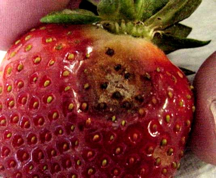
Anthracnose Fruit Rot of Strawberry
Anthracnose fruit rot can cause serious losses if not controlled. Symptoms of anthracnose include the development of circular, sunken lesions on infected fruit. Often pinkish/tan colored spore masses will develop in the center of lesions. Anthracnose in strawberry is caused by Colletotrichum spp. Spore production, germination and fruit infection are favored by warm, humid weather. The fungus can overwinter on infected plants, in plant debris or on weed hosts. Spores are dispersed by splashing water and can infect green and mature fruit. Control begins with protectant fungicides from flowering through harvest. Begin sprays no later than 10% bloom or prior to disease development and continue on a 7 to 10 day interval. Use the higher fungicide rate and shorter intervals when disease pressure is high. Do not make more than two consecutive applications of the same fungicide before switching to a fungicide in a different FRAC group. Fungicide resistance in C. acutatum and C. gloeosporioides to FRAC group 11 fungicides (azoxystrobin and pyraclostrobin) have been reported in FL in recent years.
Leather Rot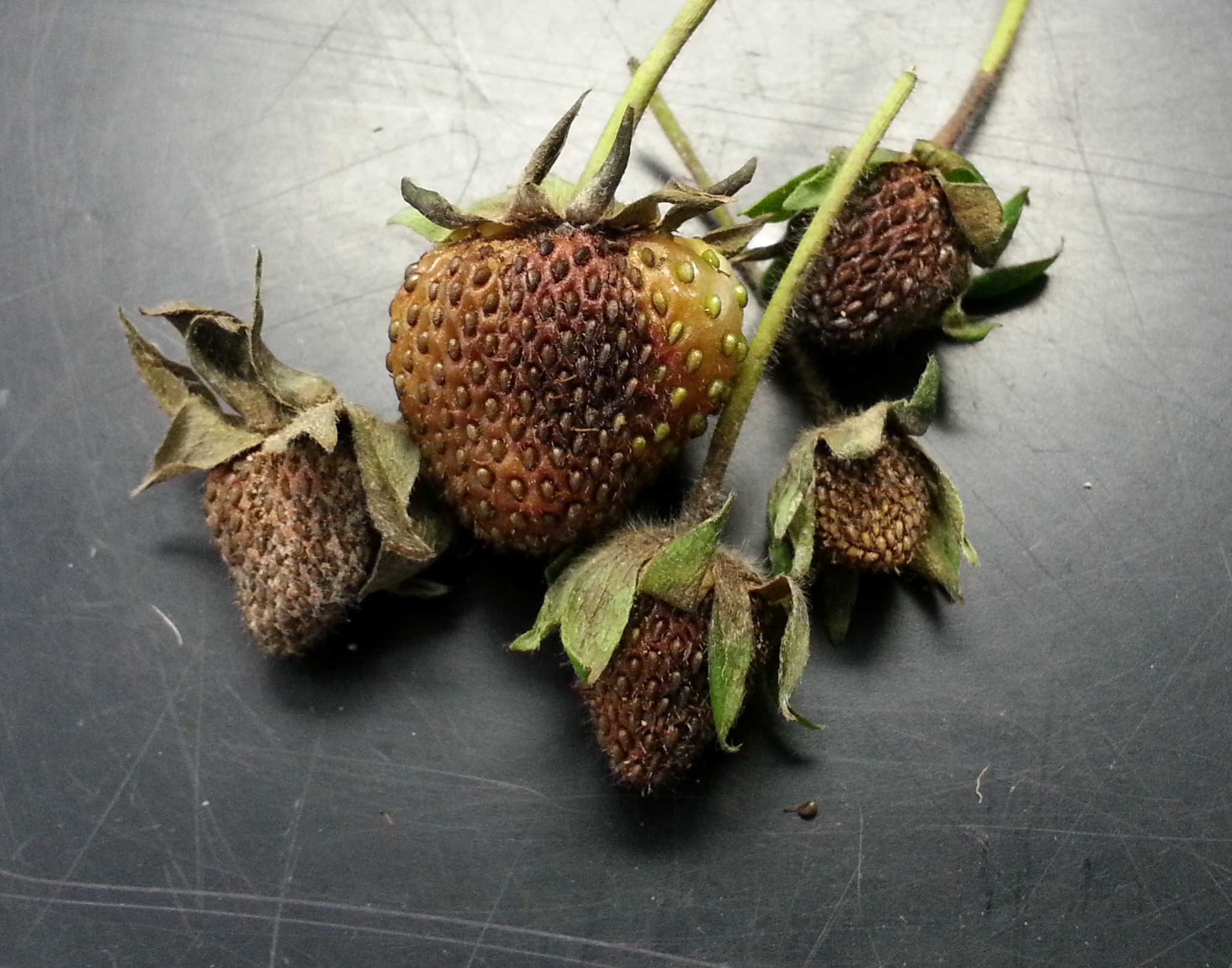 Strawberry Leather Rot Leather rot caused by Phytophthora cactorum can cause losses during warm, wet weather with extended periods of rainfall. Infection can take place during all stages of fruit development as long as favorable conditions are present. Infected fruit turn brown and have blotchy tough appearance. Infections typically occur in fruit that are in direct contact with the soil, but the pathogen can also be splashed onto fruit via rainfall and wind.Research by Dr. Mike Ellis, Using Fungicides to Control Strawberry Fruit Rots in Ohio, has shown that FRAC code 11 fungicides such as Cabrio, Abound, and Pristine are effective against leather rot. Pristine being the fungicide of choice because it also provides control of gray mold and anthracnose. Follow the link above for an excellent review of all three of these diseases and a useful efficacy table. Resistance to mefenoxam has been reported only in SC to date and resistance to QoI fungicides (FRAC group 11) in P. cactorum, from both crown and fruit infections, have been reported in FL in the past 5 years.
|
Gray Mold (Botrytis Fruit Rot)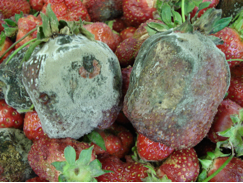 Gray Mold (Botrytis Fruit Rot) Gray mold is often a serious problem during extended cool, wet periods when fruit are sizing and reaching maturity. Symptoms of gray mold are the diagnostic grey, fuzzy growth that will cover entire fruit. Control of gray mold, like the other diseases, begins with recognizing the conditions for its development, its symptoms, and preventative fungicide applications. Start sprays when plants begin to bloom, because 90% of fruit infections occur through the flower, and repeat every 7-10 days. Increase spray intervals during persistent dry periods, but decrease intervals to 5-7 days during very wet periods. Four weekly sprays starting at 5-10% bloom are usually sufficient for season-long control. Tank-mix and rotate fungicides from different FRAC codes to reduce the chances for fungicide resistance development. Fungicide resistance in Botrytis is widely known and documented. Resistance development has been documented in MBC fungicides (FRAC code 1) to benomyl (no longer on the market) and thiophanate-methyl; the DC fungicides (FRAC group 2) with iprodione; the SDHI fungicides (FRAC group 7) with boscalid, fluxapyroxad, and penthiopyrad; the AP fungicides (FRAC group 9) with pyrimethanil and cyprodinil; the strobilurin fungicides (FRAC group 11) with azoxystrobin, trifloxystrobin, and pyraclostrobin; and the Hyd fungicides (FRAC group 17) with fenhexamid. Cross resistance to fungicides within specific FRAC groups has also been widely documented. Most importantly, resistance to multiple FRAC groups has also been widely reported in Botrytis in the US. Recent studies across the southeast have shown that some Botrytis isolates can carry resistance to 2, 3, 4, or 5 different FRAC groups. A study from 2015 examining 2,000 Botrytis isolates collected across the southeast discovered that some isolates carried resistance to 6 or 7 different FRAC groups. As described the authors, this was likely the result of “selection by association” in which resistance was selected by the fungicide applied but also indirectly because the selected isolates were also inherently resistant to fungicides in other FRAC groups. |
How to manage fruit rots and fungicide resistance development
The use of mulch to prevent/reduce soil splashing and keeping fruit from coming into direct contact with the soil surface can be beneficial in conventional production as well as organic production systems where conventional fungicides cannot be used. Long crop rotations and staying away from fields with known history of any of these pathogens is also extremely important, although this may be difficult on farms with U-pick operations where fields need to be close to the market and accessible. Adjusting plant populations to improve air movement and the drying of leaves and fruit within the canopy, and avoiding overhead irrigation are some of the cultural practices growers can do to help reduce losses to fruit rot.
Strawberry growers need to pay careful attention to the efficacy of all high-risk fungicides used during the season. Fields should be scouting regularly, particularly before and after a fungicide application. Remember, due to the specificity of high-risk fungicides, once resistance develops to any one particular fungicide chemistry the likelihood of cross-resistance development increases significantly to other fungicides within the same FRAC group. If loss of efficacy is noticed, growers should discontinue the use of that FRAC group during that growing season. Growers developing season-long fungicide programs for fruit rot control need to use as many different modes-of-action (i.e., different FRAC groups) as possible and limit the use of any single mode of action as much as possible to help mitigate resistance development. This is especially important when growers are applying fungicides with more than one mode of action. Careful attention needs to be made to both fungicide chemistries so that the same mode of action isn’t used during the next application. As a general rule, growers need to use as many different modes of action as possible and to space them out as far apart as possible during the production season.
For more information on the control of anthracnose fruit rot, gray mold, and leather rot in strawberry please see the 2020/2021 Commercial Vegetable Production Recommendations Guide for the mid-Atlantic Region.
February 15, 2020 Andy Wyenandt
Theories on managing fungicide resistance development by tank mixing or rotating fungicides
The question of whether to tank mix high-risk (HR) fungicides with low-risk (LR) protectant fungicides or the rotation of HR fungicides with LR fungicides remains an open debate. The tank mixing or alternation of fungicides has been widely advocated as a means to delay or minimize the risks of resistance development (Genet et al., 2006; McGrath 2011; Van der Bosch and Gilligan, 2008; van den Bosch et al., 2014; Elderfield et al, 2018), although differences in opinion on whether one is better than the other exist (Genet et al., 2006), or that either method may be an effective means at reducing resistance development (van den Bosch and Gilligan, 2008). The theories behind the rotation or tank mixing of different fungicides follows strategies analogous with managing antibiotic resistance, using methods known as complementary therapy or cycling therapy (van den Bosch and Gilligan, 2008). Fungicide resistance studies with tank mixes or alternations use similar density-independent models as antibiotic resistance and assumes the sensitive and resistant strains to be at low initial densities. Resistance management studies incorporate what is often referred to as takeover time as the evaluation criterion (Van der Bosch and Gilligan, 2008). Take-over time is defined as the time-period in which the fraction of the resistant population passes a critical threshold level, thereby reducing the value of the fungicide for disease control (van den Bosch and Gilligan, 2008).
The concept behind the alternation of fungicides with different modes-of-action is that cyclic selection pressure placed on the fungus should help reduce the buildup of resistant populations, however, this idea has been criticized by numerous authors (van den Bosch and Gilligan, 2008). The argument against the alternation of fungicide chemistries is that this method would only work if it comes with a fitness cost (e.g., the ability to reproduce) associated with the resistant population in absence of selection pressure against the target fungicide (van den Bosch and Gilligan, 2008). Thus, without a fitness cost, the fraction of the resistant pathogen population would not change during the time period when the target fungicide is not used (van den Bosch and Gilligan, 2008). This suggests that resistance development would continue as if there had been no alternation at all, and it would take exactly the same number of fungicide applications of the target fungicide to build up a given level of resistance to that fungicide, although the time for resistance buildup (i.e., take-over time) would be potentially delayed (van den Bosch and Gilligan, 2008). Birch and Shaw (1997) state that one of the advantages to alternation is the possibility of stabilizing selection pressure, if only one of the fungicides were applied at a time.
The concepts behind the tank mixing of fungicides closely follows the concept behind the alternation of fungicides with different modes-of-action. Van den Bosch and Gilligan (2008) using density-dependent models, showed that if no fitness costs exist, mixtures are no different from alternation strategies when comparable doses are used. Tank mixes can be useful if fitness costs exist, but is questionable whether fitness costs would ever be large enough to make mixtures a useful resistance management strategy. Van den Bosch and Gilligan (2008) suggested that tank mixtures deserve attention for their ability to act as insurance in the sense that large scale losses could be avoided if one component of the tank mixture (i.e., the HR fungicide) suddenly fails, and that this is especially important in pathogens where large-scale epidemics (e.g., cucurbit downy mildew) may occur in one year, but not others. Van den Bosch et al. (2014) using empirical and theoretical modeling suggested the following conclusions with using mixtures as a fungicide resistance tactic: 1) adding a multi-site (i.e., LR fungicide) or a specific site (another HR) fungicide to a high-risk fungicide helps reduce the rate of selection against the fungicide(s) with the specific mode-of-action, 2) adding a partner fungicide while reducing the dose of the high-risk fungicide reduces the selection pressure for resistance development without compromising effective control; and 3) while there were few studies done, evidence suggests that mixing two high-risk fungicides is also a useful resistance management strategy. The authors also pointed out that due to the limited research in this area of tank mixes, the lack of these studies should be a warning against over interpreting the findings in their review (van den Bosch et al., 2014). Elderfield et al. (2018) in exploring the alternation or tank mixing of low- and high-risk fungicide programs on lifetime yield (e.g., use) of the high-risk fungicide, in other words, the time period before the high-risk fungicide was no longer economically effective, showed through empirical and theoretical modeling that lifetime yield may be different for different fungicide-pathosystems and that alternation or tank mixing may lead to longer lifetime yields (i.e., use). The authors, based on their evidence, suggest that mixtures of low and high risk fungicides will always be the best resistance management tactic when the objective is optimizing the lifetime yield (i.e., use) of the high-risk fungicide (Elderfield et al., 2018). Gisi et al. (2006) determined in the testing of resistance development in P. viticola (down mildew of grape) using a QoI (FRAC group 11) and protectant (LR) fungicide tank mix that increasing the dose of the non-QoI partner (LR) fungicide in the mixture resulted in reduced selection pressure. The authors also suggested that the choice of non-QoI (LR) fungicide tank-mix partner and its dosage can significantly affect the success of QoI resistance management strategies under practical conditions.
Parnell et al. (2007) suggested that in-field strategies, such as the alternation or tank mixing of fungicides, used to combat fungicide resistance development may be more useful through the restricted deployment of fungicides over large areas. Restrictions on fungicide use in this manner may be extremely beneficial in controlling and managing fungicide resistance development in pathogens such as Podosphaera xanthii (cucurbit powdery mildew) and Pseudoperonospora cubensis (cucurbit downy mildew) which spread over vast geographic areas (i.e., the east coast of the U.S.) each year. Research in the mid-Atlantic region of the U.S. has confirmed the presence of cucurbit powdery mildew populations resistant to FRAC codes 3 and 11 fungicides in recent years. This suggests that QoI- and/or DMI-resistant cucurbit powdery mildew populations could be disseminating up the east coast from the southeast region of the U.S. each production season. Importantly, fungicides in FRAC code 11 are still widely recommended and used in some southern tier states, whereas recommendations and use of FRAC code 11 fungicides for cucurbit powdery mildew control in the mid-Atlantic region have been mostly discontinued in recent years. In order to help combat fungicide resistance development issues such as this in the future, more collaboration between extension personnel from different regions must be done to help establish more defined fungicide resistance management guidelines for large geographic areas such as the south- and northeast regions of the US.
Importance of risk management.
Because certain pesticide chemistries have specific MOA’s there is always a much greater chance for pests (e.g., pathogens, weeds, or insects) to develop resistance. For example, fungi which produce a vast amount of asexual inoculum (i.e. conidia), undergo multiple diseases cycles during a given production season (e.g., powdery and downy mildews), or fungi which have a high probability for sexual reproduction in a field population (e.g., Phytophthora capsici) often have a much greater chance for fungicide resistance development. Importantly, in controlling pathogens where there are but a few, HR fungicide chemistries available for use, selection pressure put on the pathogen may be increased through their overuse. Therefore, the lack of proper chemical rotations (i.e., pesticides with different modes-of-action) or improper tank mixes or rotations may have a dramatic effect on resistance development, especially if these high-risk pesticides are over used or used improperly according to the label.
The grouping of similar chemistries together by their modes-of-action (e.g., FRAC group) and the inclusion of resistance management guidelines on pesticide labels are designed to i) reduce the chances for resistance development and ii) help agricultural producers develop and follow resistance management programs. Although application restrictions and resistance management guidelines have been widely adopted by the chemical industry, the follow-through effects of such guidelines have been left solely to the individual applicator; or extension personnel or crop specialists who help train those applying agricultural pesticides. Jutsum et al. (1998) pointed out that the challenge was to develop fungicide resistance management strategies which were relevant to local production practices. In recent years, the use of FRAC, HRAC and IRAC codes has been widely included in state and regional vegetable commercial production recommendations and promoted and used by extension personnel and crop advisors as education and teaching tools in many production regions of the United States. Even with increased awareness and training, the proper use of these pesticides is ultimately placed upon the end-user (e.g., the farmer/applicator) to make sure that the pesticides are properly applied according to the label rate, its restrictions, and state and federal laws.
Take home thoughts
There is still a lot to learn in the understanding of tank mixing and rotating HR and LR fungicides with each other, and the rotation of HR fungicides with different modes of action on a weekly basis. First, growers need to follow the label. The label is the law. Where appropriate, growers need to rotate HR fungicides with different modes of action (i.e., from different FRAC groups) as much as possible to limit the overuse of any one FRAC group during the production season. In general, tank mixing HR fungicides with LR fungicides will help reduce overall section pressure for resistance development to the HR fungicide. In crops, where there are but one or a few HR fungicides labeled for control of a specific disease, the use of the HR fungicide(s) needs to be done judiciously.
For more information on fungicide resistance management strategies using cucurbit powdery mildew and cucurbit downy mildew as examples, please click on the hyperlinks.
For more information on the specific fungicides recommended for disease control please see the 2020/2021 Mid-Atlantic Commercial Vegetable Production Recommendations.
Fungicide Resistant Management Guidelines for Vegetable Crops grown in the mid-Atlantic Region for 2020/2021 will be available soon.
Author citations in parenthesis are from peer-reviewed journal publications.
February 14, 2020 Megan Muehlbauer
North Jersey Commercial Vegetable & Fruit Growers Meetings
NORTH JERSEY COMMERCIAL
VEGETABLE GROWERS MEETING
February 26, 2020
8:30 am – 3:30 pm
Hunterdon County Complex
314 State Rt. 12, Building #1
Flemington, NJ
Program
Program Chair:
Peter Nitzsche, Agriculture and Resource Management Agent
Cooperative Extension of Morris County
8:30 – Registration – Coffee and pastry compliments of industry sponsors
9:00 – Welcome and Introductions
9:10 – Integrated Pest Management (IPM) Issues and Update
Kris Holmstrom, Research Project Coordinator, Rutgers Cooperative Extension
9:40 – Update on Farm Service Programs
Doreen Beruck, County Executive Director, Hunterdon Somerset Farm Service Agency
9:50 – Jersey Fresh Marketing, WIC & Seniors FMNP Update
William Walker, Division of Markets, NJ Dept. of Agriculture
10:10 – Update on Labor Issues
Ben Casella, Field Representative, New Jersey Farm Bureau
10:30 – Enhancing Fall ‘Albion’ Strawberry Production With Holiday Light Strings
Ed Durner, Associate Research Professor, Rutgers Department of Plant Biology and Pathology
11:00 – What is New from Industry
11:10 – Growing Goldenberries
Ed Durner, Associate Research Professor, Rutgers Department of Plant Biology and Pathology
11:40 – New Options in Your Toolbox for Managing Weeds in New Jersey Vegetable Crops
Thierry Besançon, Specialist in Weed Science, Rutgers Cooperative Extension
12:10 – LUNCHEON ($20.00 pre-registration required)
1:10 – Update on Disease Control in Vegetables
Andy Wyenandt, Specialist in Vegetable Pathology, Rutgers Cooperative Extension
1:40 – Postharvest Sanitation and Sanitary Design
Meredith Melendez, County Agent, Cooperative Extension of Mercer County
2:10 – Pesticide Regulations and Policies Update
Patricia Hastings, Pesticide Safety Education Program Coordinator, Rutgers Cooperative Extension
3:00 – Update on Trials Evaluating Yacon as a Specialty Crop
Peter Nitzsche, County Agent, Cooperative Extension of Morris County
3:30 – Pesticide Recertification Credits and Adjourn
ANTICIPATED NJDEP PESTICIDE RECERTIFICATION CREDITS
CORE – 1 units, PP- 4 units, 1A – 4 units, 10 – 1 unit
NORTH JERSEY COMMERCIAL
FRUIT GROWERS MEETING
March 4, 2020
8:30 am – 3:30 pm
Hunterdon County Complex
314 State Rt. 12, Building #1
Flemington, NJ
Program
Program Chair:
Megan Muehlbauer, Agriculture and Resource Management Agent
Cooperative Extension of Hunterdon County
8:30 – Registration – Coffee and pastry compliments of industry sponsors
9:00 – Welcome and Introductions
9:20 – Updates on the Tree Fruit Soil Fertility Management in New Jersey
Megan Muehlbauer, County Agent, Cooperative Extension of Hunterdon County
9:50 – ‘Many Little Hammers’ Approach to Weed Management: Implications for Soil Quality and
Productivity Kate Brown, Graduate Student, Cornell University
10:20 – Apple Fruit Rots: Biology and Control
Norm Lalancette, Specialist in Tree Fruit Plant Pathology, Rutgers Cooperative Extension
11:00 – Plant Growth Regulator Update and Review
Win Cowgill, Win Enterprises International, Emeritus County Agent, Rutgers Cooperative Extension
11:30 – Pollinator Stewardship in Orchards
Julianna Wilson, Tree Fruit IPM Outreach Specialist, Michigan State University
12:00 – LUNCHEON ($20.00 pre-registration required)
1:00 – What is New from Industry and the New Jersey State Horticulture Society
The New Jersey State Horticultural Society (NJSHS) is a group of fruit and vegetable farmers who come together to collaborate to improve production in the state of New Jersey. Our organization seeks to foster scientific research in our industry and improve the distribution of pertinent information to growers to further their success in growing. Please be sure to visit us at our table and receive a discount off of your 2020 membership when you register at the North Jersey Fruit Meeting!
1:20 – Update on Farm Service Programs
Doreen Beruck, County Executive Director, Hunterdon Somerset Farm Service Agency
1:30 – Jersey Fresh Marketing, WIC & Seniors FMNP Update
William Walker, Division of Markets, NJ Dept. of Agriculture
1:40 – New Jersey Peach Promotion Council Updates
Jerry Frecon, Adams County Nursery Consultant, Emeritus County Agent, Rutgers Cooperative Extension
1:50 – Recommendation Updates for Tree Fruit Insect Management with Special Attention to Bee Safety
Dean Polk, State Wide Fruit IPM Agent, Rutgers Cooperative Extension
2:20 – Pesticide Safety Updates
Patricia Hastings, Pesticide Safety Education Program Coordinator, Rutgers Cooperative Extension
2:50 – Integrating Management for Key Orchard Pests
Anne Nielsen, Extension Specialist in Tree Fruit Entomology, Rutgers Cooperative Extension
3:20 – Pesticide Recertification Credits and Adjourn
NJDEP PESTICIDE RECERTIFICATION CREDITS ARE ANTICIPATED
DIRECTIONS – Hunterdon County Complex (same location as Hunterdon County Library)
FROM THE EAST ‐ SOMERVILLE AREA:
Take Route 80 to Route 287 South. Take the exit for Route 202/206 South. Stay on Route 202 South, over the Somerville Circle, to Flemington. At the Flemington Circle, take the second right‐hand exit onto Route 12 West. Stay on Route 12 past 2 more circles. The Route 12 Complex is on the left, approximately 2 miles from the last circle. Turn left into complex, make the 1st right and go to 1st building on right (blue glass silo)
FROM THE NORTH (CLINTON‐ROUTE 78/22 AREA):
Follow Route 31 South toward Flemington. At the Flemington Circle, take the first exit onto Route 12 West. Stay on Route 12 past 2 more circles. The Route 12 Complex is on the left, approximately 2 miles from the last circle. Turn left into complex, make the 1st right and go to 1st building on right (blue glass silo)
FROM THE SOUTH ‐ TRENTON AREA:
Follow Route 31 North to the Flemington Circle. Go 3/4 of the way around the circle and get onto Route 12 West. Stay on Route 12 past 2 more circles. The Route 12 Complex is on the left, approximately 2 miles from the last circle. Turn left into complex, make the 1st right and go to 1st building on right (blue glass silo)
Rutgers New Jersey Agricultural Experiment Station Cooperative Extension educational programs are offered to all without regard to race, religion, color, national origin, ancestry, age, sex, sexual orientation, gender identity and expression, disability, atypical hereditary cellular or blood trait, marital status, civil union status, domestic partnership status, military service, veteran status, and any other category protected by law. Rutgers Cooperative Extension encourages individuals with disabilities to participate in its programs and activities. If you need special accommodations, have questions about physical access, or require alternate means for program information, please contact your local Extension Office. Contact the State Extension Director’s Office if you have concerns related to discrimination, 848-932-3584.
February 14, 2020 Andy Wyenandt
Phytophthora-tolerant and -resistant bell pepper variety trial reports
Phytophthora blight caused by Phytophthora capsici is one of the most economically important diseases in pepper, tomato, and cucurbit production in New Jersey. Each year for the past few decades Rutgers has evaluated new bell pepper cultivars and breeding lines for their resistance to P. capsici in field trials at the Rutgers Agricultural Research and Extension Center (RAREC) near Bridgeton, New Jersey, and in some years at research trials on farms near Vineland, NJ. The pathogen, an oomycete – ‘water mold’ is favored by warm weather and wet soils during the production season and can survive between seasons in the soil as oospores. Once found in a field, the pathogen can establish itself, and be very difficult to control even with the use of fungicides. Fortunately, in bell pepper, phytophthora blight resistant/tolerant cultivars have been commercially-available for over 20 years now and have been used extensively by bell pepper growers throughout the state. Each year, as mentioned above, Rutgers evaluates these bell peppers for their resistance to P. capsici in heavily-infested fields as well as evaluate each for their fruit quality characteristics (e.g., color, wall thickness, number of lobes, and development of ‘silvering’). Some important points to remember. The pathogen is consistently evolving because of its sexual activity (i.e., mating types and oospore production). The more researchers look into the pathogen’s genetic diversity, the more they seem to find. The pathogen can develop resistance to important fungicides. Insensitivity to mefenoxam and copper resistance have been know for a very long time. Finally, phytophthora resistant cultivars such as Paladin which have been used extensively in southern New Jersey for the past 20 years appear to be breaking down. Over the past few years a number of new phytophthora resistant/tolerant bell peppers with new sources of genetic resistance have been released and evaluated by Rutgers. Some of these new bell peppers also have varying levels of resistance to bacterial leaf spot, with one – ‘Playmaker’ having X10R resistance to bacterial leaf spot and tolerance to P. capsici. Because of the increased reports of bacterial leaf spot and copper resistance in recent years and the difficulty in controlling it alone, all bell peppers grown in NJ at some point will need to have to have X10R resistance and phytophthora blight resistance. Importantly, for organic bell pepper growers, if you have not already done so, you should be evaluating these new lines to see if they meet your needs. The easiest way to mitigate both diseases are to start with genetic resistance. Below are the bell pepper variety reports going back to 2005 for review.
For more information on recommended bell pepper cultivars please visit the Pepper Section in the 2020/2021 Mid-Atlantic Commercial Vegetable Productions Recommendations Guide.
By: Andy Wyenandt and Wesley Kline

