I recently came across a new manuscript while catching up on research efforts on our national APS (The American Phytopathological Society) website. The article is titled ‘The inhibitory effects of the natural product Esculetin on Phytophthora capsici and its possible mechanism’. This research article caught my eye because P. capsici, the fungal oomycete which causes Phytophthora blight, is one of the most economically-important and one of the hardest diseases to control in New Jersey and other regions where vegetables are grown. [Read more…]
Vegetable Crops Edition
Seasonal updates and alerts on insects, diseases, and weeds impacting vegetable crops. New Jersey Commercial Vegetable Production Recommendations updates between annual publication issues are included.
Subscriptions are available via EMAIL and RSS.
Quick Links:
 NJ Commercial Vegetable Production Recommendations
Rutgers Weather Forecasting - Meteorological Information important to commercial agriculture.
October 4, 2021 Andy Wyenandt
Could a dead cow and a Wisconsin farmer in 1933 lead to Phytophthora blight control?
October 1, 2021 Meredith Melendez
Postharvest Equipment Cleaning and Sanitizing Twilight Meeting 11/17/21
The On-Farm Food Safety Team will hold twilight meeting at the Rutgers Agricultural Research and Extension Center in Bridgeton focusing on the cleaning and sanitation of postharvest equipment.
Topics to be covered:
Cleaning Packing Equipment
Difference Between Cleaning & Sanitizing
Sanitary Design of Packing Lines
Different products to use for monitoring pH and sanitizer concentration
Cleaning Harvest Equipment
Who should attend:
Fruit Growers
Vegetable Growers
Others interested in produce safety
Extension Education
Departments of Agriculture
Visit our upcoming trainings website for more information and to register.

September 29, 2021 Kris Holmstrom and Joe Ingerson-Mahar
Vegetable IPM Update 09/29/21
Note: Next week (10/6) will be the final scheduled edition of the Vegetable IPM Update.
Sweet Corn
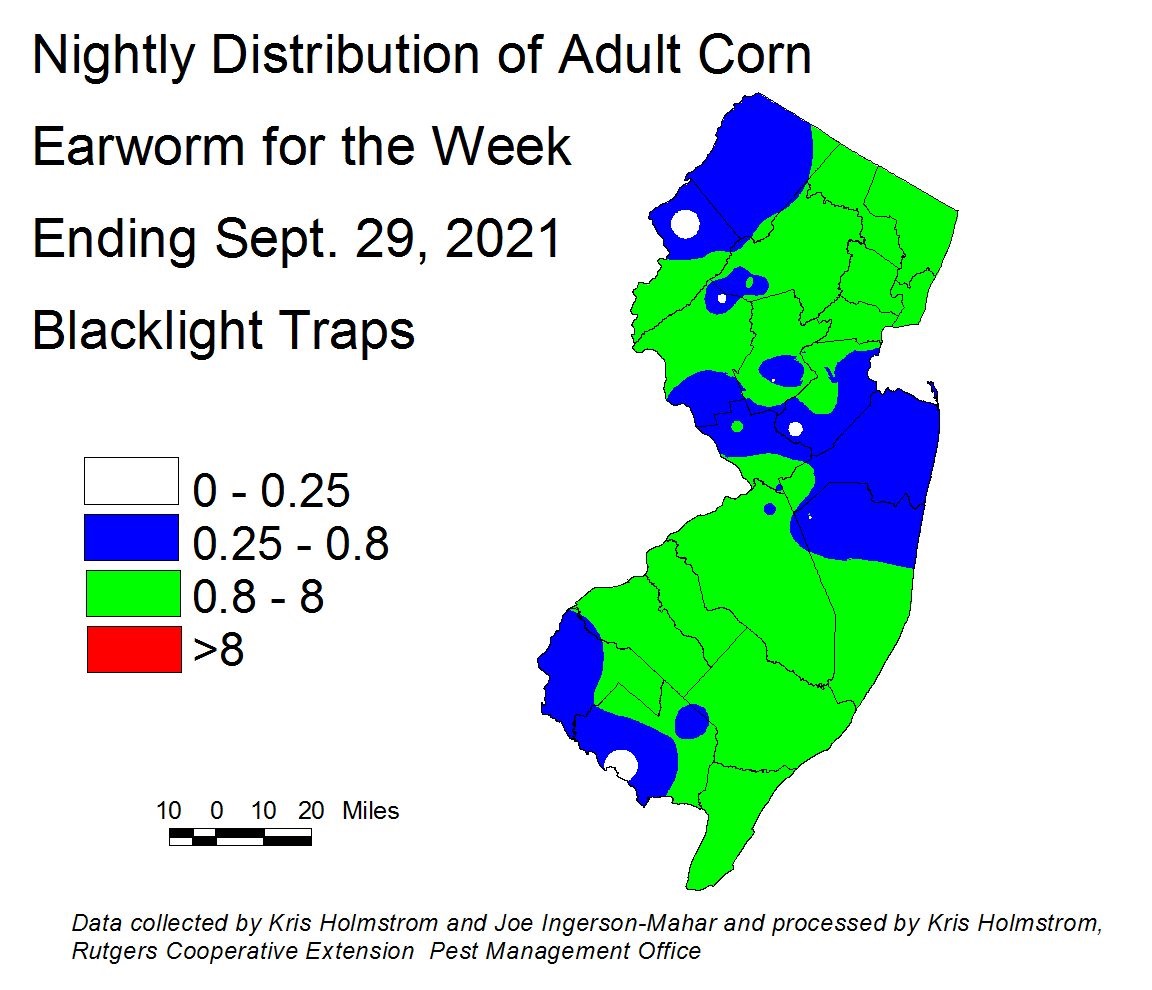 Corn earworm (CEW) moth captures from both trap types have declined dramatically with lower evening temperatures, although the population still poses a threat to remaining sweet corn. It is likely that CEW activity will rise and fall with evening temperatures for the next several weeks. Both trap types throughout the state are generally in agreement as to spray schedules (see below). Check this publication weekly for CEW status. The number of pheromone traps deployed is much lower, resulting in much broader color bands on the map. It is also important to understand that pheromone traps are more sensitive than blacklight traps, and thresholds are adjusted to account for the higher catches typical of this trap type. On the blacklight map (left), green areas represent a 3-day silk spray schedule, while blue areas on the blacklight map should be represent 4-day schedules. On the pheromone map (below right), red represents a 3 day spray schedule. Green areas on the pheromone map represent a 4-day schedule. Be sure to access information from this publication in the upcoming weeks to determine how frequently you should treat silking sweet corn to protect it from CEW infestation.
The highest nightly blacklight trap catches of CEW for the week ending 09/29/21 are as follows:
| Crosswicks 4 | Downer 2 | Oldwick 2 |
| Asbury 2 | Flanders 2 | Milltown 1 |
| Bellemeade 2 | Green Creek 2 | Pennington 1 |
| Denville 2 | Medford 2 | Princeton 1 |
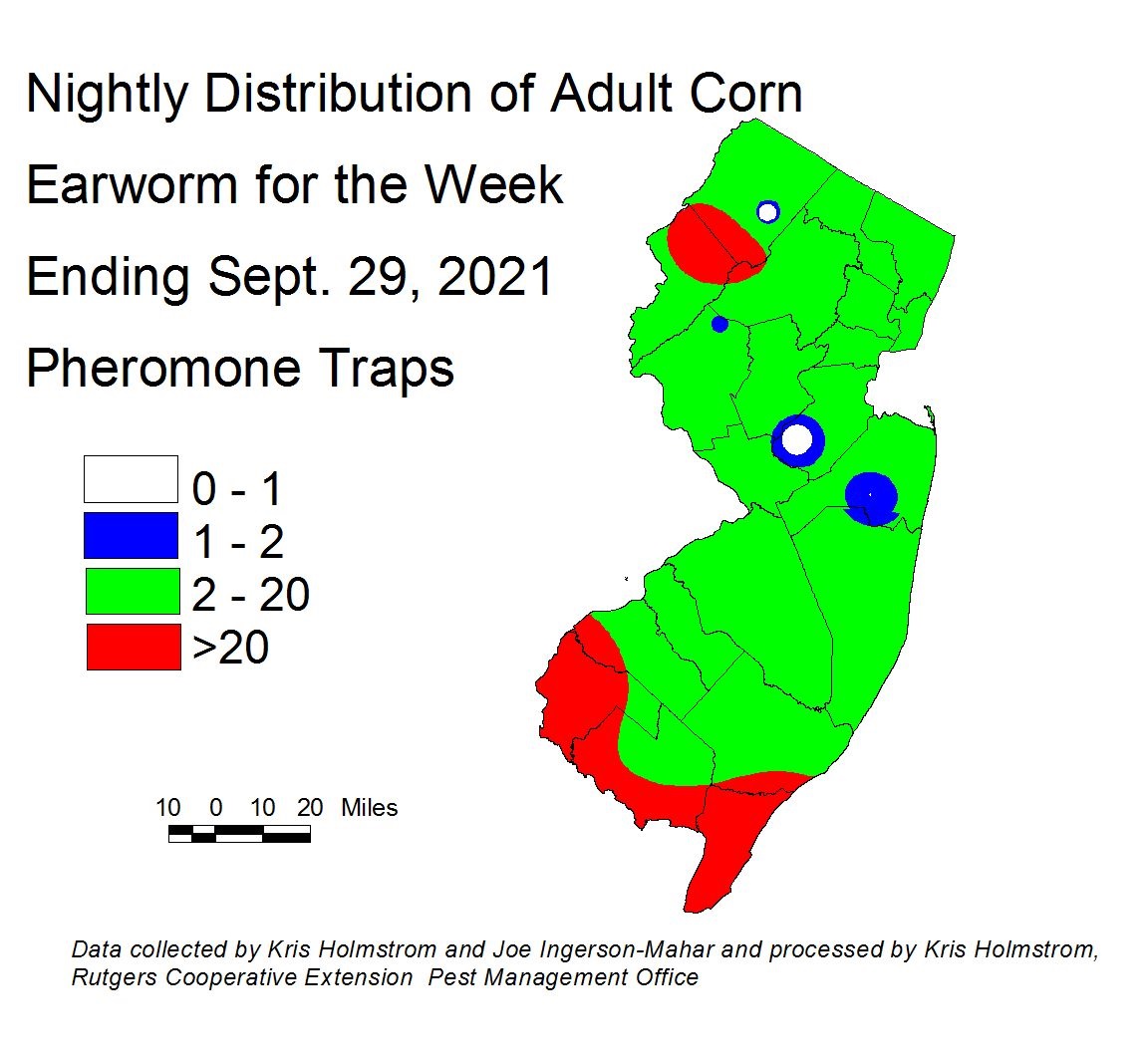
The highest nightly pheromone trap catches of CEW for the week ending 09/29/21 are as follows:
| Green Creek 69 | East Vineland 9 | Springdale 4 |
| Allamuchy 52 | Berlin 7 | Chester 3 |
| Woodstown 31 | Matawan 4 | Crosswicks 38 |
| Tabernacle 12 | South Branch 4 | Snyder Farm (Hunterdon) 3 |
Silking Spray Schedules*:
South – 3 days
Central – 3 days
North – 3 days
*These recommendations are based on regional catches. Adhere to tighter spray schedules if indicated by local trap catches. Synthetic pyrethroids alone should NOT be used for corn earworm (CEW) protection on silking corn, or for fall armyworm (FAW) management at any stage. Control with these materials is very inconsistent. Utilize materials in IRAC groups 5 and 28, or combination products that include IRAC group 28 for best control. See the Sweet Corn section of the 2020-21 Commercial Vegetable Production Guide for selections.
Cole Crops
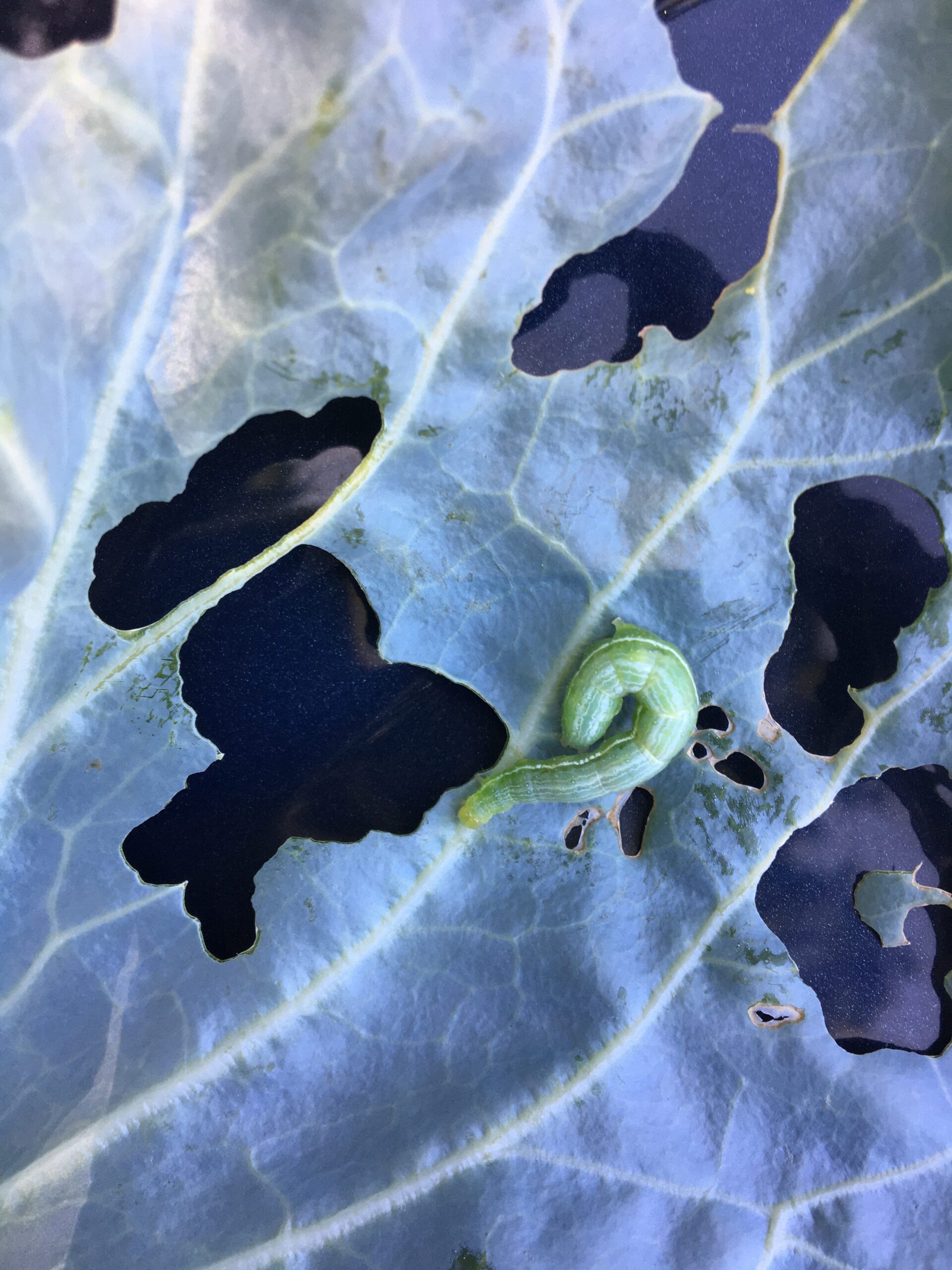 Fall plantings of cole crops continue to be infested by imported cabbageworm (ICW) and diamondback moth (DBM) larvae. With DBM being the most destructive larval type at this time. Cabbage looper (CL-photo at left), cross striped cabbage worm (CSCW-photo at right) and beet armyworm (BAW) are also causing
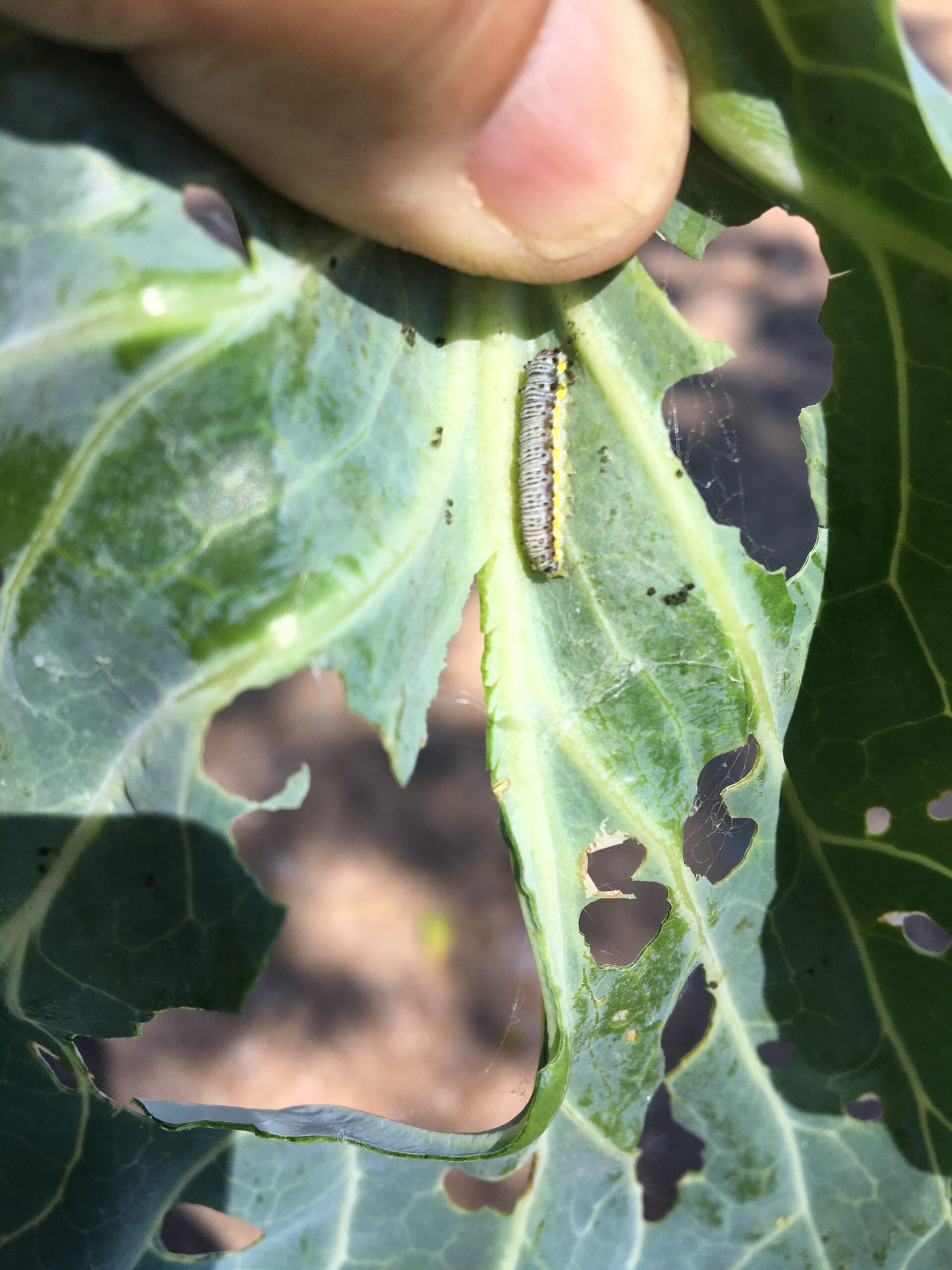 injury to these crops, with CSCW becoming more common.
Check 5 consecutive plants each in 10 random locations throughout the planting. Consider treating if caterpillars are found on 10% or more plants that are in the 0-9 true leaf stage. From 9-leaf to the early head stage (in broccoli, cauliflower, and cabbage) infestations up to 20% may be tolerated. Once heads begin to form, a 5% threshold should be observed to protect the marketable portion of the plant. For leafy greens such as collards and kale, 10% plants infested is the threshold throughout.
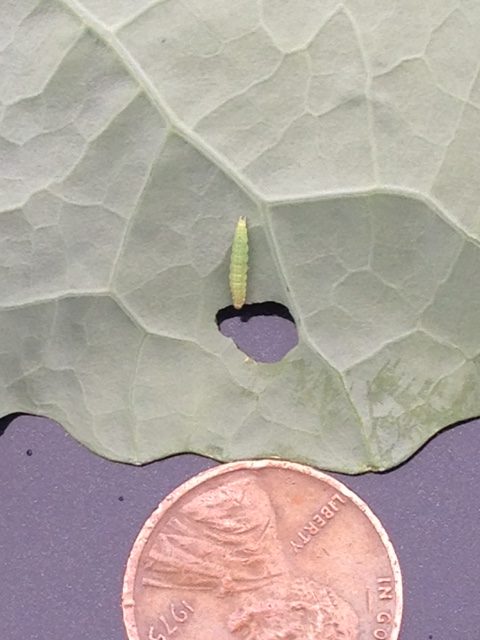
 Some populations of DBM are resistant to carbamate and synthetic pyrethroid insecticides. The lack of DBM control with these insecticides has been noted in NJ previously. It is important to distinguish between common cole crop pests for this reason. DBM larvae grow to a length of approximately 0.5”, and taper toward both ends (see photo at right). These caterpillars thrash violently when disturbed. Newer chemistries that specifically target caterpillar pests are effective against DBM as well as all other caterpillar pests of cole crops, including BAW (see photo at left), another species with exhibiting pyrethroid resistance. These materials include (active ingredient – trade name (IRAC* code)):
Spinosad/Spinetoram – Entrust(OMRI)/ Radiant (5)
Chlorantraniliprole – Coragen (28)
Cyantraniliprole – Exirel (28)
Peppers
Pepper weevil –
Two more farms (Hammonton) were found to be infested with pepper weevil bringing the known total to 4 infested farms. There does not seem to be a connection between these and the two infested farms in East Vineland, indicating that there were probably two sources for the weevils. No control efforts are likely for these newest farms.
A new fact sheet is now available for anyone interested in monitoring for pepper weevils on their own: FS1330: Monitoring and Management of Pepper Weevil in New Jersey (Rutgers NJAES).
Beet armyworm (BAW) captures are fairly low in southern NJ pheromone traps, with the exception of East Vineland. It is noteworthy that BAW larvae caused serious damage to a field of sugar beets near East Vineland two weeks ago (see photo at right). This pest can attack peppers, and growers and scouts should check for the presence of heavily damaged leaves near terminal growth on pepper plants. BAW larvae will be found in the area of damage. As yet, no injury to peppers has been reported.
The highest nightly pheromone trap catches of BAW for the week ending 09/29/21 are as follows:
| East Vineland 22 | Jones Island 2 |
| Folsom 2 | Woodstown 1 |
Pumpkins and Winter Squash
Cucurbit downy mildew (CDM) should be considered active in all parts of the state on cucumbers and pumpkins. For regional information on this important disease, see the Cucurbit Downy Mildew Forecast webpage: http://cdm.ipmpipe.org/. This forecast has NJ at moderate risk of further infection as a result of new transport events through Tuesday 9/28. It is advisable that all growers treat preventively for CDM on 
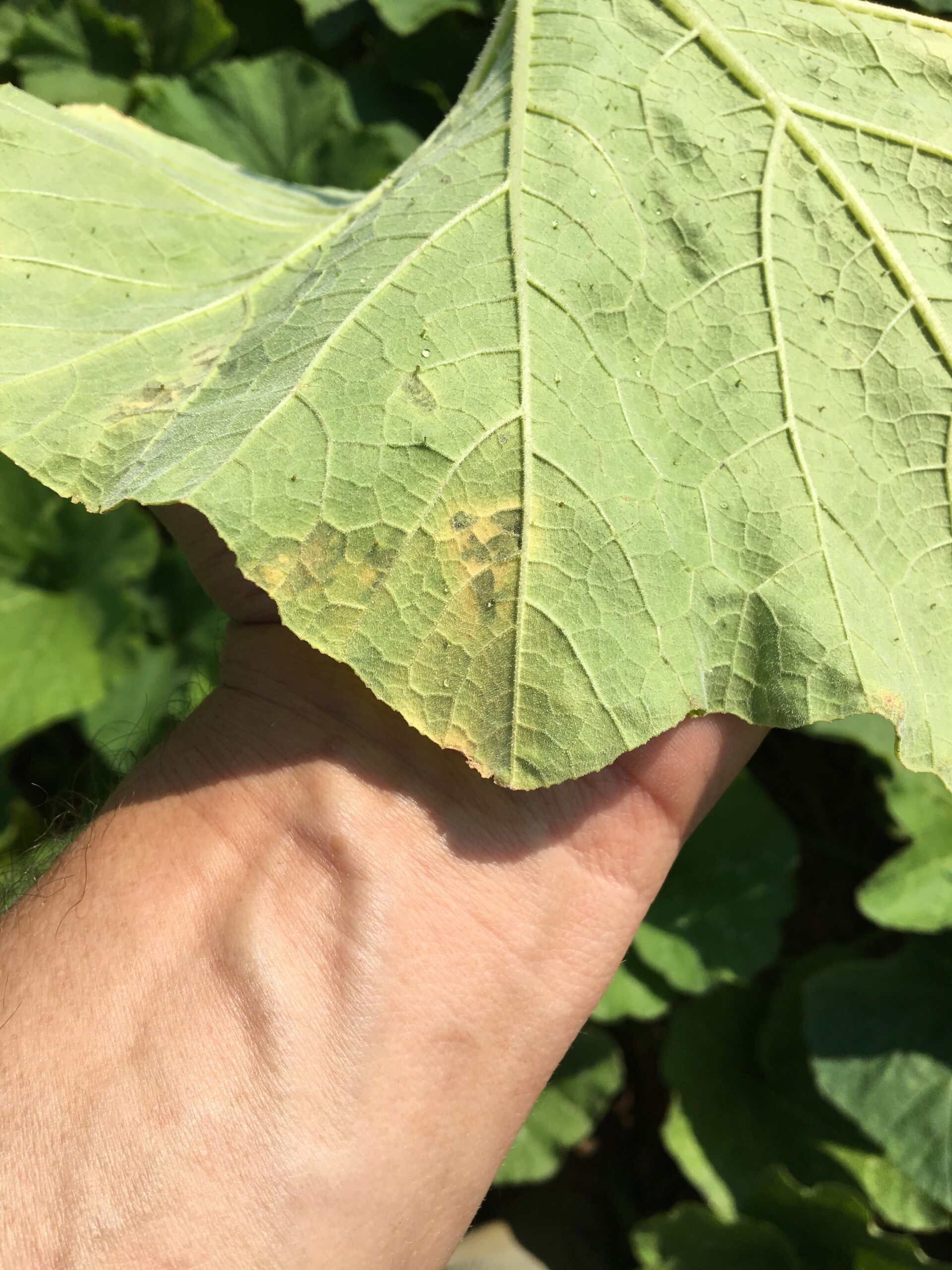 all potential host crops. CDM symptoms on the upper leaf surface include yellow areas that rapidly turn necrotic (photo at far left). Signs of dark sporulation on the lower leaf surface may be found in close association with leaf veins (photo at near left).
For a list of effective materials and fungicide rotations, see the Pumpkin/Winter Squash section of the 2020-21 Commercial Veg. Recs.
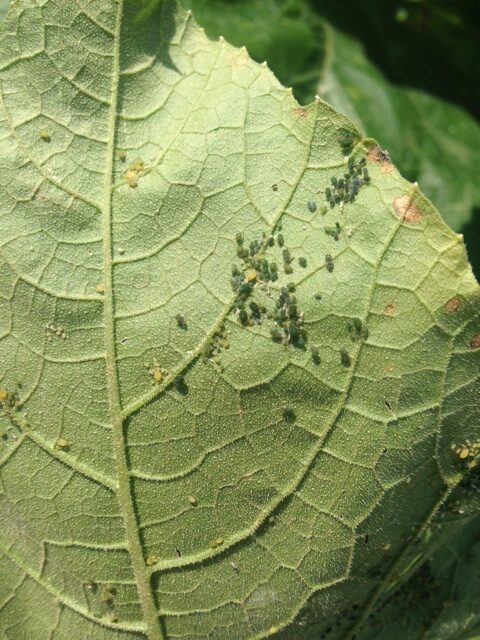
Melon aphid (see photo at left) populations may be present in pumpkin and winter squash fields. This aphid builds to heavy populations 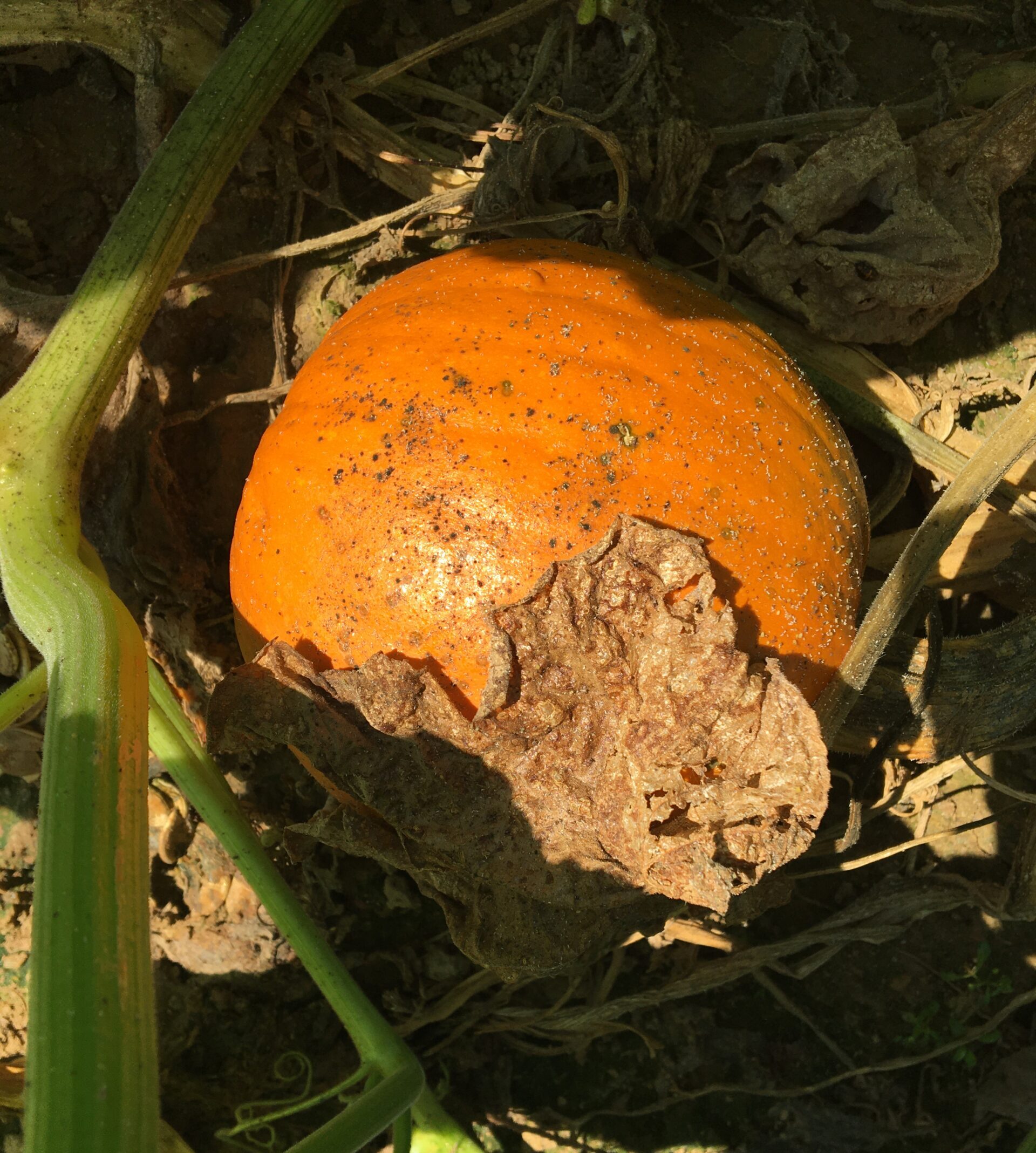 that result in the deposition of sticky droppings on the surface of fruit (see photo at right). If melon aphids appear in more than one sample site in a 10 site sample, consider treating to minimize the appearance of droppings. Insecticides effective at managing this pest are found in the Pumpkin and Winter Squash section of the Commercial Vegetable Production Recommendations.
Allium Leaf Miner
Allium leaf miner (ALM) adults should be active now, or within the next several days. As these flies emerge, they will seek out mates and begin laying eggs in allium foliage.
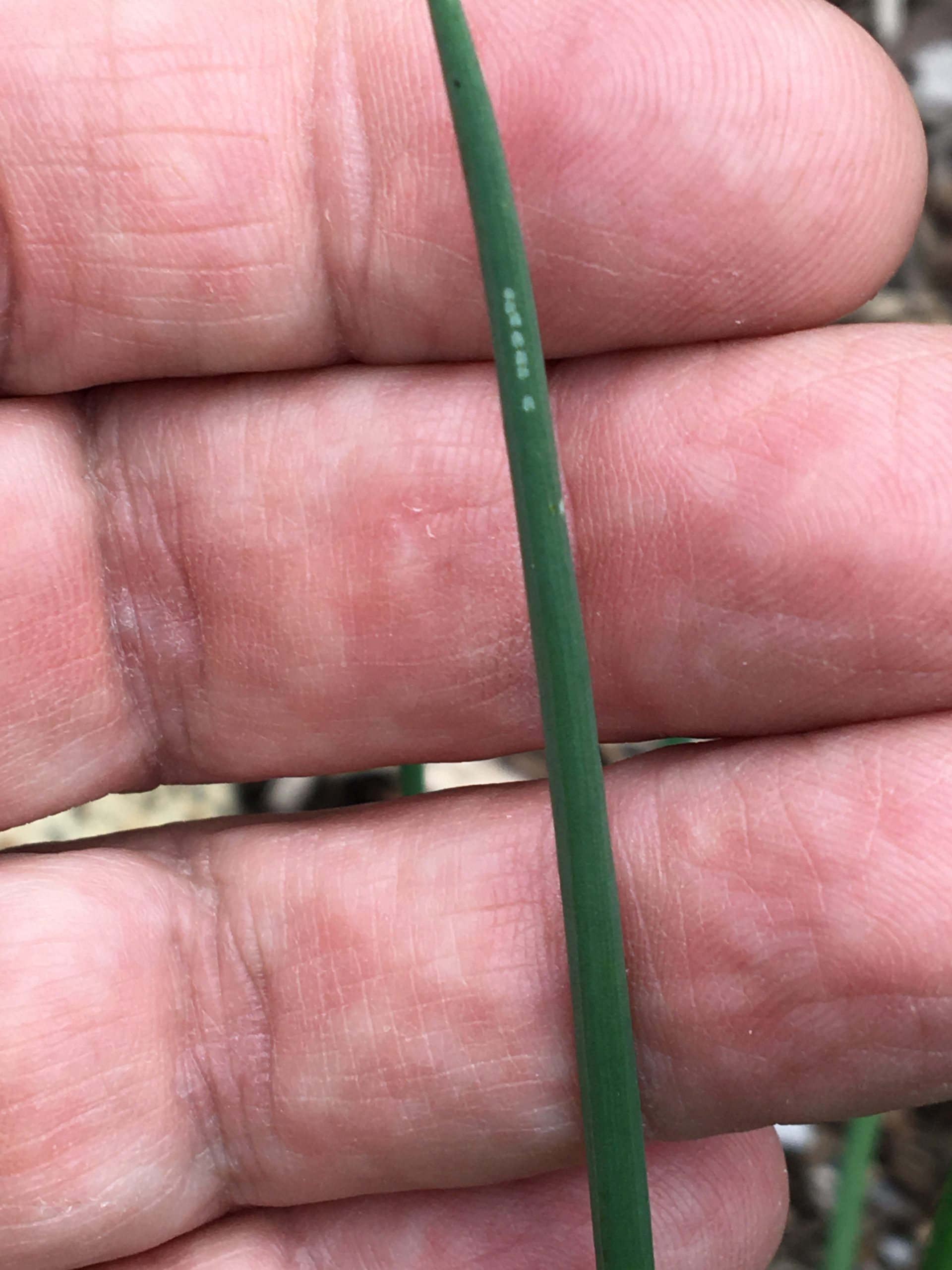 Growers should consider initiating (continuing) the control method of their choice at this time. Affected crops include chives, scallions, garlic, onions and leeks. Look for neat rows of white spots descending from the upper tips of allium leaves (see photo at left). Initial injury often occurs on the tallest leaves. Under warmer, less breezy conditions, adults may be seen near the tips of leaves (see photo of adults at lower right). Click on photos to enlarge the images.
Floating row covers, kept on until this flight ends will help minimize access to plants. Insecticide applications targeting adults may be helpful as well, although weekly sprays may not completely eliminate foliar injury. Spinosyn materials (Radiant, Entrust (OMRI approved)), pyrethroids (Mustang Maxx, Warrior), neonicotinoids (Scorpion, Venom), the diamide Exirel (section 2ee recommendation) and the insect growth regulator Trigard are labeled for leaf miner control.
Adult activity and observations of feeding will be reported on in the IPM Update as they occur. At this time, all growers should respond to the second adult generation.
September 22, 2021 Kris Holmstrom and Joe Ingerson-Mahar
Vegetable IPM Update 09/22/21
Corn Earworm Management in Sweet Corn Needs Assessment Survey – One Final Time!!
Dr. Kelly Hamby, Associate Professor/Extension Specialist with the Department of Entomology at University of Maryland, is leading a team of researchers (including Rutgers IPM personnel) who have developed a survey to prioritize research and extension efforts for improving corn earworm management in sweet corn throughout the Northeast. We appreciate your participation in this survey and will use results to develop a grant proposal to try to get federal funding to address these needs.
Survey link: https://ume.qualtrics.com/jfe/form/SV_9vRh1xHnDp4KEaa
Sweet Corn
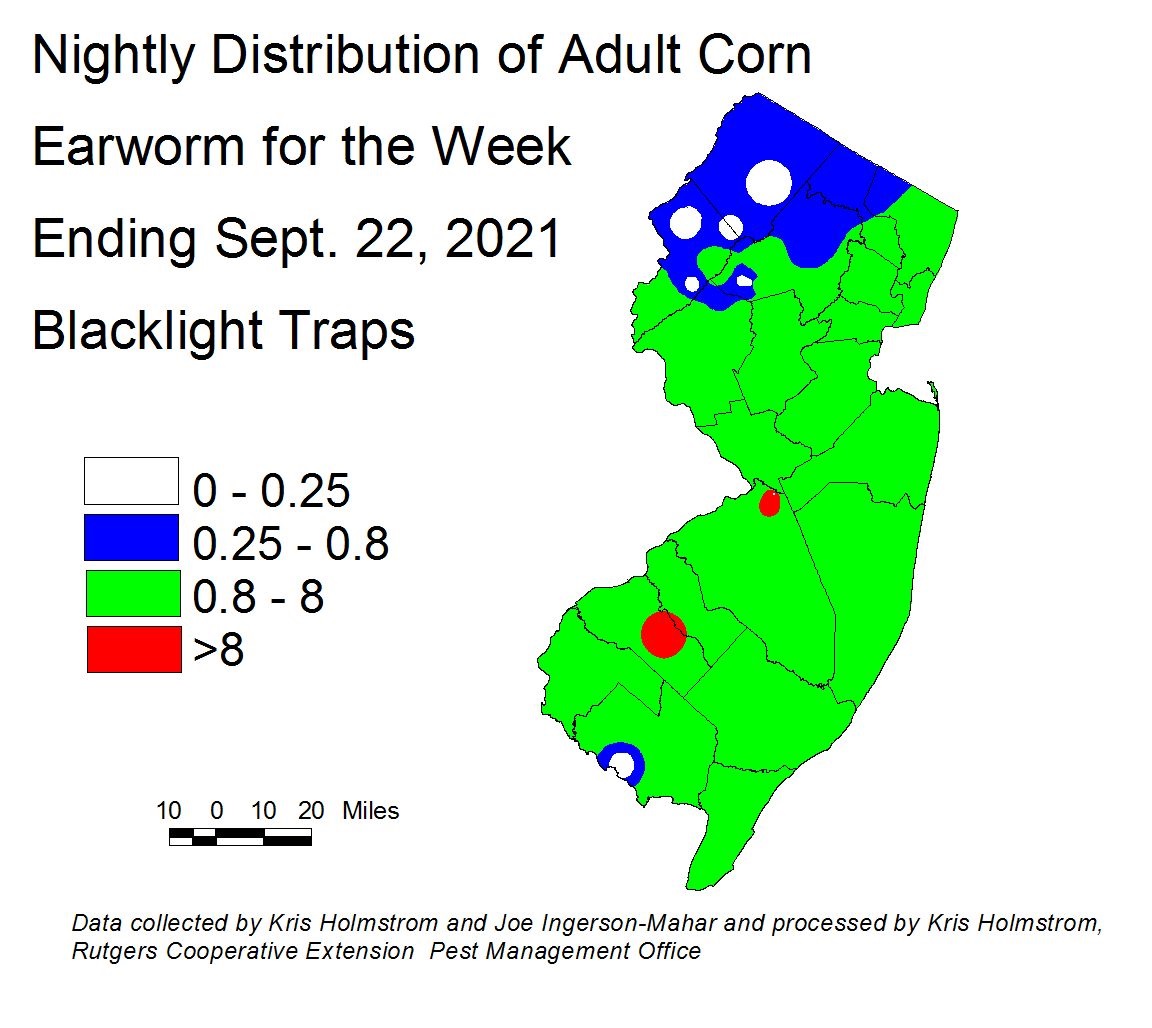 Corn earworm (CEW) moth captures from both trap types are now highly variable throughout the state, but some remain high. With lower evening temperatures and dwindling corn, moth numbers have dropped across the state, but blacklight and pheromone traps still indicate the presence of a significant population. It is likely that CEW catches will continue to rise and fall with evening temperatures for the next several weeks. Both trap types throughout the state are generally in agreement as to spray schedules (see below). Check this publication weekly for CEW status. The number of pheromone traps deployed is much lower, resulting in much broader color bands on the map. It is also important to understand that pheromone traps are more sensitive than blacklight traps, and thresholds are adjusted to account for the higher catches typical of this trap type. Silking corn is at high risk of CEW infestation at this time. On the blacklight map (left), green areas represent a 3-day silk spray schedule. Blue and white areas on the blacklight map should be considered outliers, and disregarded at this time. On the pheromone map (below right), red represents a 3 day spray schedule. Green areas on the pheromone map should be disregarded at this time, as this is largely due to gaps in data collection. Be sure to access information from this publication in the upcoming weeks to determine how frequently you should treat silking sweet corn to protect it from CEW infestation.
The highest nightly blacklight trap catches of CEW for the week ending 09/22/21 are as follows:
| Crosswicks 11 | Pennington 7 | Tabernacle 4 |
| Downer 10 | Allentown 5 | Asbury 3 |
| Georgetown 9 | Bellemeade 5 | Green Creek 3 |
| New Egypt 8 | Medford 5 | Lawrenceville 3 |
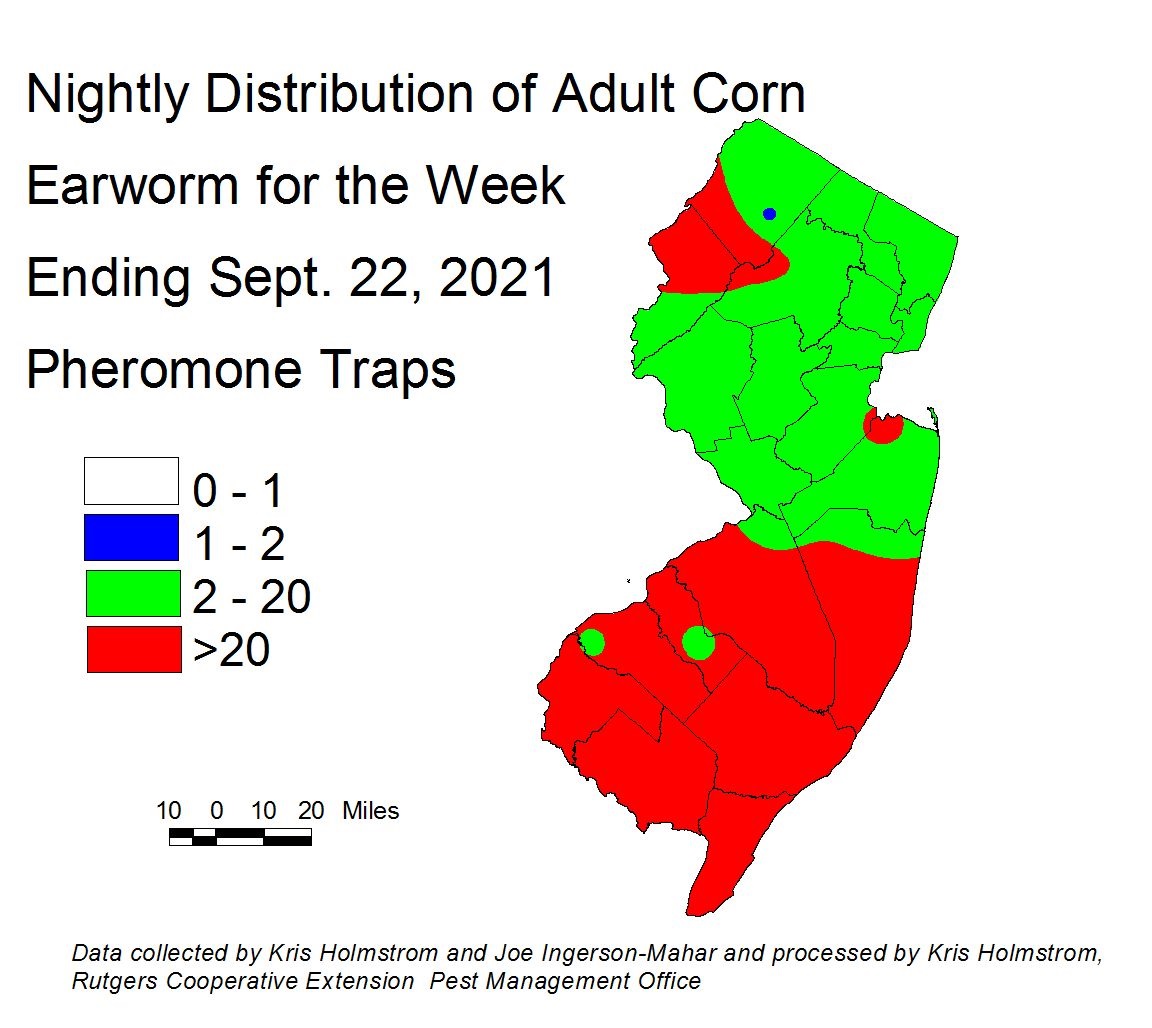
The highest nightly pheromone trap catches of CEW for the week ending 09/22/21 are as follows:
| Tabernacle 90 | Green Creek 52 | Farmingdale 12 |
| Allamuchy 67 | Springdale 40 | Crosswicks 9 |
| Woodstown 61 | Matawan 22 | Beckett 8 |
| Monroeville 54 | South Branch 16 | Chester 5 |
Silking Spray Schedules*:
South – 3 days
Central – 3 days
North – 3 days
*These recommendations are based on regional catches. Adhere to tighter spray schedules if indicated by local trap catches. Synthetic pyrethroids alone should NOT be used for corn earworm (CEW) protection on silking corn, or for fall armyworm (FAW) management at any stage. Control with these materials is very inconsistent. Utilize materials in IRAC groups 5 and 28, or combination products that include IRAC group 28 for best control. See the Sweet Corn section of the 2020-21 Commercial Vegetable Production Guide for selections.
Cole Crops
Fall plantings of cole crops are well underway at this time, and are frequently infested by imported cabbageworm (ICW) and diamondback moth (DBM) larvae. At this time, cabbage looper (CL-photo at left) and cross striped cabbage worm (CSCW-photo at right) are also causing injury to these crops, with CSCW becoming more common.
Check 5 consecutive plants each in 10 random locations throughout the planting. Consider treating if caterpillars are found on 10% or more plants that are in the 0-9 true leaf stage. From 9-leaf to the early head stage (in broccoli, cauliflower, and cabbage) infestations up to 20% may be tolerated. Once heads begin to form, a 5% threshold should be observed to protect the marketable portion of the plant. For leafy greens such as collards and kale, 10% plants infested is the threshold throughout.
Some populations of DBM are resistant to carbamate and synthetic pyrethroid insecticides. The lack of DBM control with these insecticides has been noted in NJ previously. It is important to distinguish between common cole crop pests for this reason. DBM larvae grow to a length of approximately 0.5”, and taper toward both ends (see photo at right). These caterpillars thrash violently when disturbed. Newer chemistries that specifically target caterpillar pests are effective against DBM as well as all other caterpillar pests of cole crops, including beet armyworm (BAW-see photo at left), another species with exhibiting pyrethroid resistance. These materials include (active ingredient – trade name (IRAC* code)):
Spinosad/Spinetoram – Entrust(OMRI)/ Radiant (5)
Chlorantraniliprole – Coragen (28)
Cyantraniliprole – Exirel (28)
Peppers
Pepper weevil –
Besides the two farms in East Vineland, as far as known, there are no other infested farms. The economics of attempted weevil control may not be worthwhile considering the time of year.
A new fact sheet is now available for anyone interested in monitoring for pepper weevils on their own: FS1330: Monitoring and Management of Pepper Weevil in New Jersey (Rutgers NJAES).
Beet armyworm (BAW) captures are fairly low in southern NJ pheromone traps. However, BAW larvae were discovered causing serious damage to a field of sugar beets near East Vineland last week (see photo at right). This pest can attack peppers, and growers and scouts should check for the presence of heavily damaged leaves near terminal growth on pepper plants. BAW larvae will be found in the area of damage. As yet, no injury to peppers has been reported.
The highest nightly pheromone trap catches of BAW for the week ending 09/22/21 are as follows:
| Woodstown 4 | Hammonton 2 |
| East Vineland 3 | Jones Island 1 |
Pumpkins and Winter Squash
Cucurbit downy mildew (CDM) should be considered active in all parts of the state on cucumbers and pumpkins. For regional information on this important disease, see the Cucurbit Downy Mildew Forecast webpage: http://cdm.ipmpipe.org/. This forecast has NJ at low risk of further infection as a result of new transport events through Tuesday 9/21, however the rain forecast for late this week will increase infection from local sources. It is advisable that all growers treat preventively for CDM on all potential host crops. CDM symptoms on the upper leaf surface include yellow areas that rapidly turn necrotic (photo at far left). Signs of dark sporulation on the lower leaf surface may be found in close association with leaf veins (photo at near left).
For a list of effective materials and fungicide rotations, see the Pumpkin/Winter Squash section of the 2020-21 Commercial Veg. Recs.
 Phytophthora fruit rot (see photo at left) is causing significant crop loss in a number of fields. There is no effective form of chemical control for this disease at this stage. Growers are now removing fruit from fields. Avoid harvesting fruit in and near areas showing obvious signs of Phytophthora. Fruit that may appear solid in the field can develop rot while in bins, resulting in more damaged fruit.
Melon aphid (see photo at left) populations may be present in pumpkin and winter squash fields. This aphid builds to heavy populations that result in the deposition of sticky droppings on the surface of fruit (see photo at right). If melon aphids appear in more than one sample site in a 10 site sample, consider treating to minimize the appearance of droppings. Insecticides effective at managing this pest are found in the Pumpkin and Winter Squash section of the Commercial Vegetable Production Recommendations.
Allium Leaf Miner
Allium leaf miner (ALM) adults should be active now, or within the next several days. As these flies emerge, they will seek out mates and begin laying eggs in allium foliage.
Growers should consider initiating (continuing) the control method of their choice at this time. Affected crops include chives, scallions, garlic, onions and leeks. Look for neat rows of white spots descending from the upper tips of allium leaves (see photo at left). Initial injury often occurs on the tallest leaves. Under warmer, less breezy conditions, adults may be seen near the tips of leaves (see photo of adults at lower right). Click on photos to enlarge the images.
Floating row covers, kept on until this flight ends will help minimize access to plants. Insecticide applications targeting adults may be helpful as well, although weekly sprays may not completely eliminate foliar injury. Spinosyn materials (Radiant, Entrust (OMRI approved)), pyrethroids (Mustang Maxx, Warrior), neonicotinoids (Scorpion, Venom), the diamide Exirel (section 2ee recommendation) and the insect growth regulator Trigard are labeled for leaf miner control.
Adult activity and observations of feeding will be reported on in the IPM Update as they occur. At this time, all growers should respond to the second adult generation.
September 20, 2021 Meredith Melendez
Secretary Fisher Message on Vaccine Survey
A message from Secretary Douglas Fisher:
We are reaching out regarding COVID-19 vaccination support for you and your farmworkers. We are working to ensure that all farmworkers are protected against COVID-19 as we head into the fall season – to that end, if any of your workers are not yet vaccinated for COVID-19 and are interested in receiving a vaccine, please fill out this survey. We will be happy to connect you with the appropriate resources to keep your workforce healthy.
Additionally, if your entire workforce has been vaccinated, we would still appreciate if you could please fill out the survey Any information you provide will be confidential and used solely for supporting COVID-19 vaccination efforts.
Thank you for your support in keeping our farm communities safe and healthy!
September 20, 2021 Wes Kline
Cleaning and Sanitizing Grading Equipment Grower Meeting
Join us on October 7th from 4-6pm at the Rutgers Agricultural Research and Extension Center, 121 Northville Rd., Bridgeton, NJ 08302) for a hands-on grower meeting that will cover: how to assess washing and packing equipment; differences of sanitization products; and how to monitor pH and sanitizer concentrations. We will be demonstrating a new packing line obtained through a grant from NJDA and the Food and Drug Administration.
The program is free, but please register by October 4th at http://rutgersonfarmfoodsafety.eventbrite.com. Ten people must register to hold this event. As per Rutgers policy, masks will be required during the entire meeting since it is inside. If you do not have a mask, one will be provided, and hand sanitizers will be available.