Pear psylla adults are among the earliest pests to appear in tree fruit crops, and indeed after February’s record warmth adults are already active in southern counties. The first eggs were observed following last weeks warm up and oviposition will continue from now through bloom. [Read more…]
Fruit Crops Edition
Seasonal updates on diseases, insects, weeds impacting tree fruit and small fruit (blueberry, cranberry, and wine grape). Fruit Pest Alerts are also available via this category feed.
Subscriptions are available via EMAIL and RSS.
February 16, 2017 Dan Kluchinski
SADC Cost-Sharing for Deer Fence on Permanently Preserved Farms
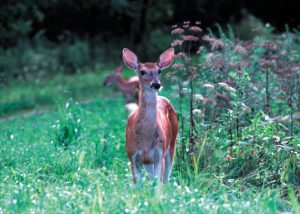
Whitetail deer. Photo courtesy USDA NRCS.
The NJ State Agriculture Development Committee (SADC) recently dedicated $500,000 of funding for 50% cost-share grants to farmers for installing high tensile woven-wire fencing on permanently preserved farms. The cost share applies to fencing materials and installation. An applicant can apply for a cost-share of up to $200/acre, with a total award amount capped at $20,000. As a ballpark estimate: accounting for the farmer’s 50% contribution, the maximum level of funding would support fence installation around roughly 20+ acres.
To be eligible for the program: [Read more…]
February 3, 2017 Norman Lalancette
2017 South Jersey Commercial Tree Fruit Grower Meeting and Stakeholder Survey
________________________________________________
Date: Thursday, February 16, 2017
Time: 8:00 am – 2:00 pm
Location: Rutgers Agricultural Research & Extension Center
121 Northville Road, Bridgeton, NJ
Pre-Registration: Required, by February 10th, contact:
Karen Holton (holton@aesop.rutgers.edu) at (856) 455-3100 x4104
Susan Bradbury (bradbury@aesop.rutgers.edu) at (856) 455-3100 x4101
Cost / person: $15.00 (checks preferred)
Lunch: Included
Pesticide Credits: Awarded for Cat 10(5), 1A(5), Core(2), PP2(5)
Program details: Norm Lalancette (856) 455-3100 x4124 [Read more…]
January 25, 2017 Rick VanVranken
Farmer Energy & Water Efficiency Training Feb. 22
Learn from Industry and Academia Experts about Innovations in Energy Efficiency and Water Conservation, that Positively Impact our Environment and Can Increase the Profitability at Your Farm
The Rutgers EcoComplex and the Rutgers Food Innovation Center have partnered together to provide this critically-needed and unique seminar for farmers, that will help companies to reduce their energy and water use, create or enhance their sustainability program, and save money in their operations. The trainers in this course are industry experts who have first-hand experience in the field.
More details here.
Date: February 22, 2017
Time: 8 am registration, Program from 8:30am – 4:30 pm
Location: 140 Locust Grove Rd, Pittstown, NJ 08867
Cost: $20 per person
January 18, 2017 Norman Lalancette
2017 South Jersey Commercial Tree Fruit Grower Meeting and Stakeholder Survey
The 2017 South Jersey Commercial Tree Fruit Meeting has been scheduled for Thursday, February 16th. The meeting will be held at the Rutgers Agricultural Research and Extension Center (RAREC), 121 Northville Road, Bridgeton, NJ. [Read more…]
October 18, 2016 Hemant Gohil
Vole Management in the Orchard
There has been growing concerns about vole damage in apple and peach orchards throughout northern and southern New Jersey counties. Vole populations are often cyclic, and can reach high populations every 2-4 years. This, combined with poor weed control in orchards, can lead to disastrous effects on trees.
Identification and Habitat
Meadow voles and pine voles are two common types of voles. Pine voles have small eyes and small, almost inconspicuous ears, while meadow voles have larger eyes and ears. Meadow voles primarily feed in open vegetation, while pine voles prefer underground burrow systems just below the ground surface. Vole diets include many primary food sources in addition to tree bark. However, they can attack fruit trees during fall and winter months when other food sources are scarce.
[Read more…]

