Fruit Crops Edition - Cranberry Section

Seasonal updates on diseases, insects, weeds impacting small fruit (blueberry, cranberry, and wine grape). Fruit Pest Alerts are also available via this category feed.
 
Subscription is through the general Fruit feed available via EMAIL and RSS.

Research on False Blossom and Blunt-nosed Leafhoppers

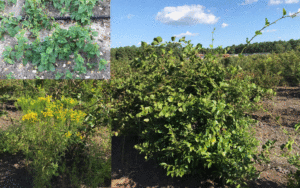
Blunt-nosed leafhoppers are vectors of a phytoplasma that causes false blossom disease in cranberries. This disease

Person researching

Nakorn Pradit, graduate student, Entomology

causes abnormalities in flowers, which include shortened, discolored and streaked petals, enlarged calyx, straighten inflorescence, and abnormal development of floral parts into leaves (phyllody). False blossom imposed a severe threat to the cranberry industry in the US in the first half of last century. However, in the second half of last century, management of leafhoppers through the development of resistant varieties and effective chemical controls reduced its incidence. Recently, the disease has re-appeared in many New Jersey cranberry farms due to changes in management practices and the use of new (possibly more susceptible) varieties. To address this issue, the entomology program at the Rutgers PE Marucci Center is conducting studies to understand the effects of phytoplasma-infected cranberry plants on resistance to leafhoppers and other insect herbivores. This research is being led by Nakorn Pradit, PhD student in the Department Entomology (Rutgers U.). We are asking two main research questions: 1. Are phytoplasma-infected cranberry plants more resistant or susceptible to leafhoppers and other non-vector insect pests? and 2) what are the mechanisms of this resistance/susceptibility? These studies will help identify possible mechanisms of insect pest resistance in cranberries and develop tools for improving control methods against insect vectors and other pests of cranberries.


Insect Update

Cranberry beds are in bloom. If insects have been effectively managed prior to bloom, we recommend no sprays at this time. A reminder: when bees are present your only choices of insecticides are insect growth regulators (IGRs) such as Intrepid 2F or Bt products such as DiPel.

During bloom we recommend monitoring insect populations using pheromone traps. Pheromone traps should be used particularly to monitor activity of Sparganothis fruitworm and blackheaded fireworm, two key pests in New Jersey.

Sparganothis fruitworm- Adult flight started a few weeks ago and we should be at peak flight activity by next week (see DD model below). Damage by the second generation larvae begins after the eggs hatch, usually 9-12 days after they are laid. These larvae will feed on foliage and fruit. Larvae will partially feed on berries, causes scoring of the fruit. However, particularly on Ben Lear, larvae may feed inside the fruit. Insecticide treatment should target small larvae. Pheromone traps can be utilized to time insecticides sprays. If treatment is required, sprays should be applied two weeks after peak moth flight and/or earlier if using an IGR. If trap counts indicate a low population that requires management, a single insecticide application may be made post-bloom. If trap counts are high, then an early application of an IGR may be used when the first eggs start to hatch. This would be followed by a second application soon after bloom. Your post-bloom options are Diazinon, Altacor, Delegate, or Intrepid.

As indicated above, controlling fruitworm populations is often very difficult and many require multiple applications depending on pest pressure. Sparganothis fruitworm populations in Massachusetts are resistant to organophosphate insecticides (e.g. Diazinon, Lorsban). Thus, organophosphates should be used with care, i.e., always rotate insecticides with different modes of action. Organophosphate insecticides will also negatively affect natural enemy populations. Delegate and Altacor are insecticides belonging to relatively new modes of action; these are registered against fruitworms and can be used as an alternative to organophosphates post-bloom.

Degree-day model for Sparganothis fruitworm

Sparganothis degree-day model

Sparganothis degree-day model benchmarks

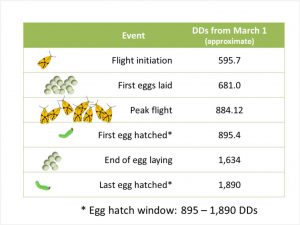
The figure details life history benchmarks of interest for Sparganothis fruitworm and associated degree-day estimates from March 1. Flight initiation is predicted around 595 DD, at a lower temperature threshold of 50 °F. Based on this model Sparganothis fight was initiated in our region (Chatsworth, NJ) about a week ago. So far, we have accumulated (starting April 15) 763 DD, which means that egg laying has started (depending on the DD accumulations specific to your farm); however, eggs are not expected to hatch until later this month. Also, a reminder that a single insecticide application aimed at Sparganothis larvae will likely have the greatest effect if it is timed between the beginning and the peak egg-hatch/larval-emergence, which is approximately 895-1,400 DD. I will keep you updated on these DD predictions as the season progresses.

Sparganothis Fruitworm Degree-Day Update: as of June 4, 2018

Based on our degree-day model for Sparganothis fruitworm, flight initiation is expected at around 596 DD (see chart). As of June 4, Sparganothis has accumulated 626 DD (using April 15 as biofix) or 586 DD (using April 25 as biofix). This indicates that flight activity has just started or will start soon. Growers are advised to place pheromone traps for monitoring this pest at this moment, if they haven’t done so already.

Sparganothis fruitworm degree-day model

Sparganothis fruitworm adult

Sparganothis fruitworm adult

Sparganothis fruitworm degree-day model


Rutgers Cooperative Extension of Gloucester County Has New Office Location

County Agricultural Agents, Michelle Infante-Casella and Hemant Gohil have a new office location in Gloucester County. The Rutgers Cooperative Extension (RCE) Office in Gloucester County relocated last week. The new location is now at the Shady Lane County Complex, 254 County House Road, Clarksboro, NJ 08020. The entrance is on the right side of the main 3-story brick building, under the numbers 254; follow the sidewalk with gray brick pavers.

Front-side of a building

Entrance to the RCE of Gloucester County Offices down the sidewalk on the right.

The office also has a new phone number and Agricultural Agents and other staff can be reached at 856-224-8040 (Agriculture and Natural Resources is extension 1). This new complex provided by Gloucester County offers more office space and multiple options for educational programs. To the left side of the complex is a 4-classroom building, formerly the Gloucester County Fire Academy, that is now operated by Rowan College of Gloucester County, that can be utilized for extension education and other county-related events. The main office building has 3 conference rooms for small group meetings. RCE will still have access to the main auditorium at the former facility in Clayton. For more information about Rutgers Cooperative Extension of Gloucester County see http://gloucester.njaes.rutgers.edu.

24(c) Special Local Need label for spot treatment with Callisto in cranberry

Callisto® (mesotrione) is a systemic preemergence and postemergence herbicide. It works mainly on broadleaf weeds and sedges, and does not work well against most of grasses. When used preemergence, weeds take up the product through the soil during emergence. When used postemergence, weeds absorb the herbicide through the treated foliage and also through the soil.Plants affected by Callisto® will turn white. Injury may take several days or weeks to show.

Callisto® recently received a New Jersey 24(c) Special Local Need label for spot treatment of tough-to-control weeds in cranberry. This type of application will concentrate the herbicide on a localized area of the bog, allowing a higher use rate that can provide control of dodder, dewberry, Poison ivy, or smilax.

The addition of a crop oil concentrate (COC) type adjuvant at 1% v/v or a nonionic surfactant (NIS) type adjuvant at a rate of 0.25% v/v is recommended for improved control of emerged weeds.

 
  Callisto® Herbicide /Gallon
Maximum Solution per Acre per Application Solution Description
0.8 teaspoon
30 to 60 gal
approximates 4 oz/acre rate
1.6 teaspoons 30 gal
approximates 8
oz/acre rate
3 tablespoons
5.3 gal
very concentrated, for woody weeds


There are a number of restrictions associated with this 24(c) SLN label:

  • Callisto® may be applied in cranberries at a rate up to 8 fl oz/A and not more than 16 fl oz/A in total per year.
  • Callisto® applications cannot exceed 2 per acre per year.
  • If two applications are made, they must be made no closer than 14 days apart.
  • In non-bearing cranberries, make the Callisto® application(s) after the bud break stage, but not less than 45 days before flooding in fall or winter.
  • In bearing cranberries, make the Callisto® application(s) after the bud break stage, but not less than 45 days prior to flooding or harvest.
  • DO NOT apply directly to water or areas where surface water is present outside the bog system.
  • DO NOT contaminate water when disposing of equipment wash water or rinsate.
  • DO NOT apply within 10 feet of surface water outside the bog system.
  • Do not apply when weather conditions may cause drift to non-target areas. Drift may result in injury to adjacent crops and vegetation. To avoid spray drift, DO NOT apply when wind speed is greater than 10 mph or during periods of temperature inversions. Use of larger droplet sizes will also reduce spray drift.

The new 24(c) SLN label is available at this address http://www.cdms.net/ldat/ld56N003.pdf

Cranberry Early Season Insect Pests

The following insect pests bear special mention for early-season scouting in cranberry bogs:

Blackheaded fireworm – Blackheaded fireworm eggs overwinter on the bed and usually hatch by around mid-May (at this time of the year). It is important to catch the first generation, if possible, because the second generation occurs during bloom and is typically much more destructive. Blackheaded fireworm larvae can be detected by sweep net sampling and it is a good idea to look along the edges of beds where vines first begin to grow. Remember: blackheaded fireworm is much easier to control if detected during the early part of the season.

Blackheaded fireworm larva

Spotted fireworm – overwinters as a 2nd instar larva. They complete two generations a year. Larvae feed between uprights they have webbed together. First-generation larvae injure the foliage causing it to turn brown as if burned. In New Jersey, first generation adult moths emerge the first week of June, followed by a second-generation of adult emergence in early August. Eggs are laid in masses on weedy hosts. Larvae from second-generation adults emerge in mid-August, and may feed on fruit. Populations of spotted fireworm are regulated by their natural enemies, in particular Trichogramma wasps that parasitize the eggs.

Spotted fireworm larva

Sparganothis fruitworm – This insect is a serious pest in most cranberry-growing states. Sparganothis fruitworm completes two generations a year and overwinters as an early-instar larva. Larvae from the 1st generation feed on foliage. In New Jersey, first generation adult moths emerge from mid-June through the first weeks in July; pheromone traps are commonly used to monitor adult flight and population size. Second-generation eggs are laid on cranberry leaves, and larvae will feed on fruit.

Cranberry blossomworm – Adults lay their eggs in October in cranberry beds. The eggs overwinter and hatch over a period of several weeks. Early instars can be found during the first week of May. Larvae go through 6 instars to complete development. Because the first instars feed during the day (and also at night), scouting can be done during the daytime using sweep nets to estimate larval abundance. Larvae turn nocturnal during the later instars. At this time, night sweeping (9 pm – 1 am) is recommended for sampling. Larvae complete their development by June-July. Older instars are very voracious and capable of destroying 100 blossoms within a 3-week period. There is a pre-pupal that lasts until the end of August and a pupal stage that lasts until October. Adults emerge from end of August to end of October.

Cranberry blossomworm larva

Sparganothis fruitworm larva

Lepidopteran Pests Monitoring and Control – Use sweep netting for monitoring early lepidopteran pests (pre-bloom). A sweep set consists of 25 sweeps and 1 sweep set is recommended per acre (this may vary depending the size of bogs). The action threshold for false armyworm, blossomworm, other cutworms, and gypsy moth (we use a combined threshold from adding all these caterpillars per sweep) is an average of 4.5 caterpillars in sets of 25 sweeps. For brown and green spanworms is an average of 18 per sweep set. The action threshold for blackheaded fireworm and Sparganothis fruitworm is an average of 1.5 per sweep set. We recommend the use of the reduced-risk materials Intrepid, Altacor, or Delegate if populations exceed action thresholds. These are reduced-risk, softer insecticides that are very effective against lepidopteran pests. More information on these (and other) lepidopteran pests will be provided as the season progresses.

Leafhoppers –There is concern among New Jersey cranberry growers of a potential increase in leafhopper populations because of recent changes in pest management strategies (e.g., adoption of new reduced-risk products and decreased applications of broad-spectrum insecticides). Blunt-nosed leafhopper is of particular concern because they can transmit cranberry false blossom disease. This leafhopper has one generation a year. Adults are found in highest numbers during July, although nymphs or adults may be found from the end of May until October. Eggs are laid in August-September. The eggs overwinter and hatch in May or June. The nymphs go through 5 instars to complete development. We are seeing 1st instars at this moment.

Blunt-nosed leafhopper nymph

Leafhopper Monitoring and Control – Leafhopper nymphs can be sampled using sweep nets (as described above for lepidopteran pests). Nymphs before bloom are small; thus, you may need to freeze the samples (to kill them), and then count the number of nymphs under a microscope or using a magnifying lens. There is no threshold based on sweep net counts, so decisions should be made based by comparing current numbers with prior infestation history and/or incidence of false blossom disease on those beds.

In cases of high numbers of blunt-nosed leafhopper nymphs, we recommend application of a broad-spectrum insecticide, such as Diazinon (no aerial applications allowed), Sevin, or Lorsban (only pre-bloom applications allowed for Ocean Spray growers). Broad-spectrum insecticides will disrupt biological control particularly the natural enemies (predators and parasitoids) of Sparganothis fruitworm, so their use should be restricted only to areas of high leafhopper populations.