Fruit Crops Edition - Cranberry Section

Seasonal updates on diseases, insects, weeds impacting small fruit (blueberry, cranberry, and wine grape). Fruit Pest Alerts are also available via this category feed.
 
Subscription is through the general Fruit feed available via EMAIL and RSS.

Cranberry Toad Bug Monitoring and Management

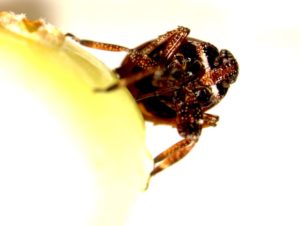
Cranberry toad bugs (Figure 1) should be the last insect pest of concern this season. Growers should start monitoring for this insect from now until the end of July.
Cranberry Toad Bug

Figure 1. Toad bug nymph. Photo by Elvira de Lange

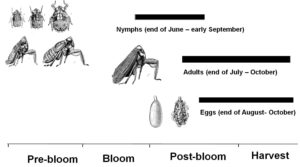
Life cycle. Toad bugs, Phylloscelis rubra (Hemiptera, Dictyopharidae), feed only on cranberries. This insect has a single generation per year. It overwinters as eggs. The nymphs appear by the end of June through early September; nymphal abundance peaks between last week in July and 1st week in August (Figure 2). The adults emerge from end of July through October (harvest) and eggs are laid from end of August through October (Figure 2). Figure 3 shows seasonal abundance of toad bug nymphs and adults in New Jersey cranberries based on sweep net samples.
Toad bug life cycle

Figure 2. Toad bug life cycle

Injury. Feeding injury can be noticed in two stages. First stage feeding injury on vines causes closing in (towards the branch) of the leaves on the new growth. Second stage feeding causes changed in color (reddish to brown) of new growth (Figure 4). The injury can be seen from July until harvest. This injury will cause dying of the branch and the berries to shrivel up (Figure 4). Heavy infestation will result in dwarfed berries.
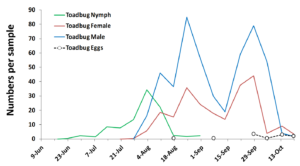
Seasonal abundance of toad bugs

Figure 3. Seasonal abundance of toad bugs in cranberry bogs
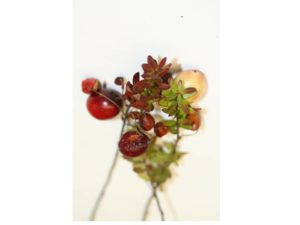
Toad bug injury

Figure 4. Toad bug injury to cranberries

Management. To determine infestation levels, lightly sweep problematic beds (bugs should be easy to catch in sweep nets as they are very active). There is currently no threshold established. Thus, insecticide applications should be based on the relative number of bugs per sweep compared with other sites and previous history of infestation. Currently, growers can use the following control options: Sevin 4F (carbamate), Diazinon, Imidan 70W (organophosphates), Actara or Assail 30SG (neonicotinoids). If infestation is high, treatments should be applied before the 1st week of August.
Post-Pollination Insect Control

If needed, post-pollination sprays (particularly for Sparganothis fruitworm and spotted fireworm) should be applied as soon as bees are removed; ideally before 11 July. Sparganothis fruitworm is monitored with pheromone traps to assess adult flight pattern and their abundance. If you had high trap counts of this pest and have not used an insecticide treatment yet you should consider treating soon to prevent damage to berries. Your post-pollination options include Diazinon, Exirel, Altacor, or Delegate.

Root-feeding insects and use of Imidacloprid

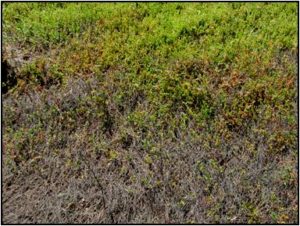
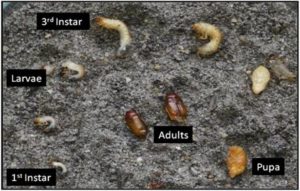
If your cranberry beds have damage caused by root feeding insects, you should consider treatment with imidacloprid (Admire Pro and other generics) immediately after bees are removed (mid-July). Dead plant patches indicate the presence of root-feeding insects (Figure 1). Pull dead vines and search through the root zone and soil for grubs. Imidacloprid is labeled for the control of rootworm, root grub (Phyllophaga spp.) (Figure 2), and other scarabs in cranberries. This insecticide is a contact and stomach poison that affects the insect nervous system. It is highly systemic and toxic to honey bees; therefore, can be used only as a post-pollination insecticide. This insecticide can be applied by ground or by chemigation. Aerial application of this product is prohibited. Admire Pro has a long residual activity (> 100 days) as long as the insecticide is not directly exposed to the sun and can be used at 7-14 fl oz/acre. A maximum of 14 fl oz of Admire Pro can be used per acre per season. Irrigate target area with 0.1 to 0.3 inches before and after the application of imidacloprid. The pre-harvest interval is 30 days. Most scarab grubs in cranberries have multi-year life cycles; consequently, you may not be able to suppress a population of 2- and 3-year life cycle grubs with a single application. You may have to use imidacloprid two to three years in a row for most effective suppression. For this reason, it is useful to know what species you have before using imidacloprid. See “Cranberry Insects of the Northeast” (authors: Averill and Sylvia) for information on how to identify common grub species in cranberries.

Damage caused by Phyllophaga grubs

Figure 1. Damage caused by Phyllophaga grubs

Phyllophaga grubs

Figure 2. Phyllophaga grubs

Sparganothis Fruitworm Degree-Day Update: as of July 01, 2020

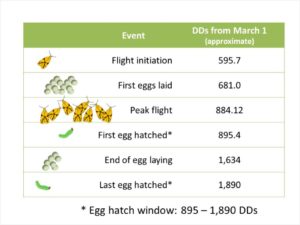
Based on our degree-day (DD) model for Sparganothis fruitworm, first eggs hatched at about 895 DD (see chart). As of July 01, Sparganothis has accumulated 979 DD (using April15 as biofix). This indicates that eggs have started to hatch, and fruit will become susceptible to infestation. Most beds are close to the end of bloom. Thus, if trap counts have been high, then a post-bloom application might be necessary. Growers should consider treatment early next week (as soon as bees are removed) to prevent damage to berries. Optimal control will be achieved if insecticides are applied before 07 July. Your best post-bloom options are Diazinon, Exirel, Altacor, or Delegate.

Sparganothis fruitworm degree-day model

Sparganothis fruitworm degree-day model

Sparganothis Fruitworm Degree-Day Update: as of June 18, 2020

Based on our degree-day (DD) model for Sparganothis fruitworm, flight initiation and first eggs laid events are expected at around 596 and 681 DD, respectively (see chart). As of June 18, Sparganothis has accumulated 661 DD (using April 15 as biofix; a biofix more realistic to New Jersey practices). Based on the April 15 biofix, flight has been initiated and eggs should start to be laid soon. However, we do not expect peak flight and those eggs to start hatching until the end of next week. Larval injury to fruit usually begins after the eggs hatch. If treatment is required (based on pheromone trap counts), sprays should be done 10-14 days after peak moth captures, ca. 7-11 July. If Sparganothis pressure has been high, it may be advisable to treat 3 weeks after the moth flight began (i.e., around 1-4 July) and again 10 days later. When bees are present your option is to use an insect growth regulator such as Confirm or Intrepid. Our “standard” recommendation has been, however, to wait until bees are removed to apply an insecticide. Your post-bloom options include Diazinon, Altacor, Delegate, Exirel, or Intrepid. Timing of insecticide application is critical; so, if needed, do not wait too long to manage this pest. I will continue to provide weekly updates to see if these estimated dates change as the season progresses.

Sparganothis fruitworm degree-day model

Sparganothis fruitworm degree-day model

2020 Cranberry Growers Twilight Meeting

Topic: 2020 Cranberry Growers Twilight Meeting
Host: Cesar Rodriguez-Saona <CRodriguez@RCE.Rutgers.edu>
Webex Host: Patricia D. Hastings
Date: Tuesday, June 23, 2020
Time: 5:45 pm, Eastern Daylight Time (New York, GMT-04:00)
Session number: Not Available
Registration password: Please obtain your session password from your host.

Agenda

5:45-6:00 PM Verification ID for registrants getting pesticide credits

6:00-6:20 PM “2020 Weed Management Updates for New Jersey Cranberries”
Dr. Thierry Besancon, Assistant Extension Specialist, Weed Science

6:20-6:35 PM “Cranberry Hybrids: their Nutrition and Crop Potential”
Dr. Nicholi Vorsa, Professor and Director, Rutgers P.E, Marucci Center
Dr. Jennifer Johnson-Cicalese, Research Associate

6:35-6:55 PM “Scouting and Managing Summer Diseases in Cranberry”
Dr. Peter Oudemans, Professor Blueberry/Cranberry Pathology

6:55-7:10 PM “Non-fungal Diseases of Cranberry”
Dr. James Polashock, Research Plant Pathologist, USDA-ARS

7:10-7:30 PM “2020 Cranberry Insect Pest Management – An Update”
Dr. Cesar Rodriguez-Saona, Extension Specialist, Entomology

7:30-8:00 PM “2020 Revisions to the New Jersey Pesticide Regulations”
Patricia Hastings, Pesticide Safety Education Program Coordinator, Rutgers NJAES

——————————————————-
To register for this session
——————————————————-
Go to https://rutgers.webex.com/rutgers/k2/j.php?MTID=t30838a4d3eac637397cb4b8b935d6418 and register.

Once the host approves your registration, you will receive a confirmation email with instructions for joining the session.

Note: If you have already registered for this session, you do not need to register again.

——————————————————-
For assistance
——————————————————-
You can contact Patricia D. Hastings at:
hastings@njaes.rutgers.edu
1-848-932-0176

https://www.webex.com

Considerations for Managing Blunt-nosed Leafhoppers in Cranberries

Blunt-nosed leafhoppers (BNLH) continue to be an increasing threat to cranberries in NJ. This insect pest has also the potential to affect other cranberry-producing states. Here I put together some guidelines to consider when managing BNLH in cranberries:

1. A challenge for managing BNLH is the fact that they vector a phytoplasma that causes false blossom disease. For this reason it is difficult to establish economic thresholds for this pest because we don’t know the proportion of individuals that are infected in the population. Moreover, this proportion can vary depending on the variety. For instance, we have observed higher incidence of infection in the newer varieties even when populations of leafhoppers are low.

2. As an IPM practice, we recommend to monitor BNLH populations before bloom using a sweep net.

3. If BNLH populations are increasing compared to previous years and the beds have not been treated for BNLH for 2-3 years, growers should consider treatment.

4. If growers have treated for BNLH in the previous year and populations are low (average of less than 10-20 BNLH per sweep set), there is no need to treat again. Keep a record of the BNLH numbers and check those same beds again the following year to see if the numbers have increased.

5. In most cases, there is no need to apply broad-spectrum insecticides (organophosphates, carbamates) to control BNLH for two or more consecutive years. These insecticides will disrupt the biological control of other pests such as Sparganothis fruitworm and therefore cause increases in insecticide use.

6. If treatment is necessary, we have limited options to manage BNLH. The best timing for insecticide treatment is before bloom to target the young nymphs. We recommend the use of organophosphates such as Lorsban (chlorpyrifos) and Diazinon (diazinon), and carbamates like Sevin (carbaryl). The neonicotinoid Assail (acetamiprid) also works well against nymphs but we do not recommend the use of neonicotinoids before bloom due to potential negative effects on bees-neonicotinoids are systemic insecticides that can accumulate in the pollen and nectar. A new registered insecticide, Closer (sulfoxaflor), is also effective against BNLH nymphs. Although Closer has a similar mode of action as the neonicotinoids, it belongs to a different class of insecticides. Closer use is prohibited during bloom (between 3 days prior to bloom and until after petal fall). Ocean Spray growers need to check restrictions on use of these insecticides prior to application.

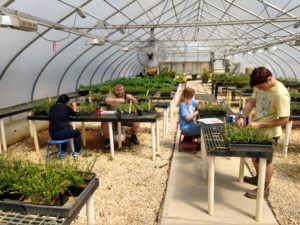
7. Last year, we (in collaboration with James Polashock, USDA-ARS) tested whether we could increase the cranberry’s own immune defenses to combat disease infection. In greenhouse studies (Fig. 1), we treated phytoplasma-infected cranberries with commercial products that elicit defenses in plants against diseases. Unfortunately, these treatments were unsuccessful at reducing the phytoplasma and, even worse, they made the cranberries more susceptible to BNLH and caterpillars.

Greenhouse

Fig. 1. Greenhouse study on the effects of elicitors of plant defenses on cranberry-phytoplasma-insect interactions

8. We have observed that phytoplasma infection makes the cranberry root system weaker. Thus, applying stresses to infected cranberries such as sanding or herbicides could prevent them from growing and potentially cause their death. Greenhouse and field studies in collaboration with Thierry Besancon (Rutgers U.), James Polashock (USDA-ARS), Dan Schiffhauer and Lindsay Wells-Hansen (Ocean Spray) are underway to test this concept.