Fruit Crops Edition - Blueberry Section

Seasonal updates on diseases, insects, weeds impacting small fruit (blueberry, cranberry, and wine grape). Fruit Pest Alerts are also available via this category feed.
 
Subscription is through the general Fruit feed available via EMAIL and RSS.

Controlling Emerged Marestail in Blueberry

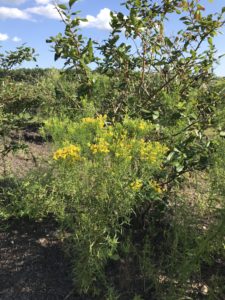
In spring, one of the first weeds that will break through the residual herbicide coverage provided by preemergence applications is horseweed, aka marestail. Horseweed has two primary periods of emergence, from late March through June and from late summer through late fall. Some of the most problematic horseweed emerges in the fall and over winters as small rosettes. If growers don’t control it with fall-applied residual herbicides, the weed has an excellent head start on the spring growing season, especially after a mild winter. Horseweed plants remain in the rosette stage through mid-April, followed by stem elongation (bolting) and rapid growth to an height of 3 to 6 feet. Plants that emerge the previous fall will bolt earlier than spring-emerging plants. Horseweed is most easily controlled when in the seedling, or rosette stage, and spring postemergence herbicides should be applied before stem elongation.


Treating them early is the key to success. Control of horseweed when its 2 to 4 inches is more likely than when it’s over 10 inches tall. Remember, most of the horseweed in New Jersey is resistant to glyphosate and there is a good probability that our populations are also resistant to ALS herbicides such as halosulfuron (active ingredient in Sandea) or rimsulfuron (active ingredient in Matrix). So, the most consistent options to control emerged horseweed include paraquat, clopyralid or glufosinate applied to small plants.

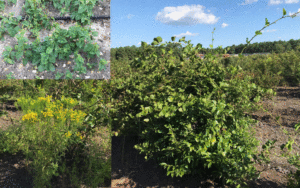
Paraquat – Use 2.4 to 4.0 pints/A of Gramoxone SL 2.0. Gramoxone is a contact killer that has no translocation or residual activity. So, best results will be achieved when seedlings are less than 1 inch in diameter. Two applications, two weeks apart are more effective than a single application. Regrowth may occur from the root systems of established weeds. Always use a nonionic surfactant (0.25% v/v) to improve the weed leaf surface in contact with the herbicide and enhance weed control. Do not allow spray or drift to contact green bark, leaves, or fruit as crop damage may result as shown on the picture.  As Gramoxone targets the plant photosystem apparatus, applications made at sunset will increase weed control efficiency by allowing more herbicide to penetrate before being activated by sunlight in the morning.

DANGER: Do not breathe spray mist. Read safety precautions on the label.


Clopyralid – Use Stinger at 3 to 4 fl oz/A of. Stinger has a 24(c) Special Local Need label for weed control in blueberry since 2013. Stinger acts as both a postemergence foliar absorbed herbicide and a residual herbicide.  The initial twisting and curling observed after  application to susceptible species is due to the foliar absorption.  Do not apply Stinger from one week prior to bloom until one week after bloom. Stinger can eventually be tank-mixed with Gramoxone to increase the spectrum of weeds controlled and defoliate existing foliage of perennial asters, goldenrod species and mugwort.  Donot allow spray or drift to contact green bark, leaves, or fruit as crop damage may result as shown on the picture. Time all applications to maintain a 30-day PHI (PreHarvest Interval). Do NOT apply Stinger in a hand-held sprayer used to “spray until wet”.  Stinger is a residual herbicide that must be applied on a rate per acre basis with a precisely calibrated sprayer. Read safety precautions on the label.

Glufosinate – Use Rely 280 at 48 to 56 fl oz/A. Rely is a foliar active, nonselective herbicide that controls a broad spectrum of emerged annual and perennial weeds. Best results are obtained when it is applied to actively growing weeds. Glufosinate does not provide residual weed control but can be tank mixed with residual herbicides for broad spectrum control. Contact of Rely with parts other than mature callused brown bark will result in extremely severe damages to the blueberry bush. Do not apply within 14 days of harvest. Warm temperature, high humidity, and bright sunlight will improve the performance of Rely. Read safety precautions on the label.

Checking Your Pesticide Recertification Credits and Course History

Roberta Lang is the Ag Resource Specialist at the NJ Dept of Agriculture who arranges the pesticide container recycling program. She reports there was a request at the Hammonton collection last Friday to provide the link to DEP’s pesticide control program where applicators can check the status of their credits and the courses that have been taken. I’ve also had recent calls from growers requesting this and it takes some searching to find it. Below are the instructions Roberta sent. You might want to bookmark whichever site below gets to the information you need most directly.

To review course history:

DEP and NJDA Extend Allowance of Controlled Open Burns to Protect Crops from Frost Threats

(17/P23) TRENTON – With the state expected to experience more freezing temperatures tonight and Thursday night, the Department of Environmental Protection and Department of Agriculture will again allow farmers to do controlled open burning or use specialized torches known as smudge pots to protect flowering crops from damage.

The two agencies previously authorized precautionary and voluntary use of smudge pots on March 10 due to below-freezing temperatures forecast through that weekend.

Temperatures are expected to drop to the low 20s tonight and Thursday night through most of the state. The expected freeze follows unusually warm temperatures in recent weeks that coaxed some economically important fruit tree crops to bud much earlier than normal.

Peach, blueberry and apple crops are particularly susceptible. Damage from freezing weather now can significantly reduce yields of these crops later in the season. There are concerns in particular about early varieties of peaches that are at a stage where buds are about to flower. [Read more…]

“In-Row” Control of Annual Weeds in Established Blueberries with Residual Herbicides

The program for the control of annual weeds in blueberries should consider the weed free strip under the row and the row-middles, sodded or tilled, separately. The “Weed Control Season” in blueberries starts in late fall.  The program implemented in the spring depends on what herbicides were applied the previous fall.  If herbicides were applied in late fall, applications may be able to be delayed until later in the spring.  Residual herbicides should be applied before bud break in late winter or early spring after the soil is no longer frozen if no late fall treatment was applied.

Winter annual weeds germinate in the fall or late winter, flower in the spring or early summer, then die.  Summer annuals germinate in the spring and early summer, flower, and die in late summer or fall.  Perennial weeds are weed species that live for more than two years.  Control of these weeds must be considered separately.

Emerged annual weeds under the row are controlled with a postemergence herbicide.  Annual weeds that germinate throughout the remainder of the season are controlled with residual herbicides.  Two applications of postemergence herbicide plus residual herbicides are recommended annually in the weed free strip under the row.

  1. The first application should be applied in late fall, after the blueberries are dormant, but before the soil freezes, or in late winter before the buds break in the spring.  This application targets the control of winter annuals and provides early season control of summer annual weeds.  The fall can be a less busy time to apply herbicides to the fields, usually after Thanksgiving in New Jersey.  In March, growers find themselves scrambling to apply insecticides and fungicides, and prune.  Pruned branches must be removed or chopped before weed spraying can be accomplished after pruning.
  2. The second application of residual herbicides should be applied before bloom or later spring, depending on the herbicides to be applied.  A postemergence herbicide may not be needed to control annual weeds in the spring if residual herbicides were applied in late fall. However, a postemergence herbicide may be included to control certain perennial weeds such as yellow nutsedge, Canada thistle, goldenrod species, or aster species.

Most residual herbicides primarily control annual grasses or annual broadleaf weeds (BLWs).  A combination of an annual grass herbicide and an annual BLW herbicide is usually recommended.  Rate ranges are recommended for most residual herbicides and will depend on soil type and organic matter content (see Table 3 in the 2017 Blueberry Weed Control Recommendations for New Jersey).  Use the lower rates in fields with coarse textured (sandy) soil low in organic matter, and the higher rate when soils are fine textured (silt and clay) and have higher organic matter. For efficient weed control, residual herbicides require a clean soil (no weeds, organic mulch or pruning residues) before spraying and need to be activated with a minimum of ½” of rain or irrigation in the week following application.

Casoron (dichlobenil), applied in late fall, followed by a spring application of a residual annual grass herbicide is the most effective residual weed control program recommended.  More different species of weeds are controlled than any other residual herbicide combination available.  Apply 4.0 lb active ingredient Casoron CS (2.7 gallons per acre) or 4.0 to 6.0 lb active ingredient Casoron 4G (100 to 150 lb per acre) in late fall when soil and air temperatures will remain below 50 degrees Fahrenheit until rainfall moves the herbicide into the soil.  The active ingredient in the granular formulation can be lost to volatilization in warm weather.  The Casoron CS formulation is encapsulated, which prevents loss due to volatilization.  Casoron provides annual broadleaf weed control until fall and annual grass control until early summer the next year.  Certain herbaceous perennials, including goldenrod species, aster species, and yellow nutsedge will also be controlled or suppressed by Casoron applied in late fall.  Late winter applications provide less consistent winter annual and perennial weed control.  Apply an additional residual annual grass herbicide in early or late spring to provide late summer annual grass control following the late fall application of Casoron.

If Casoron has not been applied in late fall, choose your residual annual grass herbicide for the coming season before the late fall or late winter herbicide application.  Options include Devrinol (napropamide), Surflan (oryzalin), or Solicam (norflurazon). All three residual annual grass herbicides can be used at the rate of 4.0 lb active ingredient per acre per year.  Apply half the yearly labeled rate, 2.0 lb active ingredient per acre, in the late fall, and the second half, an additional 2.0 lb active ingredient per acre, in the spring, or the full rate in early spring, in no late fall application was applied.

Your residual BLW herbicides should be chosen considering crop safety, effectiveness, and price.  For many years Princep (simazine) was recommended at 1.0 to 2.0 lb active ingredient per acre in the late fall, and Karmex (diuron) was recommended at 1.0 to 2.0 lb active ingredient per acre in the spring.  Both herbicides have been safe, reliable, and cost effective choices for many years, and continue to good options where their use provides good weed control.  Both Princep and Karmex share the same mode of action, inhibition of the light reaction of in photosynthesis.  Unfortunately, triazine resistant weeds (horseweed, common lambsquarters) with cross resistance to urea herbicides are present at some sites.

Where a triazine resistant weed has become established, switch to a BLW herbicide(s) with a different mode of action.  Use Chateau (flumioxazin) at 0.19 to 0.38 lb of active ingredient per acre or Callisto (mesotrione) at 0.094 to 0.19 lb of active ingredient per acre in late fall or late winter.  Chateau and Callisto must be applied before bud break in early spring to avoid crop injury.  Chateau can cause speckling and crinkling the crop’s foliage if spray drift occurs.  The activity of Chateau occurs at the soil surface as sensitive BLW seedlings emerge.  Do not disk, till or otherwise mechanically mix Chateau into the soil after application, or the effectiveness of the herbicide will be reduced or eliminated.  Callisto bleaches foliage white.  Horseweed, also called marestail or stickweed, and common lambsquarters are very sensitive to Callisto both pre and postemergence.  Chateau and Callisto can be used in combination, or either herbicide can be tank- mixed with Princep (simazine) and Karmex (diuron) to improve BLW control.

Sandea (halosulfuron) controls BLWs and yellow nutsedge in blueberries, and has postemergence and residual activity.  Sandea is an ALS inhibitor.  Herbicides with this mode of action rely on a single site of action in susceptible weeds, putting herbicides with this mode of action at high risk for weed resistance development.  Weed resistance to ALS inhibitor herbicides is already present in the New Jersey and the surrounding mid-Atlantic region.  Due to resistance management concerns, Sandea is recommended ONLY for emerged yellow nutsedge control later in spring, but not for residual annual weed control.

Stinger (clopyralid) is a growth regulator herbicide with postemergence and residual activity labeled in New Jersey for use in blueberries to control annual and perennial weeds in the legume and composite plant families.  Legume weeds found in blueberries include vetch and clover species.  Composite weeds targeted include horseweed, dandelion, aster species, goldenrod species, Canada thistle, and mugwort (also called wild chrysanthemum).  Stinger rates and application timing depend on the weed targeted.

When annual weeds have emerged before residual herbicides are applied, a postemergence herbicide should be included in the tank. Potential options include the following herbicides:

  • Gramoxone or other labeled generic paraquat formulations applied at 0.6 to 1.0 lb active ingredient per acre plus nonionic surfactant to be 0.25% of the spray solution will control most of broadleaf and grass seedlings that are 2 inches tall or less. As a contact herbicide, paraquat will not be translocated and regrowth may occur from the root system of established weeds (taller than 2 inches).
  • Roundup and other labeled generic glyphosate products can also be used to control emerged weeds as a spot treatment, and can be especially useful where susceptible perennial weeds are a problem. Take great care when spot treating with Roundup or other glyphosate formulations to never contact the blueberry bush, or serious crop injury could occur. The rate depends on the perennial weed targeted and the glyphosate product used.
  • Rely 280 (glufosinate) is an alternative to glyphosate that is registered for use in blueberries. It is not as fast as Gramoxone, but tends to provide more complete and faster control than glyphosate without the concern for systemic movement in the blueberry bush. Similarly, to glyphosate, do not allow spray to contact desirable foliage or green bark as this would result in serious injury. Consult the label for preemergence herbicides that can be tank mixed to broaden the spectrum of weed control.

Consult the Commercial Production Recommendations for rates and additional information.

Fruit IPM for 8/18/16


Peach:

Oriental Fruit Moth (OFM): Trap counts still show captures above the treatment threshold of 6/trap. Treatments are needed anywhere trap counts exceed 6 males per trap, even at this late stage of the season on any variety that is at least 7-10 days away from harvest. [Read more…]

Fruit IPM for 7/28/16

Peach:

Cat-facing Insects, Tarnished Plant Bug (TPB) and Brown Marmorated Stink Bug (BMSB): BMSB traps show only very low levels of bugs. Where ground cover consists of numerous flowering weeds, TPB population is very high. Up to 37 adults and nymphs per 50 sweeps were seen this past week in northern counties. [Read more…]