Frost Advisory in Effect Monday May 11 through Thursday May 14, 2020.
A frost advisory is in effect for parts of Northern New Jersey for the nights of Monday May 11, Tuesday May 12, and Wednesday May 13 with temperatures at or below freezing predicted. Please take appropriate measures to protect tree fruit, grapes, strawberries and other small fruit.
Below are resources for determining the critical temperatures for tree and small fruit. Note that the critical temperature for damage at a particular bud stage may vary by 4 or 5⁰F depending on temperatures during the previous few days before the cold event.
Tree Fruit
Please note the PPA post from May 6, 2020 “Frost Protection in Orchards – What Should You Monitor?“
Note the critical temperature for some of the most common pome and stone fruit crops In New Jersey is available at:
https://www.canr.msu.edu/news/critical_spring_temperatures_for_tree_fruit_bud_stages.
Additional information on frost protection methods is available at:
Small Fruit
Frost and Freeze Damage on Berry Crops
Kathy Demchak Senior Extension Associate Penn State University
Here is a review of critical temperatures for damage to berry crops, symptoms of the damage, and some key points regarding protecting plants.
Critical Temperatures for Blossoms
Damage to blossoms is the biggest concern; critical temperatures are those at which you can expect damage to occur. Air temperature close to the ground is often much colder (as much as 5°F) than the low temperature reached at the typical eye-level height where we usually post our thermometers, and if your field is in a low spot, may be even colder. We also need to factor in the fact that the blossoms radiate heat into the sky (called radiational cooling), much like your vehicle roof that may have frost on it on the mornings when the low temperature didn’t reach freezing. Of course, low temperatures in any out-of-town rural location are often quite a lot lower than those forecasts; some growers subscribe to services that forecast more accurately for their specific location.
Critical temperatures for strawberry blossoms
For strawberries, critical temperatures for flower buds are 10° when just emerging from the crown, 22° when blossoms are emerged but still tightly closed, 26° when closed but petals are visible (“popcorn” stage), and 30° when open. Young green fruit is actually better able to tolerate cold temperatures than open blossoms, having a critical temperature of 28°. Some recommend actually inserting a thermocouple into the flower buds to most accurately measure their temperatures. Just propping up a thermometer at the end of the row so it’s exposed to air on all sides and radiates heat like a blossom would have mirrored the temperatures at which we get damage quite well. Frost-damaged blossoms will have a black center.
Critical temperatures for blueberry
Blueberry blossoms can tolerate colder temperatures than strawberry blossoms. Different sources give somewhat different values for certain stages, so ranges are given here. Critical temperatures are 15-20° at bud swell; 18-23° when flower clusters are still tight; 22-25° when flowers buds in the cluster have separated; 25-26° when flowers are still closed but full-size; and 27° for open blossoms. The stage where the petals have just fallen off is actually the most tender, with a critical temperature of 28°. Petals will turn brown if damaged, and fruit tissue inside the blossom will have a water-soaked appearance.
Critical temperatures for raspberry blossoms
We never used to mention frost damage on raspberries as a possibility, since raspberries typically bloom so late that we are usually past danger of frost by the time they bloom. However, in two out of the past ten years, we had frost damage to open raspberry blossoms; this occurred when temperatures were barely below freezing, which makes me think that the critical temperature is in the 30-32° range. Frost damaged blossoms on raspberries turn black in their center, but this is a little less obvious than on strawberries because the anthers extend beyond the damaged portion.
Frost Protection Methods
For berry crops, frost protection methods consist of either applying water with overhead irrigation or using row covers, or a combination of the two. Other methods such as wind machines and under-canopy irrigation don’t typically provide enough protection for berries or can’t be used due to plant architecture.
Frost protection using overhead irrigation
The theory behind why overhead irrigation works for frost protection is that heat is released as the water freezes (144 BTUs per pound of water), so the blossom temperature stays at 32°. The water application rate must be sufficient to keep a layer of liquid water on the ice that is forming, and coverage must be fairly even. If water completely freezes before additional water is applied by the next sprinkler rotation, heat is no longer being released by the freezing process.
This means that blossom temperatures can drop to ambient air temperature instead of being kept at 32°. When coverage is uneven or it is windy (more than about 3 mph), the application pattern is uneven, and you have more heat loss from evaporation than usual, so you are likely to have more damage than if you had done nothing at all. Irrigation should be kept running in the morning until ice starts to melt from the plants.
Frost protection using overhead irrigation
The theory behind why overhead irrigation works for frost protection is that heat is released as the water freezes (144 BTUs per pound of water), so the blossom temperature stays at 32°. The water application rate must be sufficient to keep a layer of liquid water on the ice that is forming, and coverage must be fairly even. If water completely freezes before additional water is applied by the next sprinkler rotation, heat is no longer being released by the freezing process.
This means that blossom temperatures can drop to ambient air temperature instead of being kept at 32°. When coverage is uneven or it is windy (more than about 3 mph), the application pattern is uneven, and you have more heat loss from evaporation than usual, so you are likely to have more damage than if you had done nothing at all. Irrigation should be kept running in the morning until ice starts to melt from the plants.
Keep in mind that you will need to allow time for the irrigation system to fully wet the plants, and there will be evaporation from the water than will lower the plant temperature at first; for this reason, we generally recommend starting the irrigation when the air temperature is 4° above the critical temperature. Of course, if the low temperature is forecasted to occur very late in the overnight hours and is close to the critical temperature, you will need to judge whether it is worth starting irrigation up or not.
Frost protection using row covers
Row covers can be effective, but they work best on still nights and when you only need 3 or 4° of frost protection. A row cover that is fairly stiff so it doesn’t cling to the plants and ground and maintains some air space works best; clingy ones may not provide much protection. There is one particular 1.25 oz/sq. yd. fabric that works well. It is more expensive than others but has a long field life, so it can be used for multiple seasons and is less expensive in the long run.
Row covers should be pulled over the field during the afternoon to allow some heat buildup under the cover. If it is windy, protection will be less, and if winds are over 5 mph or so, you may not get any protection at all. If you have an old row cover, it can be applied as a second layer underneath the newer cover – this helps on very cold nights and also helps to some degree on windy nights.
Recently there have been some questions regarding whether anthracnose can survive on row covers. One study showed that spores can survive on fabric (in the study’s case, denim) for 5 weeks. However, typically row covers aren’t still being used when anthracnose lesions are present in PA, but if they are, this may be a concern.
Overhead irrigation – row cover combination
We have had very good results with pulling on row covers and then irrigating over top of them for frost protection. Depending on the night, this has resulted in needing no overhead irrigation at all or delaying the time that we needed to start the irrigation since the temperature under the row cover is higher than the outside temperature, and water use is greatly decreased. You’ll want to pull the row covers back off as soon as you can the next day though to allow the plants to dry, otherwise, it will likely get steamy under the row cover, increasing the possibility of disease issues.
Frost Damage to Vegetative Tissues
Vegetation on small fruit crops is quite hardy in the spring. New vigorously growing raspberry canes can get “nipped” however, sometimes seriously. I can think of two instances when this happened with ours. Once was about 20 years ago when we hit 16° in mid-April when the new canes were about a foot tall, and the second time was about in 2012 when raspberries in our high tunnels had grown to about a foot and then got nailed. Fortunately, these canes are replaced by new canes, so the damage wasn’t devastating for the long haul. The damage, if not noticed could be mistaken for some sort of disease, but the difference is that the plants grow vigorously otherwise, and the damage is all at the same location on the plants throughout the planting.
For more detailed information go to Appendix A of Mid Atlantic Berry Guide Guide
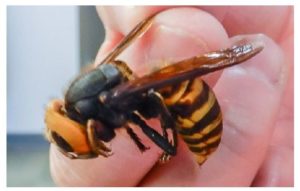
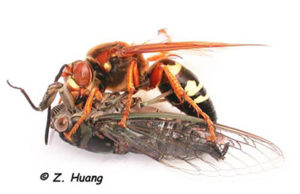 wasps found throughout the U.S. and burrow holes in the soil. Even with their large size, dangerous appearance and “dive-bombing” habit, adult Cicada killer wasps rarely come in contact with people and it is rare they will sting. The males of this species will make “dive-bombing” flight patterns, but do not have a stinger and an attack would not result in a sting. The female’s tubular egg-laying structure on the rear end can function as a very weak stinger. Her mild sting is similar to a slight pin scratch and is not considered by most people to be painful. Rutgers Cooperative Extension has more information on the