Commercial Ag Updates + Farm Food Safety

Rutgers Cooperative Extension Ag Agents provide updates on what they see in the field, upcoming events, and other important news that affects your operation, such as developments in on-farm Food Safety. Subscribe if you wish to be notified about workshops, meetings, and upcoming commercial ag events.
 
Subscriptions are available via EMAIL and RSS.

September 10 RCE Field Crop Twilight Meeting

Commercial Growers, Crop Consultants, and Ag Industry personnel
are invited to attend a RCE Field Crop Twilight Meeting

Date: Sep 10th, 5PM – Dusk
Location: Rutgers Snyder Research and Extension Farm, Pittstown, NJ
Please RSVP by 9/6/13 to (908) 788-1339

Dinner 5:00PM
Wagon Tour:
Stop 1: 67 Full season soybean varieties; evaluating soybean resistance to white mold
Stop 2: Double crop soybean variety trial following canola evaluating 65 soybean varieties resistance to white mold
Stop 3: Field corn variety study evaluating different fertilizer treatments
Stop 4: Field corn trial comparing different liming agents
Stop 5: Irrigation pond management
Stop 6: Agronomic production issues for corn mazes
RCE Field Crop Twilight Meeting

Commercial Growers, Crop Consultants, and Ag Industry personnel
are invited to attend a RCE Field Crop Twilight Meeting

Date: Sep 10th, 5PM – Dusk
Location: Rutgers Snyder Research and Extension Farm, Pittstown, NJ
Please RSVP by 9/6/13 to (908) 788-1339

Dinner 5:00PM
Wagon Tour:
Stop 1: 67 Full season soybean varieties; evaluating soybean resistance to white mold
Stop 2: Double crop soybean variety trial following canola evaluating 65 soybean varieties resistance to white mold
Stop 3: Field corn variety study evaluating different fertilizer treatments
Stop 4: Field corn trial comparing different liming agents
Stop 5: Irrigation pond management
Stop 6: Agronomic production issues for corn mazes

Late Season Palmer Amaranth Management

A number of calls have come in about Palmer amaranth in soybeans and what can be done. First of all, if the plants have been sprayed with glyphosate and they did not die, then they are likely to be glyphosate-resistant and spraying more glyphosate will not kill them. Products like Pursuit or Reflex will not control Palmer amaranth plants larger than 5 to 6 inches. Options are limited to Gramoxone, handweeding, or mowing.

After corn harvest, some fields may need to be mowed or sprayed with Gramoxone to prevent late-season seed production.

Late-season management of Palmer amaranth to reduce or prevent seed production is not easy or convenient, but it will pay dividends in the future. Removing the plants prior to harvest will reduce the spread of the seed within the field and from field to field. If a single plant can produce 500,000 seeds; spread over an acre that is 10 seeds per square foot. You can quickly see how eliminating seed production and preventing the spread of seed with equipment is a tremendous help.

Kudza Bug Getting Closer to NJ

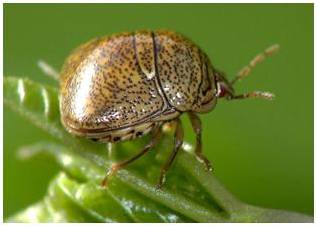
Adult Kudza Bug - Soybean Pest

Adult Kudza Bug – Soybean Pest

You may have read in different farming publications about the presence of bean platasipid (Megacopta cribraria), or more commonly the kudzu bug, in the southeastern US.
It is referred to as the kudzu bug because it has a tendency to feed on kudzu. This is not necessarily a bad thing in the south where kudzu is an exotic invasive species.

In the southeastern US kudzu bug has become a concern because it is also a pest of soybeans. This stink bug species is smaller than brown marmorated stink bug and has a different shape. Like brown marmorated stink bug it also can overwinter in homes.

This stink bug species was discovered in Georgia in 2009 and has since spread through out the southeast and is heading north. The kudzu bug has most recently been found in Sussex County Delaware. It has also been found in Maryland in Prince George, Charles, Calvert, and Anne Arundel counties. As kudzu bug is a soybean pest we need to keep a watchful eye for it here in New Jersey.

Grasshopper Reports

Over the past few days I have received several reports of large grasshopper populations in several soybean fields.

Initially, grasshoppers tend to occur along field edges and areas near drainage ditches. No economic damage has been reported due to grasshoppers yet, but consider this an early warning to scout fields. There are no good thresholds established for grasshoppers in corn or soybeans. Generally, consider treatment in pre-bloom soybeans if grasshoppers are present and 40% or more defoliation is encountered. When in the pod forming and pod filling stages treatment is recommended with 20% or more defoliation.

Wheat Harvest and Storage

Wheat is being harvested, or is ready to be harvested, in a good portion of the state, but high temperatures, high humidity and predicted rain showers daily for the next week have the potential to cause problems.

Where large amounts of rain fall, getting combines into the field may be difficult. Where fields are passable, grain may be mature but high in moisture. It is important to get wheat out of the field quickly after the kernals have matured to avoid loss of yield, reduced quality and ultimately sprouting in the heads. Combines operate most efficiently and with less kernal damage when grain moisture is between 13-20%. If wheat is harvested much above 14% it needs to be dried relatively quickly to prevent sprouting in storage. Wheat is harder to dry than corn because of the high humidity this time of the year and because it packs tighter than corn thus grain depths in the bin need to shallower or fan speeds/volumes greater.

The following links to publications from Purdue University and the University of Missouri may be useful if the current weather conditions persist and problems are encountered.