Are Your Produce Buyers Talking about Third-Party Audits?

An increasing number of farms are being asked by their wholesale produce customers to comply with a third-party audit.  What do you need to know if a buyer asks you to have a third-Baskets of tomatoesparty audit?
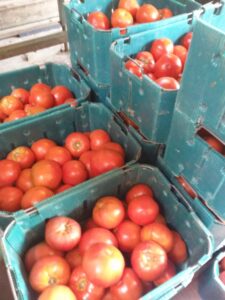
Who would ask for a third-party audit? Current buyers of your product may notify you that you need a third-party audit in order for them to continue to purchase your product. Or a prospective buyer may tell you that in order to start purchasing your product you will need to pass a third-party audit.

What is a third-party audit? A third-party audit is an assessment of your production practices in compliance with a set of produce safety standards.  Requirements include educational training in produce safety, a written food safety plan (including written policies, standard operating procedures, documentation of activities, and records) specific to your operation that meet the standards of the audit your buyer requires. A third-party audit is conducted by an audit firm or outside agency.  The audit can take from several hours to several days based on your operation. The farm pays the audit fees and receives a certificate of compliance, the audit is required annually. Farms may have multiple buyers who require different audits, resulting in multiple audits annually.

Who conducts third-party audits? Auditing firms that buyers may rely on: USDA GAP, USDA Harmonized, Primus, Global GAP, BRC, SQF, etc. In New Jersey USDA audits are conducted by the New Jersey Department of Agriculture Division of Marketing and Development.

What questions should you ask of the buyer?
– What audit firm are they requiring you to use?
– What commodities do they require the audit to cover?
– When do they require you to have the audit completed?
– What type of training is required of the farm and how often is required?

Third-party audits should not be confused with the Food Safety Modernization Act Produce Safety Rule, a federal regulation that most growers of produce that is typically consumed raw must comply with.
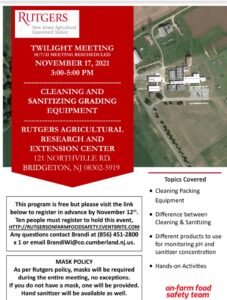

 

Postharvest Equipment Cleaning and Sanitizing Twilight Meeting 11/17/21

The On-Farm Food Safety Team will hold twilight meeting at the Rutgers Agricultural Research and Extension Center in Bridgeton focusing on the cleaning and sanitation of postharvest equipment.

Topics to be covered:
Cleaning Packing Equipment
Difference Between Cleaning & Sanitizing
Sanitary Design of Packing Lines
Different products to use for monitoring pH and sanitizer concentration
Cleaning Harvest Equipment

Who should attend:
Fruit Growers
Vegetable Growers
Others interested in produce safety
Extension Education
Departments of Agriculture

Visit our upcoming trainings website for more information and to register.

Twilight Meeting

Secretary Fisher Message on Vaccine Survey

A message from Secretary Douglas Fisher:

We are reaching out regarding COVID-19 vaccination support for you and your farmworkers. We are working to ensure that all farmworkers are protected against COVID-19 as we head into the fall season – to that end, if any of your workers are not yet vaccinated for COVID-19 and are interested in receiving a vaccine, please fill out this survey. We will be happy to connect you with the appropriate resources to keep your workforce healthy.

Additionally, if your entire workforce has been vaccinated, we would still appreciate if you could please fill out the survey  Any information you provide will be confidential and used solely for supporting COVID-19 vaccination efforts.

Thank you for your support in keeping our farm communities safe and healthy!

Food Safety for Flooded Farms

Flood waters can carry microbial and chemical contaminants that can be harmful to humans.  Food crops should be assessed to determine if they have been affected by flooding surface water sources including rivers, lakes, or streams.  These waters are the highest risk for contaminants.  The biggest question to ask is has the edible portion of the crop been exposed to these waters?  There is no way to ensure that food crops that have come in contact with contaminated flood waters are safe to eat.  Food crops that have been exposed to flood waters should be destroyed so they do not enter market channels.  For more information and guidance on how to handle crops and fields that have been flooded visit the Produce Safety Alliance Food Safety for Flooded Farms resource.

COVID Delta Variant and NJ Agriculture

As the farming season progresses so does concern for the increased prevalence of the COVID Delta variant in the region.  We asked Don Schaffner, Extension Specialist, about the Delta variant and if we should be concerned about it.  If you or your farm workers are in need of a vaccine please email njfarmvax@njaes.rutgers.edu and an Extension team member will assist you with finding local vaccination locations and/or determine if an on-farm vaccine clinic is possible for your workers.  If you have questions about the vaccine visit the Rutgers On-Farm Food Safety Vaccine Education for Growers website for information in multiple languages.

Meredith Melendez: Are we seeing an increase in cases of the COVID Delta variant in New Jersey or the region?

Don Schaffner: Yes. According to CDC, Region 2 (New Jersey, New York, Puerto Rico, and the Virgin Islands) had only 3.1% of all infections due to the Delta variant for the week ending 5/22/21. This percentage had jumped to 17.7% week for the week ending 6/5/21. There are not further updates at this time.

Also according to the CDC in NJ 3.4% all infections were due to the Delta variant for the week ending 5/22/21. No further New Jersey specific updates are available at this time.

MM: How is the Delta variant different than the COVID cases we saw over the past year?

DS: There are a number of reasons why there is increased concern over the Delta variant. Epidemiological data shows that the variant has increased transmissibility (i.e. it is more easily spread from person to person) than the original strain. Estimates indicate that it is about 60% more transmissible. This means that for every one person infected by the original virus, on average for the same conditions the Delta variant would spread to about 1.6 people.

One of the ways of combating the virus once someone is infected is with monoclonal antibody treatments. There is evidence that the Delta variant is more resistant to this important treatment.

There is also evidence that the Delta virus is not as readily neutralized by post-vaccination sera. Sera contain the antibodies in people that are vaccinated.

MM: Are the Pfizer, Moderna, and J&J vaccines as effective against the Delta variant?

DS: Yes.  The Johnson & Johnson vaccine appears to be about 60% effective against the delta variant. The Pfizer and Moderna vaccines are about 88% effective after the second dose (vs. over 90% for other variants). So while the vaccines are less effective against the Delta variant, it is still much better to be vaccinated than not.

MM: Why should someone get vaccinated now if they haven’t already?

DS: Unvaccinated individuals are vulnerable to all variants of the virus. These variants arise through the natural evolution when the virus replicates inside a sick person. Since the vaccines can stop some people from getting infected, the more people that are vaccinated the better control we will have over these variants and stop new variants from evolving.


FSMA Produce Safety Rule Inspections Taking Place on all Covered Farms

Are you a produce farm who has not yet had a FSMA Produce Safety Rule inspection?  Have you received communication from the NJ Department of Agriculture about the Produce Safety Rule?  Smaller size produce operations are currently being inspected by the NJDA for FSMA PSR compliance.  If you have not yet had an inspection you may be subject to one this season.  Here is what you need to know:

If you grow and sell over $25,000 in produce annually you may be subject to the FSMA Produce Safety Rule.  The NJDA will contact your farm to ask several questions to understand if the rule pertains to you.  What crops do you grow?  How much in produce sales do you make on an average year?  What percentage of your sales are made direct to consumer (farm stand, farmers market, CSA, direct to an individual grocery store, direct to an individual restaurant)?  What are your total food sales (including any food for human and/or animal consumption including hay, grain, baked goods, meat, milk, honey, chewing gum, etc.) for an average year? You may have previously answered these questions via a survey that was mailed to you, or over the phone with NJDA staff.

The NJDA is currently scheduling inspections with farms across the state of all sizes.  If you receive a phone call or email from the NJDA about a Produce Safety Inspection date, do not ignore the communication.  The inspection will take place and warning letters can be sent to farms who are not in compliance with the rule.

Have questions about if your farm is exempt or qualified exempt from the rule?  Remember that qualified exempt farms need to prove their exemption status, this can be done by using the qualified exempt review template on page 5 of the recordkeeping guidance from the Produce Safety Alliance.

Farms that need to comply with the rule are required to attend FDA approved training.  The next training in NJ will be held online on September 15th and 16th.  Other online trainings are available from other states, visit the Produce Safety Alliance website for more details.  The approved training covers the Produce Safety Rule requirements and ways of complying with them.