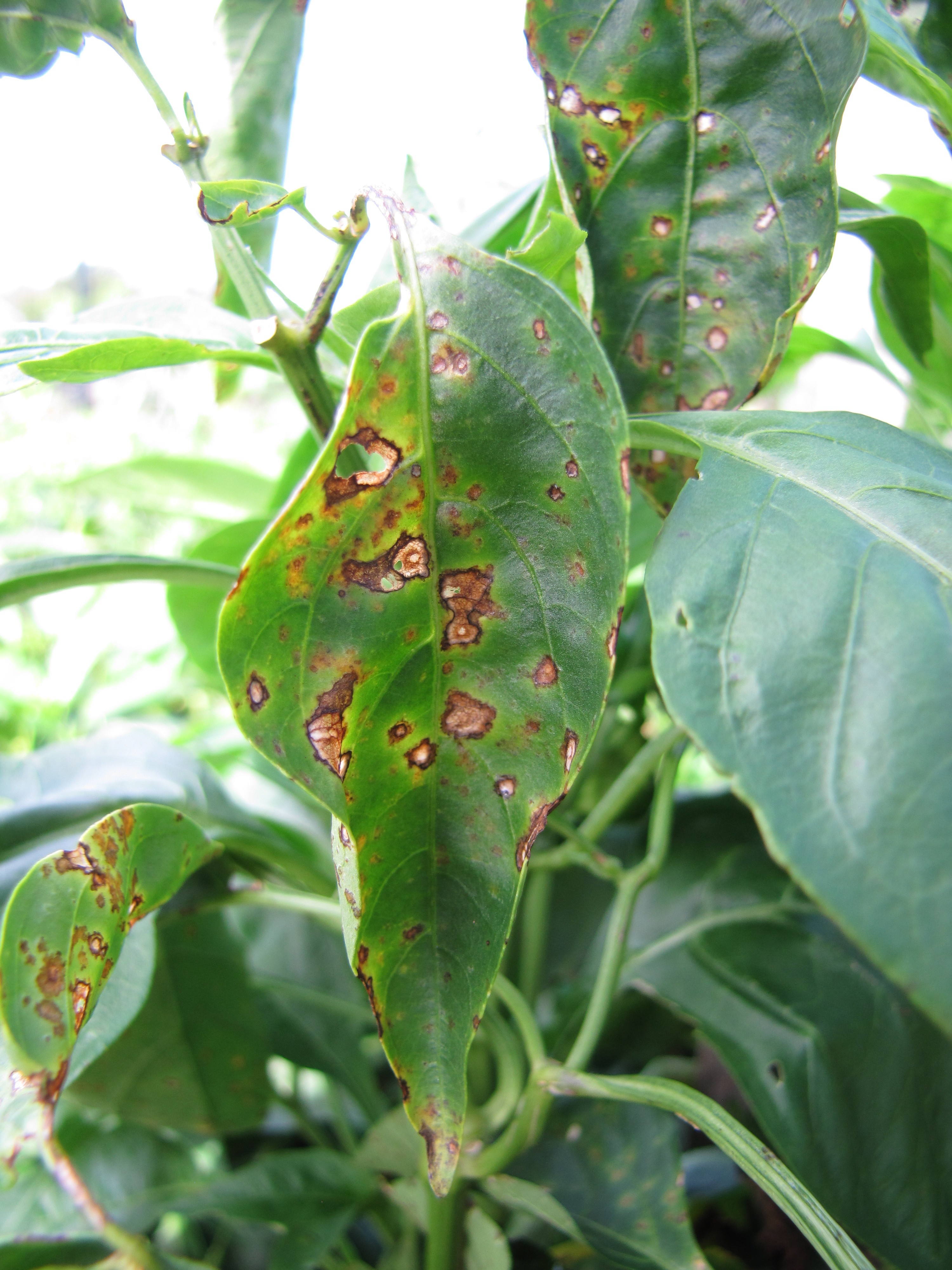
Copper resistance in bacterial leaf spot of tomato and pepper crops has been detected at a high level in New Jersey the past few summers. While not surprising, copper resistance has been known to develop for decades now. Copper applications for the control of bacterial diseases in many crops has been a mainstay for decades now and is often applied in weekly protectant fungicide programs. With help from Dr. Nrupali Patel and Dr. Don Kobayashi, bacteriologists in the Department of Plant Biology located on the New Brunswick campus, a (NJ-VGA funded) survey was initiated to determine which species of bacterial leaf spot are most prevalent in New Jersey tomato and pepper crops. Bacterial leaf spot can be caused by four species of Xanthomonas: X. euvesicatoria, X. vesicatoria, X. perforans, and X. gardneri. Currently, there are four races of BLS found in tomato (T1-T4; one for each of the 4 species stated above) and eleven races found in pepper (0-10). Differential tests in southern New Jersey using various bell pepper lines over the past 15 years has suggested that the number of races of BLS in pepper has increased over time; with all races present in the State to date. Lab testing results from samples collected from the small number of NJ vegetable farms the last three summers has shown the presence of X. euvesicatoria in pepper, as well as X. euvesicatoria and X. perforans in both tomato and pepper in the state, with ~60% of all samples testing positive for copper resistance.
Phytophthora blight control in pepper in 2023
Phytophthora blight typically develops in low-lying areas after a heavy rain and can spread quickly throughout the entire field. Fortunately, New Jersey has been really dry this summer, but that does not need you don’t need to prepare for potential Phytophthora issues down the road. This is particularly important if are in fields with a known history of Phytophthora blight. Although the extended period of dry weather works against Phytophthora development, it does not mean it will not show up eventually. [Read more…]
Identifying and controlling common leaf spot in strawberry
Strawberry leaf spot, caused by the soil-borne fungal pathogen, Mycosphaerella fragariae, can infect leaves, petioles, runners, fruit stalks (pedicels), and berry caps or calyxes. Small, dark purple to reddish-purple, round spots, 1/8 to 1/4 inch in diameter (3 to 6 millimeters), appear on the upper leaf surfaces. The center of the spots soon become tan or gray and eventually almost white, while the broad margins remain dark purple. Later in the season, dark specks (sclerotia and/or perithecia) may be seen in the older lesions. Tannish areas form on the undersides of infected leaves. The symptoms on the other plant parts, except the fruit, are almost identical to those that develop on the upper leaf surface. [Read more…]
Controlling Cercospora leaf spot and in beets in 2023
Cercospora leaf spot (CLS), caused by Cercospora beticola, is an important and emerging disease in beet and swiss chard production in New Jersey. Efforts to control this disease has become more difficult in the past few years in some areas of southern New Jersey. [Read more…]
Cucurbit powdery mildew control in 2023
Cucurbit powdery mildew (CPM), caused by Podosphaera xanthii, is one the most important diseases of cucurbit crops throughout the world. The pathogen is an obligate parasite, just like cucurbit downy mildew, meaning it needs a living host in order to survive. In northern regions that have a killing frost in the fall the pathogen will die out when the crop freezes. Not being able to overwinter, the pathogen must be re-introduced each spring or summer in the mid-Atlantic region. The pathogen accomplishes this by re-infecting cucurbit crops in the spring as they are planted up the east coast starting in Florida, then the Carolina’s, Virginia, and so forth. By late May, as soon as cucurbit crops begin to germinate in the mid-Atlantic region, the potential threat for potential powdery mildew infections begin. [Read more…]
Cucurbit Downy Mildew Alert – Cucumber – 6/11/22
Cucurbit downy mildew has been confirmed on cucumber in southern New Jersey. This is the first report of CDM in the state and region this growing season. All cucumber and cantaloupe growers should scout on a daily basis and initiate a preventative fungicide program. CDM was last confirmed on June 1 on cucumber in central North Carolina and on watermelon on June 9 in south central Georgia. Remember, some CDM isolates fall into Clade I which predominately infect watermelon, pumpkin, and squash, where other CDM isolates in Clade II predominately infect cucumber and cantaloupe.
For more information on CDM, the clades, and CDM control please click here.
Cucurbit downy mildew sporulating on the underside of an infected cucumber leaf.