NE SARE Grants Info Webinar

Join Northeast SARE grants coordinator Carol Delaney for a lunchtime webinar on Friday, October 10th at Noon regarding Farmer Grants and Partnership Grants. Carol will cover topics ranging from the application process, designing a budget, choosing a technical advisor (for farmer grants) and the review process. There will be plenty of time for Q&A. Register online.

This year, Michelle Infante-Casella takes over the reins from Jack Rabin as Northeast SARE coordinator for New Jersey. Visit NE SARE, New Jersey webpage for information on programs and priorities.

Spring Asparagus Production Notes

If you are planting a new field of asparagus or getting ready to harvest emerging spears, here are some thoughts:

Are you planting 1-year old crowns or did you seed cell trays and are going to plant seedlings? Remember, 1 year old crowns are planted and not harvested that year. In the second year, only harvest the field for 2 weeks. The third year you can being harvesting for a 6-8 week period after the crowns mature. If planting seedlings, do not harvest the year of planting or the year after. Then in the 3rd year harvest for 2 weeks, and after 4 years begin the 6-8 week cutting period.

Prolonged harvest seasons that go longer than 8 weeks can stress the plant that could lead to root and crop rot development. In addition to quality decline of fields, drought stress, pest pressure and inadequate fertility can cause poor vigor and yield loss. For more information on commercial asparagus production see the 2014 Commercial Vegetable Production Recommendations fro New Jersey.

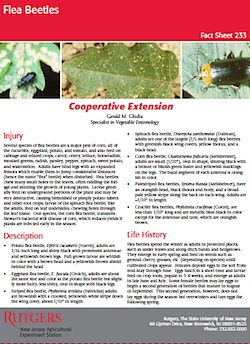
Flea Beetle: One of the First Pests of Spring

Flea beetles are one of the earliest vegetable pests to be seen in crop fields in spring. They attack many vegetable crops grown in New Jersey.

Several species can be found throughout the year, including the cabbage flea beetle, corn flea beetle, crucifer flea beetle, horseradish flea beetle, eggplant flea beetle, palestriped flea beetle, potato flea beetle, spinach flea beetle, striped flea beetle and the sweet potato flea beetle.

They generally have 1-2 generations per year, and overwinter as adults, usually in soil and litter or other protected areas, becoming active in early spring; early April – May in New Jersey. 

Flea beetle adults feed on the leaves, chewing small holes in the foliage. However, when feeding is extensive and the leaves become riddled, the adjacent tissue dies or dehydrates, and the leaf takes on a bronzed or burned appearance. Leaves will die and drop off the plant. Some species, such as the corn flea beetle, can completely skeletonize leaf tissue of seedling corn, often defoliating the plants. The corn flea beetle adult also transmits a disease, Stewart’s bacterial wilt of corn, which can stunt or even kill corn plants infected early in the season. Larvae are generally root feeders, and several species occasionally cause considerable damage to roots and tubers. [Read more…]

Agritourism Risk Management Tools

AgritourismNJAES has a new program dedicated to risk management for Agritourism and Direct Marketing. Risk management tools aimed at addressing the following issues can be found our new Extension Training For Agritourism Development website.

  • Minimizing farm safety risks
  • Managing liability
  • Mitigating financial risk through enterprise budgeting
  • Improving marketing strategies

Educational videos, enterprise budgets, fact sheets and assessment checklists are some of the helpful tools you will find.