Fruit IPM Report May 26, 2025

Peach:

Bacterial Spot: Copper formulations should be used starting at petal fall to suppress bacterial spot. Generally we recommend starting at 0.5 ozs metallic copper and gradually lowering the rate as the season progresses. The rate applied will depend on the formulation. Dr. Lalancette published a chart listing common copper formulations and rates for peach and nectarine applications. Avoid combining copper with captan especially if it has been overcast for several days. Also avoid acidic spray solutions when applying copper. Dr. Lalancette has published a handy guide for copper applications in early covers. Antibiotics containing oxytetracycline may also be used and may offer slightly more residual activity during long wetting periods. We have seen minimal bacterial spot symptoms. We are nearing pit hardening which usually occurs mid-June. Once fruit gets to this stage it develops some resistance to bacterial spot. Infections may still occur but will be less severe.

Oriental Fruit Moth: A biofix point for OFM was set on 4/2 for southern counties and 4/17 in northern counties. All Treatments for the first generation have past.

OFM 2nd Generation Timing
Insecticide Type
County/Region Degree Days by  5/26 base 45 Conventional

1150-1200

1450-1500

Intrepid/Rimon

1050-1150

1300-1400

Diamides/Virus

1075-1150

1375-1450

Gloucester – Southern 796 1st –too far off

2nd – too far off

1st –too far off

2nd – too far off

1st – too far off

2nd – too far off

Middlesex – Northern 662 1st – too far off

2nd – too far off

1st – too far off

2nd – too far off

1st – too far off

2nd – too far off

Green Peach Aphid: We are still observing aphid colonies above threshold at some farm sites. If more than 1 colony of aphids are found in nectarines, or 2-3 colonies are found in peaches, an insecticide for aphids. See the NJ Commercial Tree Fruit Production Guide for recommended materials and rates.

Tarnished Plant Bugs; and Other Catfacing Insects: Catfacing insects are active, and activity will increase with dry weather and summer temperatures. Very little recent fruit feeding has been observed.

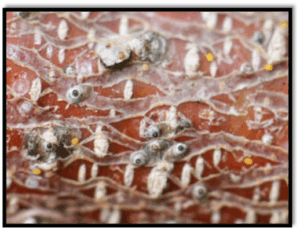
Figure 1. San Jose scale crawlers on peach. Photo by Dave Schmitt.

Scale Insects: White peach scale and San Jose scale crawlers (Figure 1) began emergence this week and will continue emergence for up to 6 weeks. Control options during crawler emergence include neonicotinoids (suppression only), and the IGR’s Esteem and Centaur. See the NJ Commercial Tree Fruit Production Guide and the product labels for more information.

Apples and Pears:

Diseases: Now that primary scab is nearing the end, or has ended, the focus turns toward summer diseases such as fruit rots (esp. Bitter rot), and sooty blotch and fly speck. Bitter rot control has been difficult at best in recent years even where management programs have been rigorous. Research has suggested products such as Merivon, Luna Sensation, Inspire Super, Omega, and Aprovia may be effective, and longtime reliable broad spectrum fungicides such as captan and ziram should provide control. Experience has suggested that the addition of phosphorous acid products such as Prophyt or Rampart to captan sprays may improve control. Observations are that these products improve control of other summer diseases such as sooty blotch and flyspeck, and may help suppress scab infections where present. Scab symptoms are appearing in some orchards statewide.

Fire Blight: Fire Blight symptoms began appearing in southern county apple orchards the week of 5/19 (Figure 2). Typically it is recommended to cut out infected limbs however this is a practical decision that must be made. This blog post from Michigan State may be helpful to decide whether it is worth cutting out infected tissue. Once the terminal buds set, typically in July, infected wood should be removed to prevent colonization by the bitter rot pathogen.

Figure 2. Fire blight strike on apple tree branch. Photo by Karlton Neidigh.

Codling Moth: A Codling Moth Biofix was set in Southern counties on 4/28 and in Northern counties on 4/30. See the NJ Commercial Tree Fruit Production Guide for recommended materials and rates. Where Mating Disruption has been employed, supplemental Madex applications should be made at the timings listed below.

Codling Moth Degree Day Timing
Application and Insecticide Type
County Area Biofix Rimon:

75-100DD + 14-17 days later


Intrepid

150 + 450 DD

Diamides – Altacor, Voliam mixes: (150-200 DD)

Madex

250 DD + every 7-9 days during brood hatch (later if first spray is an IGR)

Standard Insecticides –  Delegate, Avaunt, OP’s, carbamates, pyrethroids

250 DD + 550 DD


DD 75 100 150 450 250 250 550
Southern April 28 past past past May 29 past past too soon to predict
Northern  April 30 past past past too soon to predict past past too soon to predict


Ambrosia Beetle : Infested trees are showing signs of stress. If you have had a history of this pest in your orchard, now is a good time remove and burn any trees that have been attacked as the flight appears to be declining or is over.

Wooly Apple Aphid (WAA); Green Apple (Spirea) Aphids (GAA): GAA colonies are beginning to appear in some apple blocks. GAA is generally a pest that can be tolerated since they do little direct damage. Treatment thresholds for GAA are if 50% of the shoots are infested with no beneficial insects present. WAA aerial colonies are also forming in southern counties. This is about a month earlier than usually observed. In most years these are controlled by beneficials however in some years like 2022, serious outbreaks can occur. The best control for WAA is Movento applied before or when the first colonies appear. Diazinon is also effective at knocking down infestations. Movento will also control GAA and should control San Jose scale when applied in mid-May, and suppress scale when applied in late May or early June.  Do not combine diazinon, oil, or oil based penetrants with Captan.

Potato Leafhoppers (PLH): PLH adults began appearing in apples this past week (Figure 3). PLH should not be tolerated in non-bearing orchards because they can stunt the growth of new shoots. Likewise they should not be tolerated in orchards were fire blight is present because they have been demonstrated to spread the disease. PLH appear as light green smallish leafhoppers and are often found on the new leaves in the growing tips. Neonicotinoids are generally recommended for control however there are other broad spectrum materials that are effective. Refer to the NJ Commercial Tree Fruit Production Guide for more information.

Potato Leafhopper Adult & Nymph

Figure 3. Potato Leafhopper Adult & Nymph

Pear: Second generation pear psylla began hatching about 5/19. Options for control include spinosyn products such as Delegate and Entrust, and the neonicotinoids (IRAC group 4A). The addition of 0.25-1 gal of summer oil may improve control. Other options include Movento, the IGR’s Esteem and Centaur, and products containing abamectin. Be sure to read and follow the label instructions regarding the addition of penetrants for abamectin products, and Movento. Pear Psylla are still actively laying eggs and nymphs continue to hatch.

Grape: Early blooming native grapes were at trace bloom on 5/16, therefore we have set the Grape Berry Moth biofix at 5/16 for southern counties. Since V. riparia typically blooms with early natives we used Concord to set the biofix. The model works best when growers record their own bloom dates and use the Grape Berry Moth model at NEWA. Applications for GBM using Intrepid or Diamides should be made at 810 DD base 47. Other effective materials can be applied a few days later. Applications have been historically made around the end of June in southern counties.

Phenology Table: Based on annual observations made in Gloucester County.

Pest Event or Growth Stage Approximate Date 2025 Observed Date
 Bud Swell (Redhaven/PF-17)  March 23 +/- 15 Days March 30
1/4″ Green Tip Red Delicious March 31 +/- 13 Days March 30
Pink Peach (Redhaven/PF-17) April 4 +/- 15 Days April 1
Tight Cluster Red Delicious April 9 +/- 13 Days April 5
Full Bloom Peach (Redhaven/PF-17) April 9 +/- 14 Days April 10
Pink Apple (Red Delicious) April 14 +/- 12 Days April 16
Full Bloom Apple (Red Delicious) April 22 +/- 11 Days April 25
Petal Fall (Redhaven) April 22 +/- 10 Days April 19
Petal Fall (Red Delicious) April 27 +/- 13 Days May 2
Shuck Split (Redhaven) April 30 +/- 11 Days April 26
Pit Hardening June 15 +/- 9 Days


Tree Fruit Trap Captures – Southern Counties

Week Ending STLM TABM-A CM BMSB OFM-A DWB OFM-P TABM-P LPTB PTB
4/5/2025 0 0 0 0 0 0 0 0 0 0
4/12/2025 0 0 0 0 6 0 0 0 0 0
4/21/2025 0 0 0 0 36 0 1 0 0 0
4/27/2025 25 0 0 0 24 0 5 0 1 0
5/2/2025 517 0 4 0 12 0 6 0 13 0
5/9/2025 159 4 10 0 3 16 5 4 46 0
5/16/2025 91 11 6 0 1 36 2 14 69 0
5/23/2025 299 21 3 0 1 23 1 26 23 0


Tree Fruit Trap Captures – Northern Counties

Week Ending STLM TABM-A CM BMSB OFM-A DWB OFM-P TABM-P LPTB PTB AMBROSIA BEETLE
4/5/2025 387 0 0 0 0 0 0 0 0 0 0
4/21/2025 435 0 0 0 0 0 1.3 0 0 0 0
4/27/2025 26 0 0 0 0 0 25 0 0 0 72
5/2/2025 86 0 0.33 0 72.5 0 47.2 0 0 0 136
5/9/2025 56 0 5.3 0 58.8 0 22.9 0 0 0 145
5/16/2025 13.75 2.6 7.3 0 4 0 5 0 0 0 50.5
5/23/2025 4.8 10.3 10.5 0 0.6 31.25 4.2 0 14.6 1 22.2

Fruit IPM Report May 20, 2025

Peach:

Bacterial Spot: Copper formulations should be used starting at petal fall to suppress bacterial spot. Generally we recommend starting at 0.5 ozs metallic copper and gradually lowering the rate as the season progresses. The rate applied will depend on the formulation. Dr. Lalancette published a chart listing common copper formulations and rates for peach and nectarine applications. Avoid combining copper with captan especially if it has been overcast for several days. Also avoid acidic spray solutions when applying copper. Dr. Lalancette has published a handy guide for copper applications in early covers. Antibiotics containing oxytetracycline may also be used and may offer slightly more residual activity during long wetting periods. We have observed bacterial leaf spot symptoms in orchards in southern and northern counties.

Peach Scab: In addition to Rusty Spot and Bacterial Spot, Peach Scab requires protective applications starting at petal fall. Peach scab cankers (Figure 1) begin to expand at bloom and by shuck split begin to shed spores during wetting periods.

Figure 1. Peach Scab lesions on peach twig. Photo by Dave Schmitt.

Topsin, Topsin/Captan combinations, Flint Extra, Inspire Super, and Quadris Top applied at petal fall are the best materials for blocks that had scab last year. Quadris Top, Flint Extra or Topsin should be used at the high rate to suppress overwintering lesions on the wood. Quadris Top contains azoxystrobin which is phytotoxic to many apple varieties. Phytotoxic residues can remain in the tank for long periods after an application is made, even if a tank cleaner is used. Do not use Quadris Top or Abound in the same sprayer used for apples. Bravo (chlorothalonil) is also a good protectant that may be applied no later than shuck split. Captan is also helpful in cover sprays after shuck split where scab was troublesome last year.

Oriental Fruit Moth: We have recorded high OFM trap captures this season throughout the state. A biofix point for OFM was set on 4/2 for southern counties and 4/17 in northern counties. All Treatments for the first generation have past.

OFM 2nd Generation Timing
Insecticide Type
County/Region Degree Days by  5/19 base 45 Conventional

1450-1500

Diamide

1300-1400

Gloucester – Southern 712 1st –too far off

2nd – too far off

1st –too far off

2nd – too far off

Middlesex – Northern 586 1st –too far off

2nd – too far off

1st –too far off

2nd – too far off

Green Peach Aphid: GPA colonies begin forming sometime during bloom. Examine trees for the presence of colonies from pink to shuck split. Count the number of colonies on ten trees and use a treatment threshold of 2 colonies/tree at petal fall for peach, and 1 colony/tree for nectarine. The best way to scout for aphids during bloom is with a beating tray. Blossoms may also be collected, opened, and examined for the presence of aphids using a hand lens. This is particularly important for nectarine blocks. Check 10 trees per block with the beating tray. Collect 50 blossoms per block and examine for the presence of aphids. If more than 1 colony of aphids are found in nectarines, or 2-3 colonies are found in peaches, an insecticide for aphids will be needed when all petals are off. See the NJ Commercial Tree Fruit Production Guide for recommended materials and rates. We are observing aphid colonies above threshold at some farm sites.

Plum Curculio; Tarnished Plant Bugs; and Other Catfacing Insects: We continue to see an increase of percent injury on fruit from plum curculio with an average 1.5% injury reported on developing apples in southern counties. Plum Curculio start to move into orchards at about 88-100 degree days base 50 after January 1. Applications for PC should be initiated once all petals are off, with a second application made with ovicidal materials at 379-402 DD. We are currently past this treatment window as southern counties have accumulated about 664 DD base 50 and northern counties have accumulated 584 DD base 50. Growers can monitor degree day development at their site by finding the nearest weather station and using the degree day development tool at NEWA. Catfacing insects are active now and can cause injury. Greater than 1 to 2% fresh catfacing injury on the fruit means that adjustments have to be made in the spray program.

Scale Insects: White peach scale crawlers will begin to emerge in southern counties and should continue emergence until about the middle of June. San Jose scale crawlers typically begin emergence about late May or Early June and continue emergence for up to 6 weeks. Control options during crawler emergence include Neonicotinoids (suppression only), and the IGR’s Esteem and Centaur. See the NJ Commercial Tree Fruit Production Guide and the product labels for more information.

Apples and Pears:

Diseases: Now that primary scab is nearing the end, or has ended, the focus turns toward summer diseases such as fruit rots (esp. Bitter rot), and sooty blotch and fly speck. Bitter rot control has been difficult at best in recent years even where management programs have been rigorous. Research has suggested products such as Merivon, Luna Sensation, Inspire Super, and Aprovia may be effective, and longtime reliable broad spectrum fungicides such as omega, captan and ziram should provide control. Experience has suggested that the addition of phosphorous acid products such as Prophyt or Rampart to captan sprays may improve control. Observations are that these products improve control of other summer diseases such as sooty blotch and flyspeck, and may help suppress scab infections where present. Scab symptoms are appearing in some orchards statewide.

Fire Blight: Infections can still occur post bloom so covers with antibiotics when infection events are forecast using the NEWA fire blight model may be beneficial. Remember to rotate streptomycin and oxytetracycline products. Where symptoms occur (Figure 2) it is recommended to cut out infected limbs; however, this is a practical decision that must be made.

Figure 2. Fire Blight strike on limb in apple.

This blog post from Michigan State may be helpful to decide whether it is worth cutting out infected tissue. Once the terminal buds set, typically in July, infected wood should be removed to prevent colonization by the bitter rot pathogen.


Codling Moth: A Codling Moth Biofix was set in Southern counties on 4/28 and in Northern counties on 4/30. See the NJ Commercial Tree Fruit Production Guide for recommended materials and rates. Where Mating Disruption has been employed, supplemental Madex applications should be made at the timings listed below.

Codling Moth Degree Day Timing
Application and Insecticide Type
County Area Biofix Rimon:

75-100DD + 14-17 days later


Intrepid

150 + 450 DD

Diamides – Altacor, Voliam mixes: (150-200 DD)

Madex

250 DD + every 7-9 days during brood hatch (later if first spray is an IGR)

Standard Insecticides –  Delegate, Avaunt, OP’s, carbamates, pyrethroids

250 DD + 550 DD


DD 75 100 150 450 250 250 550
Southern April 28 past past past too soon to predict past past too soon to predict
Northern  April 30 past past past too soon to predict past past too soon to predict

Scale Insects: Dormant oil applications are standard recommendations for scale control but in some years when conditions are not optimal for oil application scale control may be less than desired. Where oil was not applied or in orchards where scale is a recurring problem, an application of Centaur at petal fall or Movento between petal fall and first cover should “clean up” problem blocks. Centaur is recommended at 34.5 oz/A and Movento should be applied at 6-9 oz/A. A penetrant must be included to Movento as per the product label. Movento will also control apple aphids, including Wooly Aphid, when used at this timing. In pears Movento may also control aphids and 2nd generation pear psylla (if eggs are present) when applied at first cover.

Wooly Apple Aphid (WAA); Green Apple (Spirea) Aphids (GAA): GAA colonies are present in some apple blocks. GAA is generally a pest that can be tolerated since they do little direct damage. Treatment thresholds for GAA are if 50% of the shoots are infested with no beneficial insects present. WAA aerial colonies are also beginning to form in southern counties. This is about a month earlier than usual. In most years these are controlled by beneficials; however, in some years like 2022, serious outbreaks can occur. The best control for WAA is Movento applied before or when the first colonies appear. Diazinon is also effective at knocking down infestations. Movento will also control GAA and should control San Jose scale when applied in mid-May, and suppress scale when applied in late May or early June.  Do not combine Diazinon with Captan.

Ambrosia Beetle : Trap captures continue to decline. Infested trees should be showing signs of stress or will be soon. Once these beetles bore into the trunk, they will form a gallery in the heartwood of the tree to lay their eggs and farm the ambrosia fungus to feed themselves and their larvae. Once the female lays her eggs, it will take about 30 days for them to become adults and emerge from their host tree to begin the second flight. If you have had a history of this pest in your orchard, you should begin scouting for damage and remove any trees that have been attacked. It may be beneficial to leave attacked trees in the orchard for a few weeks before removal so they can act as trap trees to reduce populations. Beetles generally do not leave the host tree once they’ve attacked it. They will attract other beetles to the stressed tree and adjacent trees so they tend to stay in one area rather than spread throughout the orchard.

Pear Psylla: Second generation pear psylla adults are present and laying eggs in southern counties (Figure 3).

Pear Psylla eggs along midrib

Figure 3. Pear Psylla eggs along midrib.

Hatch should begin soon. Options for control include spinosyn products such as Delegate and Entrust, and the neonicotinoids (IRAC group 4A). The addition of 0.25-1 gal of summer oil may improve control. Other options include Movento, and products containing abamectin. If you are planning to use Movento for the second generation it should be applied just before hatch or as soon as newly hatched nymphs appear as it takes about a week for the material to move throughout the tree. Be sure to read and follow the label instructions regarding the addition of penetrants for these products.


Grapes

Early blooming native grapes were at trace bloom on 5/16, therefore we have set the Grape Berry Moth (GBM) biofix at 5/16 for southern counties. Since V. riparia typically blooms with early natives we used Concord and Ives to set the biofix. The model works best when growers record their own bloom dates and use the Grape Berry Moth model at NEWA. Applications for GBM using Intrepid or Diamides should be made at 810 DD base 47 from the biofix date. Other effective materials can be applied a few days later. Applications have been historically made around the end of June in southern counties. SLF nymphs were observed emerging the week of 4/28 in southern counties and will continue to hatch over several weeks. Management for SLF nymphs is not recommended at this time. The most important diseases to manage at this time are Phomopsis, Powdery Mildew, and Black Rot. More information about early season disease control can be found in this blogpost from Virginia Tech.

Phenology Table: Based on annual observations made in Gloucester County.

Pest Event or Growth Stage Approximate Date 2025 Observed Date
 Bud Swell (Redhaven/PF-17)  March 23 +/- 15 Days March 30
1/4″ Green Tip Red Delicious March 31 +/- 13 Days March 30
Pink Peach (Redhaven/PF-17) April 4 +/- 15 Days April 1
Tight Cluster Red Delicious April 9 +/- 13 Days April 5
Full Bloom Peach (Redhaven/PF-17) April 9 +/- 14 Days April 10
Pink Apple (Red Delicious) April 14 +/- 12 Days April 16
Full Bloom Apple (Red Delicious) April 22 +/- 11 Days April 25
Petal Fall (Redhaven) April 22 +/- 10 Days April 19
Petal Fall (Red Delicious) April 27 +/- 13 Days May 2
Shuck Split (Redhaven) April 30 +/- 11 Days April 26
Pit Hardening June 15 +/- 9 Days


Tree Fruit Trap Captures – Southern Counties

Week Ending STLM TABM-A CM BMSB OFM-A DWB OFM-P TABM-P LPTB PTB
4/5/2025 0 0 0 0 0 0 0 0 0 0
4/12/2025 0 0 0 0 6 0 0 0 0 0
4/21/2025 0 0 0 0 36 0 1 0 0 0
4/27/2025 25 0 0 0 24 0 5 0 1 0
5/2/2025 517 0 4 0 12 0 6 0 13 0
5/9/2025 159 4 10 0 3 16 5 4 46 0
5/16/2025 91 11 6 0 1 36 2 14 69 0


Tree Fruit Trap Captures – Northern Counties

Week Ending STLM TABM-A CM BMSB OFM-A DWB OFM-P TABM-P LPTB PTB AMBROSIA BEETLE
4/5/2025 387 0 0 0 0 0 0 0 0 0 0
4/21/2025 435 0 0 0 0 0 1.3 0 0 0 0
4/27/2025 26 0 0 0 0 0 25 0 0 0 72
5/2/2025 86 0 0.33 0 72.5 0 47.2 0 0 0 136
5/9/2025 56 0 5.3 0 58.8 0 22.9 0 0 0 145
5/16/2025 13.75 2.6 7.3 0 4 0 5 0 0 0 50.5

Tree Fruit IPM Report May 12, 2025

Peach:

Bacterial Spot: Copper formulations should be used starting at petal fall to suppress bacterial spot. Generally we recommend starting at 0.5 ozs metallic copper and gradually lowering the rate as the season progresses. The rate applied will depend on the formulation. Dr. Lalancette published a chart listing common copper formulations and rates for peach and nectarine applications. Avoid combining copper with captan especially if it has been overcast for several days. Also avoid acidic spray solutions when applying copper. Dr. Lalancette has published a handy guide for copper applications in early covers. Antibiotics containing oxytetracycline may also be used and may offer slightly more residual activity during long wetting periods. We have observed bacterial leaf spot symptoms in the field starting last week (Figure 1).

Figure 1. Bacterial leaf spot in peach. Photo by Dave Schmitt.

Oriental Fruit Moth: We have recorded high OFM trap captures this season throughout the state. A biofix point for OFM was set on 4/2 for southern counties and 4/17 in northern counties. The first of two insecticide timings for first generation Oriental Fruit Moth control fall at 170-200 degree days base 45 after biofix. This timing generally coincides with 100% petal fall in peaches. Timings are updated below: Do not apply insecticides until all bloom is off. No Insecticides for OFM are needed where Mating Disruption is implemented.

OFM 1st Generation Timing
Insecticide Type
County/Region Degree Days by 5/12 base 45 Conventional

170-200, 350-375

Diamide

100-150, 300-350

Gloucester – Southern 555 1st –past

2nd – past

1st –past

2nd –past

Middlesex – Northern 444 1st –past

2nd –past

 1st – past

2nd –past

Green Peach Aphid: GPA colonies begin forming sometime during bloom. Examine trees for the presence of colonies from pink to shuck split. Count the number of colonies on ten trees and use a treatment threshold of 2 colonies/tree at petal fall for peach, and 1 colony/tree for nectarine. The best way to scout for aphids during bloom is with a beating tray. This is particularly important for nectarine blocks. If more than 1 colony of aphids are found in nectarines, or 2-3 colonies are found in peaches, an insecticide for aphids will be needed when all petals are off. See the NJ Commercial Tree Fruit Production Guide for recommended materials and rates. Aphid colonies curling leaves was noted in southern counties starting the week of 4/28.

Plum Curculio; Tarnished Plant Bugs; and Other Catfacing Insects: Last week we observed on average 1% injury on developing fruit from PC (Figure 2), specifically apples, in southern counties. This is an increase from 0.3% injury observed from last week.

Figure 2. Injury to developing fruit from plum curculio oviposition in apple.

Plum Curculio start to move into orchards at about 88-100 degree days base 50 after January 1. Applications for PC should be initiated once all petals are off, with a second application made with ovicidal materials at 379-402 DD. Currently we have accumulated about 452 DD base 50 in southern counties, and 397 DD base 50 in northern counties. Growers can monitor degree day development at their site by finding the nearest weather station and using the degree day development tool at NEWA. Catfacing insects are active now and can cause injury. Greater than 1 to 2% fresh catfacing injury on the fruit means that adjustments have to be made in the spray program.

Scale Insects: White peach scale crawlers have not yet emerged but usually begin emergence about the third week of May and continue emergence until about the middle of June. San Jose scale crawlers typically begin emergence about late May or Early June and continue emergence for up to 6 weeks. Control options during crawler emergence include Neonicitiniods (suppression only), and the IGR’s Esteem and Centaur. See the NJ Commercial Tree Fruit Production Guide and the product labels for more information.

Lesser and Greater Peach Tree Borers: Growers using mating disruption for borer control can begin placing dispensers around the end of April and should have them in place by mid-May.

Apples and Pears:

Diseases: Now that primary scab is nearing the end, or has ended, the focus turns toward summer diseases such as fruit rots (esp. Bitter rot), and sooty blotch and fly speck. Bitter rot control has been difficult at best in recent years even where management programs have been rigorous. Studies have shown that fruitlets become susceptible to bitter rot infections 20 days post petal fall. Products such as Merivon, Luna Sensation, Inspire Super, and Aprovia may be effective, and longtime reliable broad spectrum fungicides such as Omega, captan and ziram should provide control. Experience has suggested that the addition of phosphorous acid products such as Prophyt or Rampart to captan sprays may improve control. Observations are that these products improve control of other summer diseases such as sooty blotch and flyspeck, and may help suppress scab infections where present.

Fire Blight: Infections can still occur post bloom so covers with antibiotics when infection events are forecast using the NEWA fire blight model may be beneficial. Remember to rotate streptomycin and oxytetracycline products. To reduce the risk of antibiotic resistance developing, apply in combination Actigard and Apogee to control fire blight. These products may be particularly useful in young trees where fire blight incidence and damage can be significant. This article from Michigan State provides more information on the use of these materials to target shoot blight. If symptoms appear, it is generally recommended to cut out infected limbs; however, this is a practical decision that must be made. This blog post from Michigan State may be helpful to decide whether it is worth cutting out infected tissue.

Codling Moth: A Codling Moth Biofix was set in Southern counties on 4/28 and in Northern counties on 4/30. See the NJ Commercial Tree Fruit Production Guide for recommended materials and rates. Where Mating Disruption has been employed, supplemental Madex applications should be made at the timings listed below.

Codling Moth Degree Day Timing
Application and Insecticide Type
County Area Biofix Rimon:

75-100DD + 14-17 days later


Intrepid

150 + 450 DD

Diamides – Altacor, Voliam mixes: (150-200 DD)

Madex

250 DD + every 7-9 days during brood hatch (later if first spray is an IGR)

Standard Insecticides –  Delegate, Avaunt, OP’s, carbamates, pyrethroids

250 DD + 550 DD


DD 75 100 150 450 250 250 550
Southern April 28 Past Past 5/7 Too far off 5/14 5/14 Too far off
Northern  April 30 Past Past 5/10 Too far off Too far off Too far off Too far off

Scale Insects: Dormant oil applications are standard recommendations for scale control but in some years when conditions are not optimal for oil application scale control may be less than desired. Where oil was not applied or in orchards where scale is a recurring problem, an application of Centaur at petal fall or Movento between petal fall and first cover should “clean up” problem blocks. Centaur is recommended at 34.5 ozs./ac and Movento should be applied at 6-9 ozs./ac. A penetrant must be included to Movento as per the product label. Movento will also control apple aphids, including Wooly Aphid, when used at this timing. In pears Movento may also control aphids and 2nd generation pear psylla (if eggs are present) when applied at first cover.

Rosy Apple Aphid:  If a pre-bloom application was not made, monitor for colonies during bloom and use a treatment threshold of 1 colony/tree at petal fall. Rosy aphid colonies have been observed in orchards starting the week of 4/28.

Wooly Apple Aphid (WAA); Green Apple (Spirea) Aphids (GAA): GAA colonies are being observed in some apple blocks. GAA is generally a pest that can be tolerated since they do little direct damage. Treatment thresholds for GAA are if 50% of the shoots are infested with no beneficial insects present. WAA aerial colonies are also being observed about a month earlier than usual. In most years these are controlled by beneficials however in some years like 2022, serious outbreaks can occur. The best control for WAA is Movento applied before or when the first colonies appear. Diazinon is also effective at knocking down infestations. Movento will also control GAA and should control san jose scale when applied in mid-May, and suppress scale when applied in late May or early June.  Do not combine Diazinon with Captan.

Ambrosia Beetle : Trap captures continue at previous week’s levels. Infested trees should be showing signs of stress or will be soon. Once these beetles bore into the trunk, they will form a gallery in the heartwood of the tree to lay their eggs and farm the ambrosia fungus to feed themselves and their larvae. Once the female lays her eggs, it will take about 30 days for them to become adults and emerge from their host tree to begin the second flight. If you have had a history of this pest in your orchard, you should begin scouting for damage and remove any trees that have been attacked. It may be beneficial to leave attacked trees in the orchard for a few weeks before removal so they can act as trap trees to reduce populations. Beetles generally do not leave the host tree once they’ve attacked it. They will attract other beetles to the stressed tree and adjacent trees so they tend to stay in one area rather than spread throughout the orchard.

Pear Psylla:  Second generation pear psylla have not appeared yet, but usually begin hatching mid-late May. Options for control include spinosyn products such as Delegate and Entrust, and the neonicotinoids (IRAC group 4A). The addition of 0.25-1 gal of summer oil may improve control. Other options include Movento, and products containing abamectin. Be sure to read and follow the label instructions regarding the addition of penetrants for these products.

Grapes

We are prebloom in vineyards in southern counties. The most important diseases to manage at this time are Phomopsis and Powdery Mildew. Starting at 3″ growth start managing for Black Rot. More information about early season disease control can be found in this blogpost from Virginia Tech. SLF nymphs are emerging in southern counties and will continue to hatch over the next few weeks.

Figure 3. SLF Nymphs on Grape.

We are beginning to catch grape berry moth in pheromone traps in vineyards; however, a biofix will not be set until early native varieties are at trace bloom. Research has shown that insecticide timing for the first generation provides little, if any, control of grape berry moth in vineyards.


Phenology Table: Based on annual observations made in Gloucester County.

Pest Event or Growth Stage Approximate Date 2025 Observed Date
 Bud Swell (Redhaven/PF-17)  March 23 +/- 15 Days March 30
1/4″ Green Tip Red Delicious March 31 +/- 13 Days March 30
Pink Peach (Redhaven/PF-17) April 4 +/- 15 Days April 1
Tight Cluster Red Delicious April 9 +/- 13 Days April 5
Full Bloom Peach (Redhaven/PF-17) April 9 +/- 14 Days April 10
Pink Apple (Red Delicious) April 14 +/- 12 Days April 16
Full Bloom Apple (Red Delicious) April 22 +/- 11 Days April 25
Petal Fall (Redhaven) April 22 +/- 10 Days April 19
Petal Fall (Red Delicious) April 27 +/- 13 Days May 2
Shuck Split (Redhaven) April 30 +/- 11 Days April 26
Pit Hardening June 15 +/- 9 Days

Tree Fruit Trap Captures – Southern Counties

Week Ending STLM TABM-A CM BMSB OFM-A DWB OFM-P TABM-P LPTB PTB
4/5/2025 0 0 0 0 0 0 0 0 0 0
4/12/2025 0 0 0 0 6 0 0 0 0 0
4/21/2025 0 0 0 0 36 0 1 0 0 0
4/27/2025 25 0 0 0 24 0 5 0 1 0
5/2/2025 517 0 4 0 12 0 6 0 13 0
5/9/2025 159 4 10 0 3 16 5 4 46 0

Tree Fruit Trap Captures – Northern Counties

Week Ending STLM TABM-A CM BMSB OFM-A DWB OFM-P TABM-P LPTB PTB AMBROSIA BEETLE
4/5/2025 387 0 0 0 0 0 0 0 0 0 0
4/21/2025 435 0 0 0 0 0 1.3 0 0 0 0
4/27/2025 26 0 0 0 0 0 25 0 0 0 72
5/2/2025 86 0 0.33 0 72.5 0 47.2 0 0 0 136
5/9/2025 56 0 5.3 0 58.8 0 22.9 0 0 0 145


Tree Fruit IPM Report May 5, 2025

Tree Fruit Phenology: In southern counties peach orchards are shuck split to shuck off. Redhaven /PF-17 was at approximately at petal fall on April 19. Red Delicious is at petal fall. Cherries are at past bloom and petal fall depending on variety.

Peach:

Bacterial Spot: Copper formulations should be used starting at petal fall to suppress bacterial spot. Generally we recommend starting at 0.5 ozs metallic copper and gradually lowering the rate as the season progresses. The rate applied will depend on the formulation. Dr. Lalancette published a chart listing common copper formulations and rates for peach and nectarine applications. Avoid combining copper with captan especially if it has been overcast for several days. Also avoid acidic spray solutions when applying copper. Dr. Lalancette has published a handy guide for copper applications in early covers. Antibiotics containing oxytetracycline may also be used and may offer slightly more residual activity during long wetting periods.

Peach Scab: In addition to Rusty Spot and Bacterial Spot, Peach Scab requires protective applications starting at petal fall. Peach scab cankers begin to expand at bloom and by shuck split begin to shed spores during wetting periods. Topsin, Topsin/Captan combinations, Flint Extra, Inspire Super, and especially Quadris Top applied at petal fall are the best materials for blocks that had scab last year. Quadris Top, Flint Extra or Topsin should be used at the high rate to suppress overwintering lesions on the wood. Quadris Top contains azoxystrobin which is phytotoxic to many apple varieties. Phytotoxic residues can remain in the tank for long periods after an application is made, even if a tank cleaner is used. Do not use Quadris Top or Abound in the same sprayer used for apples. Bravo (chlorothalonil) is also a good protectant that may be applied no later than shuck split. Captan is also helpful in cover sprays after shuck split where scab was troublesome last year.

Oriental Fruit Moth: A biofix point for OFM was set on 4/2 for southern counties and 4/17 in northern counties.  The first of two insecticide timings for first generation Oriental Fruit Moth control fall at 170-200 degree days base 45 deg F after biofix. This timing generally coincides with 100% petal fall in peaches. Do not apply insecticides until all bloom is off. No insecticides for OFM are needed where Mating Disruption is implemented.

OFM 1st Generation Timing
Insecticide Type
County/Region Degree Days by 5/5 base 45 Conventional

170-200, 350-375

Diamide

100-150, 300-350

Gloucester – Southern 423 1st –past

2nd – past

1st –past

2nd –past

Middlesex – Northern 322 1st –past

2nd –5/6-5/8

 1st – past

2nd –5/4-5/7

Green Peach Aphid: GPA colonies begin forming sometime during bloom. Examine trees for the presence of colonies from pink to shuck split. Count the number of colonies on ten trees and use a treatment threshold of 2 colonies/tree at petal fall for peach, and 1 colony/tree for nectarine. The best way to scout for aphids during bloom is with a beating tray. Blossoms may also be collected, opened, and examined for the presence of aphids using a hand lens. This is particularly important for nectarine blocks. Check 10 trees per block with the beating tray. Collect 50 blossoms per block and examine for the presence of aphids. If more than 1 colony of aphids are found in nectarines, or 2-3 colonies are found in peaches, an insecticide for aphids will be needed when all petals are off. See the NJ Commercial Tree Fruit Production Guide for recommended materials and rates. The first aphid colonies curling leaves was noted in southern counties last week.

Plum Curculio; Tarnished Plant Bugs; and Other Catfacing Insects: Plum Curculio start to move into orchards at about 88-100 degree days base 50 after January 1. Applications for PC should be initiated once all petals are off, with a second application made with ovicidal materials at 379-402 DD. Currently we have accumulated about 354 DD base 50 in southern counties, and 310 DD base 50 in northern counties. Growers can monitor degree day development at their site by finding the nearest weather station and using the degree day development tool at NEWA. Catfacing insects are starting activity but cause little damage at this time of the year. Catfacing insects will become more of an issue as temperatures warm and mowing and other ground cover activities become more common after bloom. Insecticides for catfacing insects are not recommended until after all petals are off.

Scale Insects: Dormant oil applications are standard recommendations for scale control but in some years when conditions are not optimal for oil application scale control may be less than desired. Where oil was not applied or in orchards where scale is a recurring problem, an application of Centaur at petal fall or Movento between petal fall and shuck split should “clean up” problem blocks. Centaur is recommended at 34.5 ozs./ac and Movento should be applied at 6-9 ozs./ac. A penetrant must be included to Movento as per the product label. Movento will also control green peach aphid when used at this timing.

Lesser and Greater Peach Tree Borers: Growers using mating disruption for borer control can begin placing dispensers around the end of April and should have them in place by mid-May.

Apples and Pears:

Diseases: Fire Blight, Apple Scab, Rust diseases, and Powdery Mildew are the main targets at this stage. The NEWA apple scab model is estimating about 99% ascospore maturity as of 5/5 in southern NJ with 94% of cumulative ascospores discharged. The model estimates about 98% ascospore maturity for Northern Counties with 96% ascospores released. Primary apple scab spores are released during any substantial infection period. Between tight cluster and first cover include products effective for powdery mildew and cedar apple rust. To manage Fire Blight in both apples and pears, consider using Kasumin at bloom. Kasumin is an antibiotic like Streptomycin and Oxytetratracycline. It contains Kasugamycin which is a different chemistry. Kasumin is only labeled for bloom and petal fall applications while strep and oxytet are labeled for post bloom use (Note that Fireline 45 is only labeled for 1 post bloom application on apple.). Using 3 different chemistries in rotation allows for resistance management while extending the protection into the post bloom period when late blossoms typically appear which ever material you use, the addition of Actigard, Lifegard, or other plant defense elicitors may improve control.

Rust Diseases: The two most common rust diseases that affect pome fruit are Quince Rust and Cedar Apple Rust. In some years these diseases can be troublesome in commercial orchards. Most disease control programs for scab will also control rust. In organically managed blocks in the east options are limited for approved materials that are effective for rust. Potassium Bicarbonate products have shown good efficacy for rust diseases in trials performed in Virginia. Organic growers should seek out and plant rust resistant cultivars. Cultural controls are not practicable due to the widespread presence of alternate host Junipers both wild and cultivated. Rust disease development on junipers should now be producing large spore releases during wetting periods. See this link for pictures of rust on pome fruit and juniper.

Codling Moth: A Codling Moth Biofix was set on 4/28 in Southern counties on 4/30 in Northern counties. See the NJ Commercial Tree Fruit Production Guide for recommended materials and rates. Where Mating Disruption has been employed, supplemental Madex applications should be made at the timings listed below.

Codling Moth Degree Day Timing
Application and Insecticide Type
County Area Biofix Rimon:

75-100DD + 14-17 days later


Intrepid

150 + 450 DD

Diamides – Altacor, Voliam mixes: (150-200 DD)

Madex

250 DD + every 7-9 days during brood hatch (later if first spray is an IGR)

Standard Insecticides –  Delegate, Avaunt, OP’s, carbamates, pyrethroids

250 DD + 550 DD


DD 75 100 150 450 250 250 550
Southern April 28 5/1 5/3 5/6 Too far off Too far off Too far off Too far off
Northern  April 30 5/5 5/6 Too far off Too far off Too far off Too far off Too far off


Scale Insects: Dormant oil applications are standard recommendations for scale control but in some years when conditions are not optimal for oil application scale control may be less than desired. Where oil was not applied or in orchards where scale is a recurring problem, an application of Centaur at petal fall or Movento between petal fall and shuck split should “clean up” problem blocks. Centaur is recommended at 34.5 ozs./ac and Movento should be applied at 6-9 ozs./ac. A penetrant must be included to Movento as per the product label. Movento will also control apple aphids, including Wooly Aphid, when used at this timing. In pears Movento may also control aphids and 1st generation pear psylla when applied at petal fall.

Rosy Apple Aphid:  If a pre-bloom application was not made, monitor for colonies during bloom and use a treatment threshold of 1 colony/tree at petal fall.

Ambrosia Beetle : Across all northern counties, we are catching increasing number of beetles on our clear sticky traps. We are monitoring the first-generation flight as they are moving into orchards in search of stressed trees to attack. Once these beetles bore into the trunk, they will form a gallery in the heartwood of the tree to lay their eggs and farm the ambrosia fungus to feed themselves and their larvae. Once the female lays her eggs, it will take about 30 days for them to become adults and emerge from their host tree to begin the second flight. If you have had a history of this pest in your orchard, you should begin scouting for damage and remove any trees that have been attacked. It may be beneficial to leave attacked trees in the orchard for a few weeks before removal so they can act as trap trees to reduce populations. Beetles generally do not leave the host tree once they’ve attacked it. They will attract other beetles to the stressed tree and adjacent trees so they tend to stay in one area rather than spread throughout the orchard.

Pear Psylla:  Dormant oil applications should have already been started to deter psylla egg laying. At the green cluster stage a pyrethroid or Esteem is generally included with oil. Pyrethroids may knock down some of the adults (Fig. 1) migrating into the orchard, while Esteem may sterilize them.

Figure 1. Adult pear psylla.

In lieu of oil or insecticides, Surround may also be applied starting at swollen bud and continued through petal fall. If using Surround through the bloom period stop at petal fall and switch to applications of 1% summer oil @ 1gal/100 in no less than 150 gals/ac. these should be made at no more than 2 week intervals. At petal fall insecticide options for Psylla control include Actara, Assail, Belay, Movento, Sivanto Prime, and Agri-mek. See the NJ Commercial Tree Fruit Production Guide for recommended materials and rates.

Pear Diseases:  Include effective materials such as Ziram or EBDC formulations for Pear Scab and Rust diseases beginning at the cluster bud stage. At white bud use products effective for pear scab, rusts, and fabrea leaf spot. For both apples and pears, consider using Kasumin at bloom. Kasumin is an antibiotic like Streptomycin and Oxytetratracycline. It contains Kasugamycin which is a different chemistry. Kasumin is only labeled for bloom and petal fall applications while strep and oxytetracycline are labeled for post bloom use. Using 3 different chemistries in rotation allows for resistance management while extending the protection into the post bloom period when late blossoms typically appear. Whichever material you use, the addition of Actigard, Lifegard, or other plant defense elicitors may improve control.

Grapes

Figure 2. First instar SLF nymph on grape. (Photo – David Schmitt).

The most important diseases to manage at this time are Phomopsis and Powdery Mildew. At 3″ growth start managing for Black Rot. More information about early season disease control can be found in this blogpost from Virginia Tech. Insect pests to monitor are Grape Flea Beetle, and Climbing Cutworms. Controls for these insects are rarely needed. If control is determined to be necessary, use one of the materials recommended in the New Jersey Commercial Grape Production Guide. SLF nymphs (Fig. 2) usually begin to emerge around this time and have been observed in southern counties. There is no need to control SLF at this time.


Phenology Table: Based on annual observations made in Gloucester County.

Pest Event or Growth Stage Approximate Date 2025 Observed Date
 Bud Swell (Redhaven/PF-17)  March 23 +/- 15 Days March 30
1/4″ Green Tip Red Delicious March 31 +/- 13 Days March 30
Pink Peach (Redhaven/PF-17) April 4 +/- 15 Days April 1
Tight Cluster Red Delicious April 9 +/- 13 Days April 5
Full Bloom Peach (Redhaven/PF-17) April 9 +/- 14 Days April 10
Pink Apple (Red Delicious) April 14 +/- 12 Days April 16
Full Bloom Apple (Red Delicious) April 22 +/- 11 Days April 25
Petal Fall (Redhaven) April 22 +/- 10 Days April 19
Petal Fall (Red Delicious) April 27 +/- 13 Days May 2
Shuck Split (Redhaven) April 30 +/- 11 Days April 26
Pit Hardening June 15 +/- 9 Days


Tree Fruit Trap Captures – Southern Counties

Week Ending STLM TABM-A CM BMSB OFM-A DWB OFM-P TABM-P LPTB PTB
4/5/2025 0 0 0 0 0 0 0 0 0 0
4/12/2025 0 0 0 0 6 0 0 0 0 0
4/21/2025 0 0 0 0 36 0 1 0 0 0
4/27/2025 25 0 0 0 24 0 5 0 1 0
5/2/2025 517 0 4 0 12 0 6 0 13 0


Tree Fruit Trap Captures – Northern Counties

Week Ending STLM TABM-A CM BMSB OFM-A DWB OFM-P TABM-P LPTB PTB AMBROSIA BEETLE
4/5/2025 387 0 0 0 0 0 0 0 0 0 0
4/21/2025 435 0 0 0 0 0 1.3 0 0 0 0
4/27/2025 26 0 0 0 0 0 25 0 0 0 72
5/2/2025 86 0 0.33 0 72.5 0 47.2 0 0 0 136

Tree Fruit IPM Report April 29, 2025

Tree Fruit Phenology: Tree Fruit Phenology has advanced rapidly this past week. In southern counties all peach orchards are petal fall to shuck split. Redhaven /PF-17 was at approximately full bloom on April 8. Plums are at shuck off. Pears are at petal fall. Red Delicious is just past full bloom. Sweet cherries are at about late bloom depending on variety.

Peach:

Bacterial Spot: Copper formulations should be used starting at petal fall to suppress bacterial spot. Generally we recommend starting at 0.5 ozs metallic copper and gradually lowering the rate as the season progresses. The rate applied will depend on the formulation. Dr. Lalancette published a chart listing common copper formulations and rates for peach and nectarine applications. Avoid combining copper with captan especially if it has been overcast for several days. Also avoid acidic spray solutions when applying copper. Dr. Lalancette has published a handy guide for copper applications in early covers. Antibiotics containing oxytetracycline may also be used and may offer slightly more residual activity during long wetting periods.

Peach Scab: In addition to Rusty Spot and Bacterial Spot, Peach Scab requires protective applications starting at petal fall. Peach scab cankers begin to expand at bloom and by shuck split begin to shed spores during wetting periods. Topsin, Topsin/Captan combinations, Flint Extra, Inspire Super, and especially Quadris Top applied at petal fall are the best materials for blocks that had scab last year. Quadris Top, Flint Extra or Topsin should be used at the high rate to suppress overwintering lesions on the wood. Quadris Top contains azoxystrobin which is phytotoxic to many apple varieties. Phytotoxic residues can remain in the tank for long periods after an application is made, even if a tank cleaner is used. Do not use Quadris Top or Abound in the same sprayer used for apples. Bravo (chlorothalonil) is also a good protectant that may be applied no later than shuck split. Captan is also helpful in cover sprays after shuck split where scab was troublesome last year.

Oriental Fruit Moth: A biofix point for OFM was set on 4/2 in southern counties and 4/17 in northern counties.  The first of two insecticide timings for first generation Oriental Fruit Moth control fall at 170-200 degree days base 45 deg F after biofix. This timing generally coincides with 100% petal fall in peaches. Timings are updated below. Do not apply insecticides until all bloom is off. No Insecticides for OFM should be needed where Mating Disruption is implemented.

OFM 1st Generation Timing
Insecticide Type
County/Region Degree Days by 4/28 base 45 Conventional

170-200, 350-375

Diamide

100-150, 300-350

Gloucester – Southern 263 1st – past

2nd – 5/2-5/4

1st – past

2nd – 4/30-5/2

Middlesex – Northern 186 1st –4/27-4/29

2nd – too early

 1st – past

2nd – too early

Green Peach Aphid: GPA colonies begin forming sometime during bloom. Examine trees for the presence of colonies from pink to shuck split. Count the number of colonies on ten trees and use a treatment threshold of 2 colonies/tree at petal fall for peach, and 1 colony/tree for nectarine. The best way to scout for aphids during bloom is with a beating tray. Blossoms may also be collected, opened, and examined for the presence of aphids using a hand lens. This is particularly important for nectarine blocks. Check 10 trees per block with the beating tray. Collect 50 blossoms per block and examine for the presence of aphids. If more than 1 colony of aphids are found in nectarines, or 2-3 colonies are found in peaches, an insecticide for aphids will be needed when all petals are off. See the NJ Commercial Tree Fruit Production Guide for recommended materials and rates. Aphid colonies were reported this week, but none above threshold.

Plum Curculio; Tarnished Plant Bugs; and Other Catfacing Insects: Plum Curculio start to move into orchards at about 88-100 degree days base 50 after January 1. Applications for PC should be initiated once all petals are off, with a second application made with ovicidal materials at 379-402 DD. Currently we have accumulated about 229 DD base 50 deg F in southern counties, and 209 DD base 50 deg F in northern counties. Growers can monitor degree day development at their site by finding the nearest weather station and using the degree day development tool at NEWA. Catfacing insects are starting activity but cause little damage at this time of the year. Catfacing insects will become more of an issue as temperatures warm and mowing and other ground cover activities become more common after bloom. Insecticides for catfacing insects are not recommended until after all petals are off.

Scale Insects: Dormant oil applications are standard recommendations for scale control but in some years when conditions are not optimal for oil application scale control may be less than desired. Where oil was not applied or in orchards where scale is a recurring problem, an application of Centaur at petal fall or Movento between petal fall and shuck split should “clean up” problem blocks. Centaur is recommended at 34.5 ozs./ac and Movento should be applied at 6-9 ozs./ac. A penetrant must be included to Movento as per the product label. Movento will also control green peach aphid when used at this timing.

Lesser and Greater Peach Tree Borers: Growers using mating disruption for borer control can begin placing dispensers around the end of April and should have them in place by mid-May.

Apples and Pears:

Diseases: Fire Blight, Apple Scab, Rust diseases, and Powdery Mildew are the main targets at this stage. The NEWA apple scab model is estimating about 95% ascospore maturity as of 4/28 in southern NJ with 88% of cumulative ascospores discharged. The model estimates about 80% ascopsore maturity for Northern Counties with 66% ascospores released. Primary apple scab spores are released during any substantial infection period. Between tight cluster and first cover include products effective for powdery mildew and cedar apple rust. To manage Fire Blight in both apples and pears, consider using Kasumin at bloom. Kasumin is an antibiotic like Streptomycin and Oxytetratracycline. It contains Kasugamycin which is a different chemistry. Kasumin is only labeled for bloom and petal fall applications while strep and oxytet are labeled for post bloom use (Note that Fireline 45 is only labeled for 1 post bloom application on apple.). Using 3 different chemistries in rotation allows for resistance management while extending the protection into the post bloom period when late blossoms typically appear which ever material you use, the addition of Actigard, Lifegard, or other plant defense elicitors may improve control.

Rust Diseases: The two most common rust diseases that affect pome fruit are Quince Rust and Cedar Apple Rust. In some years these diseases can be troublesome in commercial orchards. Most disease control programs for scab will also control rust. In organically managed blocks in the east options are limited for approved materials that are effective for rust. Potassium Bicarbonate products have shown good efficacy for rust diseases in trials performed in Virginia. Organic growers should seek out and plant rust resistant cultivars. Cultural controls are not practicable due to the widespread presence of alternate host Junipers both wild and cultivated. Rust disease development on junipers should now be producing large spore releases during wetting periods. See this link for pictures of rust on pome fruit and juniper.

Scale Insects: Dormant oil applications are standard recommendations for scale control but in some years when conditions are not optimal for oil application scale control may be less than desired. Where oil was not applied or in orchards where scale is a recurring problem, an application of Centaur at petal fall or Movento between petal fall and shuck split should “clean up” problem blocks. Centaur is recommended at 34.5 ozs./ac and Movento should be applied at 6-9 ozs./ac. A penetrant must be included to Movento as per the product label. Movento will also control apple aphids, including Wooly Aphid, when used at this timing. In pears, Movento may also control aphids and 1st generation pear psylla when applied at petal fall.

Rosy Apple Aphid:  If a pre-bloom application was not made, monitor for colonies during bloom and use a treatment threshold of 1 colony/tree at petal fall.

Ambrosia Beetle : This pest has traditionally been an economically damaging pest of ornamental crops. In more recent years we have found it opportunistically attacking our tree fruit orchards. Ambrosia Beetles are attracted to young, stressed trees with trunks no greater than 4 inches in diameter, however it will attack larger trees in some years. Over the past few years, some New Jersey farms have experienced significant tree loss to this pest. In northern counties, we are been deploying Ambrosia Beetle monitoring tools. Each farm in the program has had one clear sticky trap with a commercial ethanol lure and three wood dowel traps filled with ethyl alcohol placed along the wood line closest to their tree fruit orchards. The clear sticky trap is being used to monitor flights of this pest while the wood dowel traps are being used to time management decisions. We had our first Ambrosia Beetle trap catch on 4/21, and we are catching beetles on clear sticky traps at every location they were placed at. We have seen tunneling in southern county orchards this past week.

Sticky panel baited with ethanol to attract ambrosia beetle.

Ambrosia beetle caught on sticky panel.

Pear Psylla:  Dormant oil applications should have already been started to deter psylla egg laying. At the green cluster stage a pyrethroid or Esteem is generally included with oil. Pyrethroids may knock down some of the adults migrating into the orchard, while Esteem may sterilize them.  In lieu of oil or insecticides, Surround may also be applied starting at swollen bud and continued through petal fall. If using Surround through the bloom period stop at petal fall and switch to applications of 1% summer oil @ 1gal/100 in no less than 150 gals/ac. these should be made at no more than 2 week intervals. At petal fall insecticide options for Psylla control include Actara, Assail, Belay, Movento, Sivanto Prime, and Agri-mek. See the NJ Commercial Tree Fruit Production Guide for recommended materials and rates.

Pear Diseases:  Include effective materials such as Ziram or EBDC formulations for Pear Scab and Rust diseases beginning at the cluster bud stage. At white bud use products effective for pear scab, rusts, and fabrea leaf spot. For both apples and pears, consider using Kasumin at bloom. Kasumin is an antibiotic like Streptomycin and Oxytetratracycline. It contains Kasugamycin which is a different chemistry. Kasumin is only labeled for bloom and petal fall applications while strep and oxytetracycline are labeled for post bloom use. Using 3 different chemistries in rotation allows for resistance management while extending the protection into the post bloom period when late blossoms typically appear. Whichever material you use, the addition of Actigard, Lifegard, or other plant defense elicitors may improve control.

Grapes: Grapes are at budbreak to the 3″ stage of development. The most important disease to manage at this time is Phomopsis. Insect pests to monitor are Grape Flea Beetle, and Climbing Cutworms. Controls for these insects are rarely needed. If control is determined to be necessary, use one of the materials recommended in the New Jersey Commercial Grape Production Guide. It’s also not too late to scout for and destroy SLF egg masses on posts and trunks.

Phenology Table: Based on annual observations made in Gloucester County.

Pest Event or Growth Stage Approximate Date 2025 Observed Date
 Bud Swell (Redhaven/PF-17)  March 23 +/- 15 Days March 30
1/4″ Green Tip Red Delicious March 31 +/- 13 Days March 30
Pink Peach (Redhaven/PF-17) April 4 +/- 15 Days April 1
Tight Cluster Red Delicious April 9 +/- 13 Days April 5
Full Bloom Peach (Redhaven/PF-17) April 9 +/- 14 Days April 10
Pink Apple (Red Delicious) April 14 +/- 12 Days April 16
Full Bloom Apple (Red Delicious) April 22 +/- 11 Days April 25
Petal Fall (Redhaven) April 22 +/- 10 Days April 19
Petal Fall (Red Delicious) April 27 +/- 13 Days
Shuck Split (Redhaven) April 30 +/- 11 Days  April 26
Pit Hardening June 15 +/- 9 Days

Tree Fruit Trap Captures – Southern Counties

Week Ending STLM TABM-A CM BMSB OFM-A DWB OFM-P TABM-P LPTB PTB
4/5/2025 0 0 0 0 0 0 0 0 0 0
4/12/2025 0 0 0 0 6 0 0 0 0 0
4/21/2025 0 0 0 0 36 0 1 0 0 0
4/27/2025 25 0 0 0 24 0 5 0 1 0

Tree Fruit Trap Captures – Northern Counties

Week Ending STLM TABM-A CM BMSB OFM-A DWB OFM-P TABM-P LPTB PTB AMBROSIA BEETLE
4/5/2025 387 0 0 0 0 0 0 0 0 0 0
4/21/2025 435 0 0 0 0 0 1.3 0 0 0 0
4/27/2025 26 0 0 0 0 0 25 0 0 0 72

Tree Fruit IPM Report April 21, 2025

Tree Fruit Phenology: Tree Fruit Phenology remains advanced in peach, but development is slowing. In southern counties all peach orchards are late bloom to petal fall. PF-17 was at approximately full bloom on April 8. Plums are near shuck split. Pears are near petal fall. Apples and cherries are coming into bloom.

Peach:

Brown Rot: Blossom infections from the brown rot fungus can occur whenever pistils are exposed and a favorable climate exists. Infections can occur during any wetting period when temperatures are between 41 and 86 °F. However, optimum conditions for infection occur with wetting and temperatures in the mid 70’s. During long wetting periods (several days or more) blossoms can be infected regardless of temperature. Generally infections that occur when conditions are sub optimal are less severe. Blossoms and fruitlets will remain susceptible until the pistil desiccates (sometime between petal fall and shuck split). Initiate coverage for blossom blight starting at pink for short petal varieties and 5-10% bloom for showy flowers. See the NJ Commercial Tree Fruit Production Guide for recommended materials and rates.

Bacterial Spot: Copper formulations should be used starting at petal fall to suppress bacterial spot. Generally we recommend starting at 0.5 ozs metallic copper and gradually lowering the rate as the season progresses. The rate applied will depend on the formulation. Dr. Lalancette published a chart listing common copper formulations and rates for peach and nectarine applications. Avoid combining copper with captan especially if it has been overcast for several days. Also avoid acidic spray solutions when applying copper. Dr. Lalancette has published a handy guide for copper applications in early covers. Antibiotics such as Mycoshield or Fireline may also be used and may offer slightly more residual activity during long wetting periods.

Peach Scab: In addition to Rusty Spot and Bacterial Spot, Peach Scab requires protective applications starting at petal fall. Peach scab cankers begin to expand at bloom and by shuck split begin to shed spores during wetting periods. Topsin, Topsin/Captan combinations, Flint Extra, Inspire Super, and especially Quadris Top applied at petal fall are the best materials for blocks that had scab last year. Quadris Top, Flint Extra or Topsin should be used at the high rate to suppress overwintering lesions on the wood. Quadris Top contains azoxystrobin which is phytotoxic to many apple varieties. Phytotoxic residues can remain in the tank for long periods after an application is made, even if a tank cleaner is used. Do not use Quadris Top or Abound in the same sprayer used for apples. Bravo (chlorothalonil) is also a good protectant that may be applied no later than shuck split. Captan is also helpful in cover sprays after shuck split where scab was troublesome last year.

Oriental Fruit Moth: A biofix point for OFM was set on 4/2 in southern counties and 4/17 in northern counties. The first insecticides for first generation Oriental Fruit Moth control should be applied at 170-200 degree days (base 45 deg F) after biofix. This timing generally coincides with petal fall in peaches. Timings can be calculated using the degree day calculator at the NEWA website by choosing the weather station nearest your farm, entering the biofix date as the start date, and choosing base 45 in the “degree day type” menu.  Do not apply insecticides until all bloom is off regardless of degree day timing. No Insecticides for OFM should be needed where Mating Disruption is implemented.

OFM 1st Generation Timing
Insecticide Type
County/Region Degree Days by  4/21 base 45 Conventional

170-200, 350-375

Diamide

100-150, 300-350

Gloucester – Southern 148 1st –4/22-4/24

2nd

1st –4/19-4/21

2nd

Middlesex – Northern 65 1st –too early

2nd

 1st – 4/23-4/25

2nd


Green Peach Aphid: GPA colonies begin forming sometime during bloom. Examine trees for the presence of colonies from pink to shuck split. Count the number of colonies on ten trees and use a treatment threshold of 2 colonies/tree at petal fall for peach, and 1 colony/tree for nectarine. The best way to scout for aphids during bloom is with a beating tray. Blossoms may also be collected, opened, and examined for the presence of aphids using a hand lens (Figure 1). This is particularly important for nectarine blocks. Check 10 trees per block with the beating tray. Collect 50 blossoms per block and examine for the presence of aphids. If more than 1 colony of aphids are found in nectarines, or 2-3 colonies are found in peaches, an insecticide for aphids will be needed when all petals are off. See the NJ Commercial Tree Fruit Production Guide for recommended materials and rates.

Green Peach Aphid

Plum Curculio, Tarnished Plant Bugs and Other Catfacing Insects: Plum Curculio start to move into orchards at about 88-100 degree days base 50 after January 1. Applications for PC should be initiated once all petals are off, with a second application made with ovicidal materials at 379-402 DD. Currently we have accumulated about 150 DD base 50 in southern counties. Growers can monitor degree day development at their site by finding the nearest weather station and using the degree day development tool at NEWA. Catfacing insects are starting activity but cause little damage at this time of the year. Catfacing insects will become more of an issue as temperatures warm and mowing and other ground cover activities become more common after bloom. Insecticides for catfacing insects and plum curculio are not recommended until after all petals are off.

Scale Insects: Dormant oil applications are standard recommendations for scale control, but in some years conditions are not good for oil and control is less than desired. Where scale has been recurring the application of Movento at petal fall to shuck split has “cleaned up” chronic scale outbreaks. Movento should be applied at 6-9 ozs/ac. a penetrant must be included as described on the product label. Movento will also control green peach aphid at this timing.

Lesser and Greater Peach Tree Borer: Mating disruption dispensers for borers should be deployed in early May. See the NJ Commercial Tree Fruit Production Guide for recommended dispensers and rates.

Apples and Pears:

Diseases: Fire Blight, Apple Scab, Rust diseases, and Powdery Mildew are the main targets at this stage. The NEWA apple scab model is estimating about 79% ascospore maturity as of 4/21 in southern NJ with 28 % of cumulative ascospores discharged. Northern counties were at Green tip on or about 3/27. The model estimates about 38% ascopsore maturity for Northern Counties with only 10% ascospores released. Primary apple scab spores are released during any substantial infection period. More information can be found in this blogpost from Penn State. Between tight cluster and first cover include products effective for powdery mildew and cedar apple rust. To manage Fire Blight in both apples and pears, consider using Kasumin at bloom. Kasumin is an antibiotic like Streptomycin and Oxytetratracycline. It contains Kasugamycin which is a different chemistry. Kasumin is only labeled for bloom and petal fall applications while strep and oxytet are labeled for post bloom use (note that Fireline 45 only allows for 1 postbloom application on apple). Using 3 different chemistries in rotation allows for resistance management while extending the protection into the post bloom period when late blossoms typically appear which ever material you use, the addition of Actigard or other plant defense elicitors may improve control.

Rust Diseases: The two most common rust diseases that affect pome fruit are Quince Rust and Cedar Apple Rust. In some years these diseases can be troublesome in commercial orchards. Most disease control programs for scab will also control rust. In organically managed blocks in the east options are limited for approved materials that are effective for rust. Potassium Bicarbonate products have shown good efficacy for rust diseases in trials performed in Virginia. Organic growers should seek out and plant rust resistant cultivars. Cultural controls are not practicable due to the widespread presence of alternate host Junipers both wild and cultivated. Rust disease development on junipers should now be producing large spore releases during wetting periods. See this link for pictures of rust on pome fruit and juniper.

Scale Insects: Dormant oil applications are standard recommendations for scale control, but in some years conditions are not good for oil and control is less than desired. Where scale has been recurring the application of Movento at petal fall to shuck split has “cleaned up” chronic scale outbreaks. Movento should be applied at 6-9 ozs/ac. a penetrant must be included as described on the product label. Movento should also control rosy apple aphid at this timing.

Rosy Apple Aphid:  If a pre-bloom application was not made, monitor for colonies during bloom and use a treatment threshold of 1 colony/tree at petal fall. See the NJ Commercial Tree Fruit Production Guide for recommended materials and rates.

Pear Psylla:  Dormant oil applications should have already been started to deter psylla egg laying. At the green cluster stage a pyrethroid or Esteem is generally included with oil. Pyrethroids may knock down some of the adults migrating into the orchard, while Esteem may sterilize them.  In lieu of oil or insecticides, Surround may also be applied starting at swollen bud and continued through petal fall. If using Surround through the bloom period stop at petal fall and switch to applications of 1% summer oil @ 1gal/ac in no less than 150 gals/ac. these should be made at no more than 2 week intervals. At petal fall insecticide options for Psylla control include Actara, Assail, Belay, Movento, Sivanto Prime, and Agri-mek. See the NJ Commercial Tree Fruit Production Guide for recommended materials and rates.

Pear Diseases:  Include effective materials such as Ziram or EBDC formulations for Pear Scab and Rust diseases beginning at the cluster bud stage. At white bud use products effective for pear scab, rusts, and fabrea leaf spot. For both apples and pears, consider using Kasumin at bloom. Kasumin is an antibiotic like Streptomycin and Oxytetratracycline. It contains Kasugamycin which is a different chemistry. Kasumin is only labeled for bloom and petal fall applications while strep and oxytet are labeled for post bloom use. Using 3 different chemistries in rotation allows for resistance management while extending the protection into the post bloom period when late blossoms typically appear. whichever material you use, the addition of Actigard or other plant defense elicitors may improve control.

Pest Event or Growth Stage Approximate Date 2025 Observed Date
 Bud Swell (Redhaven/PF-17)  March 23 +/- 15 Days March 30
1/4″ Green Tip Red Delicious March 31 +/- 13 Days March 30
Pink Peach (Redhaven/PF-17) April 4 +/- 15 Days April 1
Tight Cluster Red Delicious April 9 +/- 13 Days April 5
Full Bloom Peach (Redhaven/PF-17) April 9 +/- 14 Days April 10
Pink Apple (Red Delicious) April 14 +/- 12 Days April 16
Full Bloom Apple (Red Delicious) April 22 +/- 11 Days
Petal Fall (Redhaven) April 22 +/- 10 Days April 19
Petal Fall (Red Delicious) April 27 +/- 13 Days
Shuck Split (Redhaven) April 30 +/- 11 Days
Pit Hardening June 15 +/- 9 Days

Tree Fruit Trap Captures – Southern Counties

Week Ending STLM TABM-A CM BMSB OFM-A DWB OFM-P TABM-P LPTB PTB
4/5/2025 0 0 0 0 0 0 0 0 0 0
4/12/2025 0 0 0 0 6 0 0 0 0 0
4/21/2025 0 0 0 0 36 0 1 0 0 0

Tree Fruit Trap Captures – Northern Counties

Week Ending STLM TABM-A CM BMSB OFM-A DWB OFM-P TABM-P LPTB PTB AMBROSIA BEETLE
4/5/2025 387 0 0 0 0 0 0 0 0 0 0
4/21/2025 435 0 0 0 0 0 1.3 0 0 0 0