Cranberry Pests During Bloom, With Attention to Sparganothis fruitworm

Cranberry beds are in bloom.  If insects have been effectively managed prior to bloom, we recommend no sprays at this time.  A reminder: when bees are present your only choices of insecticides are insect growth regulators (IGRs) such as Intrepid 2F or Bt products such as DiPel.

During bloom we recommend monitoring insect populations using pheromone traps.  Pheromone traps should be used particularly to monitor activity of Sparganothis fruitworm and blackheaded fireworm, two key pests in New Jersey.

Sparganothis fruitworm– Adult flight started a few weeks ago and we should be at peak flight activity.  Damage by the second generation larvae begins after the eggs hatch, usually 9-12 days after they are laid.  These larvae will feed on foliage and fruit.  Larvae will partially feed on berries, causes scoring of the fruit.  However, particularly on Ben Lear, larvae may feed inside the fruit.  Insecticide treatment should target small larvae.  Pheromone traps can be utilized to time insecticides sprays.  If treatment is required, sprays should be applied two weeks after peak moth flight and/or earlier if using an IGR.  If trap counts indicate a low population that requires management, a single insecticide application may be made post-bloom. If trap counts are high, then an early application of an IGR may be used when the first eggs start to hatch, i.e., at this time of the year. This would be followed by a second application soon after bloom. Your post-bloom options are Diazinon, Altacor, Delegate, or Intrepid.

As indicated above, controlling fruitworm populations is often very difficult and many require multiple applications depending on pest pressure.  Sparganothis fruitworm populations in Massachusetts are resistant to organophosphate insecticides (e.g. Diazinon, Lorsban).  Thus, organophosphates should be used with care, i.e., always rotate insecticides with different modes of action.  Organophosphate insecticides will also negatively affect natural enemy populations.  Delegate and Altacor are new insecticides registered against fruitworms and can be used as an alternative to organophosphates post-bloom.

Degree-day model for Sparganothis fruitworm

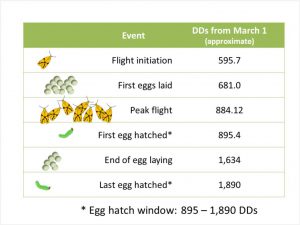
The figure details life history benchmarks of interest for Sparganothis fruitworm and associated degree-day estimates from March 1 (credit:

Life history benchmarks for Sparganothis fruitworm and associated degree-day estimates (credit: Elissa Chasen and Shawn Steffan, USDA-ARS and UW Entomology).

Life history benchmarks for Sparganothis fruitworm and associated degree-day estimates (credit: Elissa Chasen and Shawn Steffan, USDA-ARS and UW Entomology).

Elissa Chasen and Shawn Steffan, USDA-ARS and UW Entomology). Flight initiation is predicted around 595 DD, at a lower temperature threshold of 50 °F. Based on this model Sparganothis fight was initiated in our region (Chatsworth, NJ) around June 9 (last week). So far, we have accumulated (starting April 15) 698 DD, which means that egg laying has started (depending on the DD accumulations specific to your farm); however, eggs are not expected to hatch until later this month. Also, a reminder that a single insecticide application aimed at Sparganothis larvae will likely have the greatest effect if it is timed between the beginning and the peak egg-hatch/larval-emergence, which is approximately 895-1,400 DD. I will keep you updated on these DD predictions as the season progresses.

Insect Pests to Look For in Cranberry Bogs: Early Season

The following insect pests bear special mention for early-season scouting in cranberry bogs:

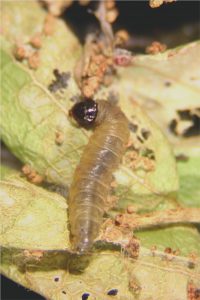
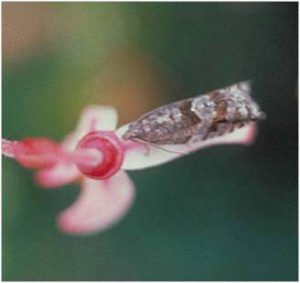
Blackheaded fireworm – Blackheaded fireworm eggs overwinter on the bed and usually hatch by around mid-May. It is important to catch the first generation, if possible, because the second generation occurs during bloom and is typically much more destructive. Blackheaded fireworm larvae can be detected by sweep net sampling and it is a good idea to look along the edges of beds where vines first begin to grow. Remember: blackheaded fireworm is much easier to control if detected during the early part of the season.

Blackheaded fireworm Larva (Photo by D. Schiffhauer)

Blackheaded fireworm Larva (Photo by D. Schiffhauer)

Blackheaded fireworm Adult (Photo by D. Schiffhauer)

Blackheaded fireworm Adult (Photo by D. Schiffhauer)

[Read more…]

Grower Survey: Spotted Wing Drosophila Management

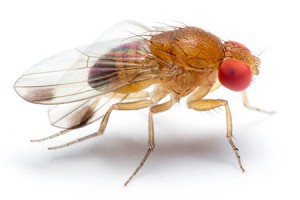
Spotted Wing Drosophila

Spotted Wing Drosophila
Photo: Matt Bertone

Deadline: May 1, 2016

Survey Purpose: To measure the effects of spotted wing drosophila (SWD) on fruit crop production. Results will be used to develop national research and extension projects to minimize future impacts of SWD.

Survey website: https://survey.ncsu.edu/swd/

Growers of blueberry, raspberry, blackberry, strawberry, and cherry who make pest management decisions are invited to participate in this multi-state survey as part a grant funded effort led by NC State University’s Dr. Hannah Burrack to develop better ways to manage SWD.

Collaborators include Michigan State, Oregon State, Cornell and Rutgers universities, as well as the universities of Maine; Notre Dame; Georgia; California, Davis; and California, Berkeley; and the U.S. Department of Agriculture’s Agricultural Research Service.

The survey may be completed online or printed and returned by fax or mail. Grower participation is vital and appreciated.

Beating the Bugs in the Bogs:
Insect Resistance in Different Cranberry Varieties

Insects are a major problem in cranberry production – they are estimated to reduce yield by 1-2% and without spraying, cranberry false blossom, a phytoplasma vectored by blunt-nosed leafhopper, would eliminate commercial cranberry production completely. Spraying chemical pesticides is the most common practice to combat pathogens and herbivorous insects, but beneficial insects, such as honeybees, important pollinators of cranberry, and natural enemies, such as predators and parasitoids, could be affected as well. Therefore, at the P.E. Marucci Center for Blueberry and Cranberry Research and Extension, we study the defensive mechanisms that cranberry plants themselves use against insect feeding. The research project of Dr. Elvira de Lange, a postdoc at the P.E. Marucci Center, focuses on four of the most problematic insects on cranberry in New Jersey: Sparganothis fruitworm, spotted fireworm, gypsy moth and the above-mentioned blunt-nosed leafhopper.

  [Read more…]

American Cranberry Growers Association 2015 Summer Field Day

The American Cranberry Growers Association 2015 Summer Field Day will be held on Thursday August 20, 2015 at the P.E. Marucci Center for Blueberry & Cranberry Research & Extension, Chatsworth, NJ

AGENDA

CRANBERRY BOGS
8:30–8:45 Opening Remarks
Shawn Cutts, President, American Cranberry Growers Association

8:45-9:05 Virus Observations in the Field-Symptoms and Detection (Bog 8)
James Polashock, Research Plant Pathologist, USDA-ARS

9:05–10:25 Update on Disease Management (Bog 10)
Peter Oudemans, Department of Plant Biology and Pathology, Rutgers University

9:25–9:45 Next Generation Cranberry Hybrids: the 3rd Breeding and Selection Cycle (Bog 10)
Nicholi Vorsa, P.E. Marucci Center for Blueberry & Cranberry Research & Extension, Rutgers University, Chatsworth, NJ

9:45-10:05 Evaluation of Our “Top Ten” Fruit Rot Resistant Selections (Bog 11)
Jennifer Johnson-Cicalese, P.E. Marucci Center for Blueberry & Cranberry Research & Extension, Rutgers University, Chatsworth, NJ

10:05–10:25 Update on Insect Management (Bog 19)
Cesar Rodriguez-Saona, Department of Entomology, Rutgers University; Vera Kyryczenko-Roth, P.E. Marucci Center; and Robert Holdcraft, P.E. Marucci Center

10:25-10:45 Assessing Insect Resistance in Cranberries (Bog 20)
Elvira de Lange, Department of Entomology, Rutgers University

CONFERENCE ROOM
11:00–11:15 Cranberry Statistics
Bruce A Eklund, State Statistician, U.S. Department of Agriculture | National Agricultural Statistics Service

11:15–11:30 Cranberry Museum
Ted Gordon, Pine Barrens Botanist, Historian

11:30–12:00 Show and Tell
Cranberry growers

12:00–1:00 LUNCH (Pole Barn)

1:00–1:30 Farm Safety
Ray Samulis, Cooperative Extension Agent, Burlington County Extension, Rutgers University

Cranberry Toad Bug: Life Cycle & Management

Recently the cranberry toad bug, Phylloscelis atra (Figure 1), has become a problematic pest of cranberries in New Jersey. Toad bugs are hemipteran insects, similar to blunt-nosed leafhoppers, but belong to the Family Dictyopharidae (planthoppers) as opposed to leafhoppers, which belong to the family Cicadellidae.

Fig 1. Cranberry Toad Bug

Fig 1. Cranberry Toad Bug

[Read more…]