 There is a national effort to identify management options for no-spray or organic growers that are trying to manage spotted wing drosophila. If you are an organic grower, please consider filling out this survey to help researchers prioritize areas of research.
Organic Grower Survey on Spotted Wing Drosophila
April 25, 2014 Anne Nielsen
Organic SWD Management Survey
February 25, 2014 Anne Nielsen
‘Polar Vortex’ vs. Stink Bugs
This winter, especially January and February have been a bit cold, complete with ‘polar vortexes’ and lots of snow. There have been a couple of newspaper articles about how this will negatively impact insect pest populations, specifically brown marmorated stink bug. Is this true?
For BMSB, most likely NO. While insects do have something similar to antifreeze in their hemolymph (blood) there is a critical freezing temperature at which most species will die. Preliminary research by Dr. Tom Kuhar at Virginia Tech says the super cooling point – when the blood freezes – of BMSB is 5ºF. Populations in natural habitats may have suffered from the extreme cold weather. However, the majority of the BMSB population spends its winter with you, tucked inside the attic and under the eaves of houses, in boxes, under tarps etc. where it is warmer. They are in a reproductive diapause at this point, meaning that adult BMSB have physically prepared themselves to survive cold temperatures, and snow further acts to insulate the populations. There is a saying in Japan that lots of snow in the winter means lots of stink bugs (BMSB) in the summer! Research by Dr. K. Kiritani in Japan shows that BMSB is better adapted at surviving the winter than other stink bug species. There are many factors that contribute to winter mortality or survival and previous research suggests ~20% winter mortality for BMSB in any given year, regardless of weather.
So since the polar vortex may not keep the stink bugs at bay, keep monitoring your crops in the mid-late Spring for the initial dispersal.
September 17, 2013 Anne Nielsen and Bryan Petty
Fruit Flies at Grape Harvest
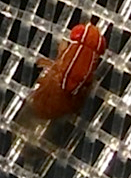
African Fig Fly
In New Jersey, and the rest of the mid-Atlantic, we have two newly invasive fruit flies that attack grapes including wine grapes.
My lab is currently working to determine the impact these insects will have to the berries and to yield.
[Read more…]
July 26, 2013 Anne Nielsen
Insecticide Trial Results for BMSB
We have been conducting numerous insecticide trials at RAREC against BMSB in peaches (Encore variety). In particular, we are evaluating the efficacy of a a single insecticide sprayed on a 10 day schedule to see if we can identify differences in effectiveness of selected insecticides throughout the season. I understand that growers will not (and should not) spray the same chemical throughout the season but it helps to isolate the effect each chemical. This is complimented by laboratory trials using field collected bugs. Because of limitations in the number of applications for certain chemicals I feel that this is an important component to developing IPM programs in NJ. We have evaluated Lannate LV, Bifenture (Sect 18 only), Bifenture+Assail (Sect 18 only), Assail+Perm-Up, Voliam Xpress, Voliam Flexi, Danitol, Endigo and Closer. Closer is a new neo-nicotinoid like compound (IRAC Class 4C) from Dow AgroSciences that is effective against green peach aphid. Because of its potential importance as a resistance management tool, we included this in the evaluation.
Our results thus far are interesting. We evaluate 3 ways:
- Percent of fruit with injury
- Severity of injury (ie. the number of feeding sites) and
- Mortality in the lab.
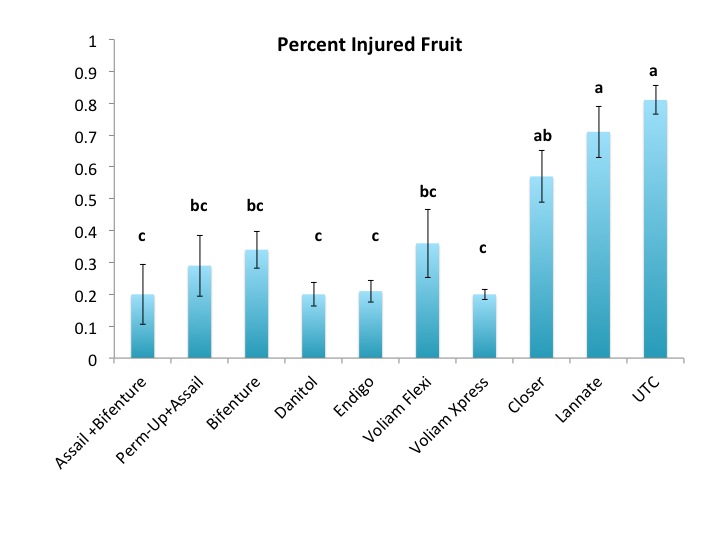
Percent BMSB Damaged Fruit in Mid July
Click to View
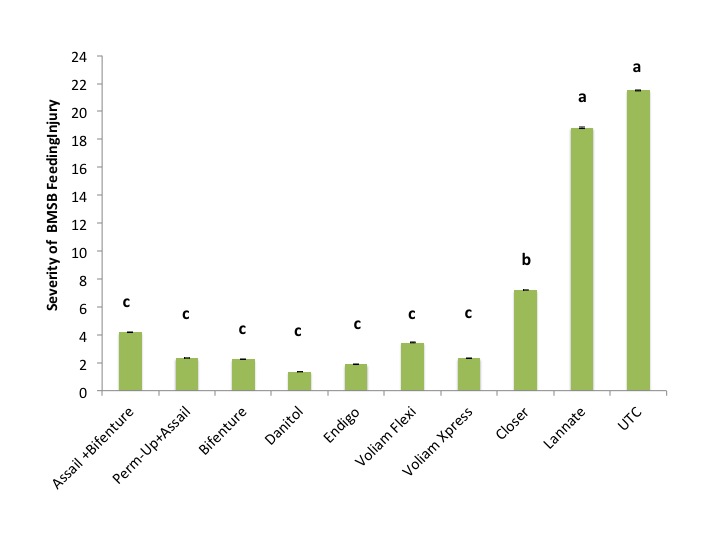
Severity of BMSB Injury in Mid July
Click to View
What we have seen suggests that Perm-Up+Assail and Danitol are more effective early season but Bifenture and Voliam Xpress have not decreased in effectiveness from end of May to now. This suggests that for those chemistries, it would be best to use Perm-Up or Danitol early in the season against the adults that are just emerging from diapause and migrating to the orchard. From the fruit injury data, our data strongly suggests that Lannate is not an effective compound against BMSB. Closer performed ok, there was a lot of fruit with injury, but the injury was not severe. Danitol, Voliam Xpress, Assail+Bifenture and Endigo had the least percent injured fruit. Keep in mind that Bifenture/bifenthrin is ONLY allowable on peaches and apples with a Sect. 18 which we do not have yet!! Danitol has been very variable in previous studies, but is performing well this season at RAREC. Voliam Flexi, Assail+Perm-Up and Bifenture alone also significantly reduced injury. Assail by itself has not performed well against BMSB in previous trials. Feeding severity was significantly reduced for all insecticides other than Closer and Lannate, although Closer was better than Lannate. Bifenture causes 100% mortality in the lab so my guess is that in the field it may not have as long of residual but once available, it will be a great addition to use and will cause mortality of BMSB present in the orchard.
Please keep in mind that the BMSB pressure at RAREC is very high! Always follow label instructions.
July 18, 2013 Anne Nielsen
BMSB Populations in Mid-July
 BMSB populations are significantly higher than last year and unsprayed fruit is already damaged.
Fruit harvested (mid-season assessment) around July 4 in a research trial under light management had very early season injury as well as recent feeding damage. Some of this is due to the wet June we experienced which reduced the effectiveness of treatments, but this is compounded by high populations.
The ranking of materials can be found in previous posts or in the Rutgers Tree Fruit Production Guide utilizing a short interval between sprays. It is anticipated that two good BMSB chemicals Bifenthrin/Brigade and Scorpion/Venom will be available at effective rates shortly once the Sect. 18 request has been filled. The maximum rate of Belay has shown good results as has Endigo in last year’s trials at RAREC. Always follow label instructions.
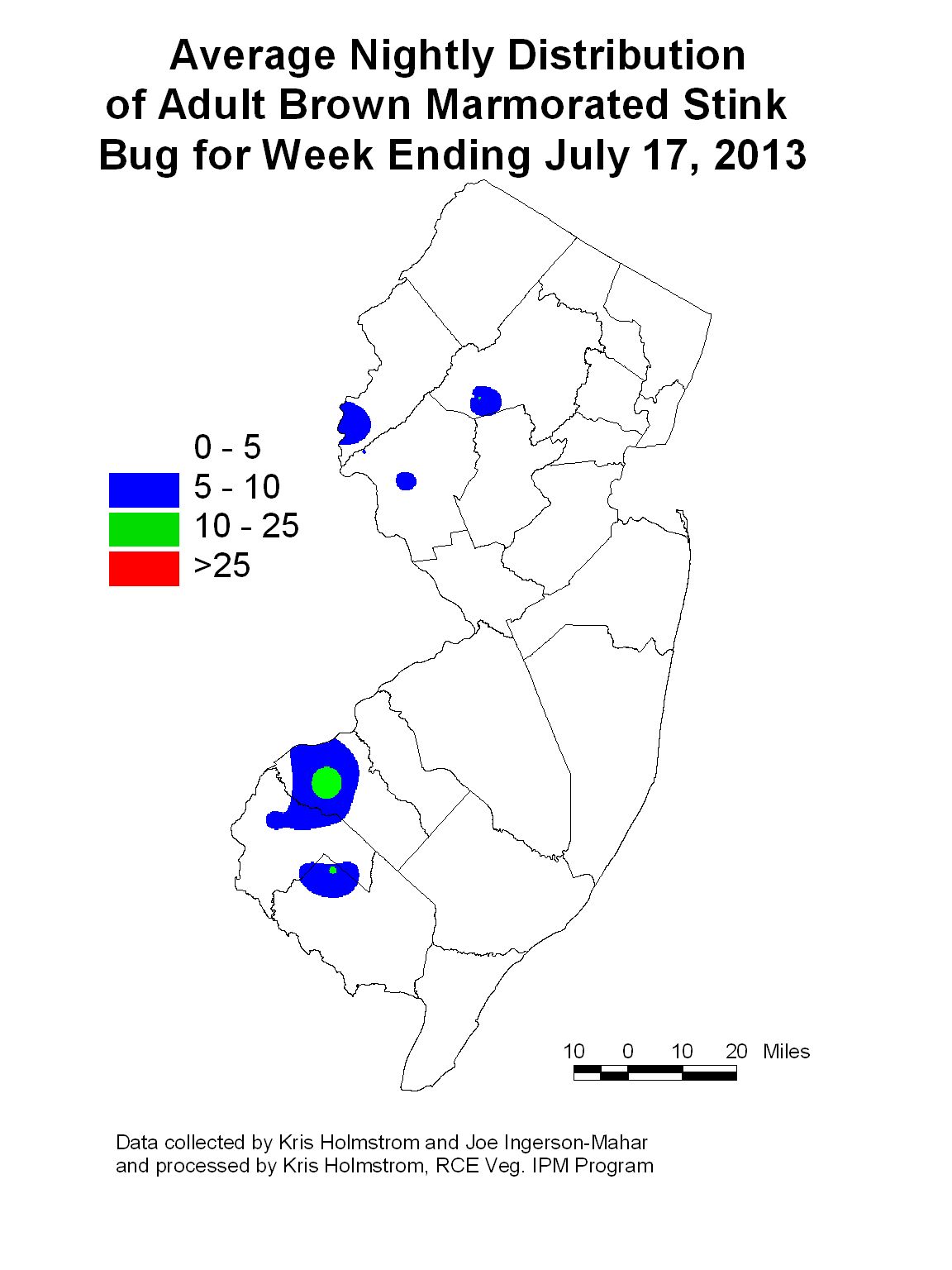
BMSB Black Light Trap Maps
Kris Holmstrom of Rutgers Vegetable IPM program develops a weekly map of BMSB catches in black light traps. We have been monitoring BMSB in black light traps at vegetable farms throughout NJ since 2004. This has proven to be a great resource for identifying the spread of BMSB. From 2004 through 2011, BMSB spread at a rate of 2.84 new farms each year and is now spread throughout NJ.
The black lights work to attract BMSB adults flying at night. They mistake the trap for the moon and get caught. We have been able to correlate trap captures with key periods of flight activity, such as development of the 1st generation adults and large movements between crops. In late May/early June, early catches tell us that BMSB is active on the farm and coincides with the beginning of egg laying. Currently, these traps tell us about the activity of BMSB in the landscape, not on specific crops. We are working to identify what trap captures mean in terms of management decisions. In the meantime, if there is an increase in BMSB catches in your area it is a good indication of activity in a crop and the possibly need for management decisions. As Kris develops these maps each week, I will distribute them to the fruit growers.
This week’s map shows that activity in southern NJ has picked up as well as some spots in northern farms – a trend that I anticipate to increase.
BMSB Insecticide Options – Revised
We have developed a table outlining the recommended insecticides for BMSB and their use restrictions to aide growers in making management decisions. Please note that the table has been revised since its original publication.
