Veg IPM Update: Week Ending 5/10/17

Sweet Corn

Cold temperatures are slowing corn growth considerably.  The same weather is also delaying the onset of pests like the European corn borer (ECB).  No ECB were captured in blacklight traps this week.  As the population develops, look for maps to be published in the weekly IPM Update.

Cole Crops

Although cold weather and heavy rains have suppressed them, IPM personnel continue to observe infestations of crucifer flea beetle.  These beetles can build to high populations quickly, especially where wild mustard and related cruciferous weeds are common.  Extreme feeding on small transplants can cause irreversible damage if not controlled promptly. [Read more…]
Veg IPM Update: Week Ending 5/03/17

Sweet Corn

The Vegetable IPM blacklight trap network is nearly complete.  With limited numbers of traps having been checked, only one European corn borer (Allentown, Mercer County) and one corn earworm (Old Bridge, Middlesex County) have been recorded.  As sweet corn is currently in the seedling stage, neither of these catches represent a threat.  As catches become more consistent, maps of the adult populations of these two pests will be published in the weekly IPM Update.

Cole Crops

With warm, sunny days, IPM personnel have discovered a number of heavy infestations of crucifer flea beetle.  These beetles can build to high populations quickly, especially where wild mustard and related cruciferous weeds are common.  Extreme feeding on small transplants can cause irreversible damage if not controlled promptly. [Read more…]

Allium Leafminer Alert II in New Jersey

A survey of fields from Princeton/Pennington in Mercer County northward through Milford and Asbury (Hunterdon County) and east to Chester in central Morris Co. revealed heavy allium leafminer feeding and active adults in chives only.  There was only one garlic plant at the Pennington site that had feeding signs.  Yellow sticky cards from chive plots in the Princeton area had numerous adults, but cards from a garlic field in Pennington did not have leafminers despite being within 200 yards of an infested chive plot.

At this point, allium leafminer adults appear to be favoring chives for feeding and egg laying.  As one of the earliest and most succulent allium leaf types, chives may be a good indicator of the onset of adult activity, and could be useful as we decide when to begin protecting our other allium crops, including overwintered leeks, garlic and onion plants now being transplanted.  Because egg laying is now happening, the prudent course of action would be to protect these crops, either with row covers or with recommended insecticides.  These include Trigard, Scorpion, Radiant and Entrust (OMRI-approved).  For a complete list see the RCE Vegetable Crops Online Resource Center Critical Updates to the Mid-Atlantic Commercial Vegetable Recommendations.

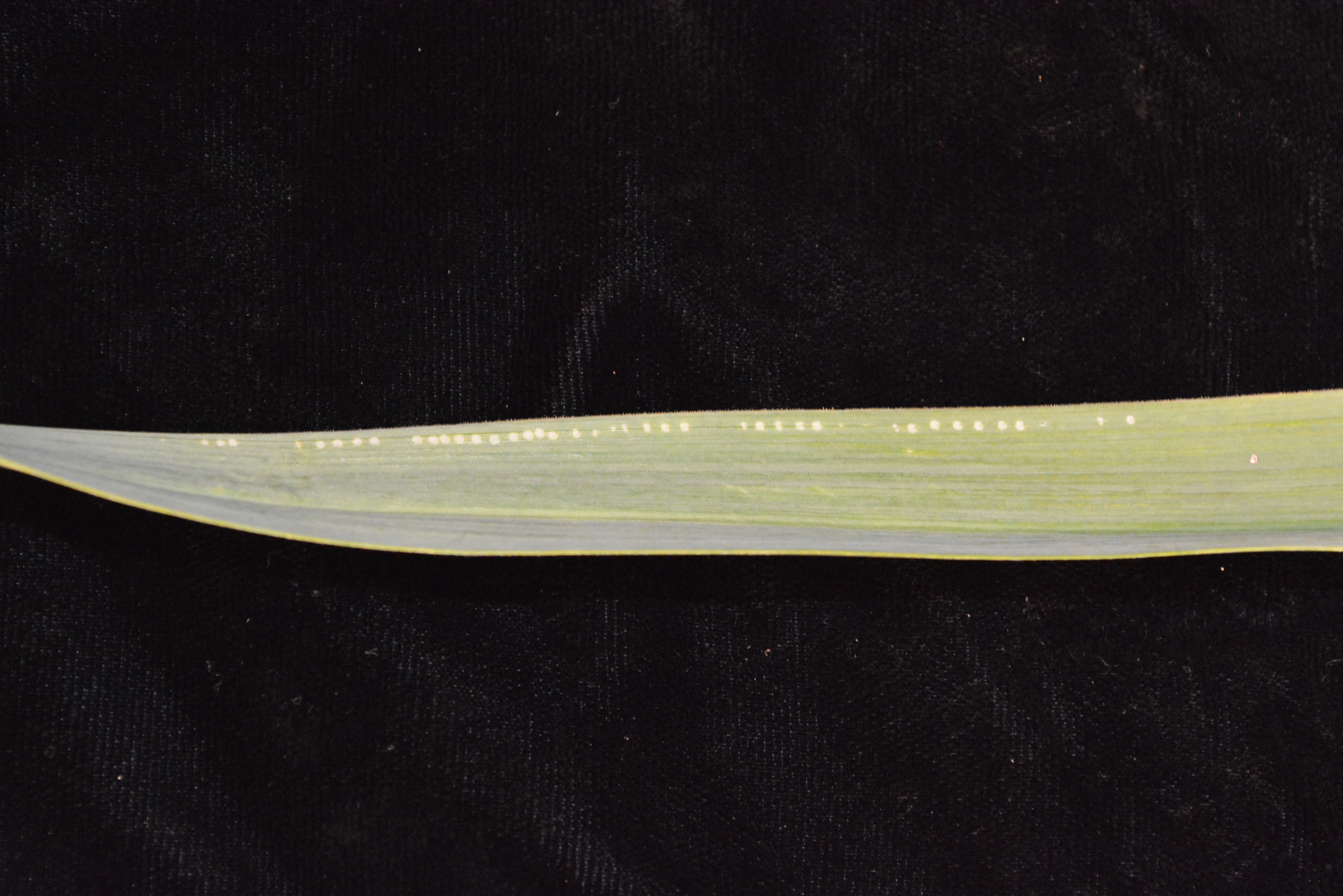
If you wish to inspect crops in your area, start with chives.  Observe the tallest leaves first, and look for lines of characteristic white spots.  These are wounds made by the female as she pierces the leaves to lay eggs and  extract plant sap on which to feed (see photo below).

Allium leaf miner oviposition scars on garlic.

As a review, allium leafminer has spread from Pennsylvania into New Jersey, New York, and Maryland.  At present, the main area of infestation in New Jersey appears to be in the northern counties.  Only one suspected fly has been caught (Fall, 2016) in southern New Jersey in East Vineland.   Traps set in this southern area will be checked this week.  The Vegetable IPM Program will continue to track the spread and population levels of ALM in New Jersey.

Veg IPM Update: Week Ending 10/05/16

Sweet Corn

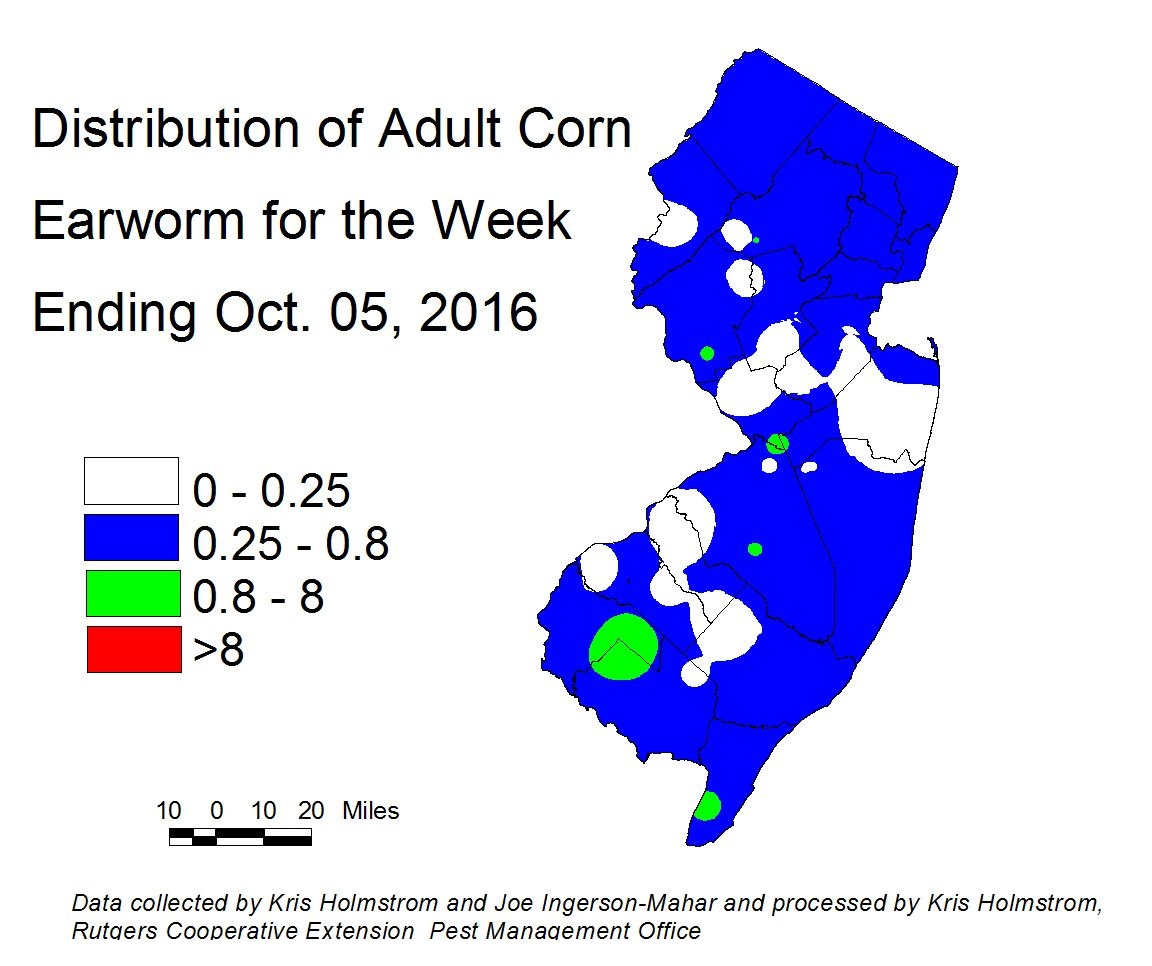
16cew1005aCorn earworm moth (CEW) activity has been fairly steady over the past week.  Patches of locally higher activity remain within a generally low population (see CEW map).  Catches are now rising and falling with night time temperatures.  It is advisable to incorporate materials into the spray program that have different modes of action from the pyrethroids.  This includes IRAC 28 materials like Coragen, Exirel and Besiege, as well as IRAC 5 (Radiant, Entrust (OMRI approved), and Blackhawk)).  Growers should be checking CEW activity frequently, and adjust spray schedules according to local activity.  On this map, green areas correspond to a 3-4 day silk spray schedule, while blue is 4-5 days.

The highest nightly CEW catches for the previous week are as follows:

Centerton   3 Denville   1 Milford   1
Green Creek   2 Eldora   1 New Egypt   1
Blairstown   1 Farmingdale   1 Sergeantsville   1
Califon   1 Jones Island   1 Tabernacle   1


[Read more…]

Veg IPM Update: Week Ending 9/28/16

Sweet Corn

European corn borer (ECB) moths are nearly non-existent now.  There are no particular areas of higher activity, and  no map will appear in this edition. It is unlikely that we will realize any further injury from this pest this season.

Nearly all remaining sweet corn plantings are now in the silk stage.  Fall armyworm (FAW) however, continues to be a threat to these sweet corn plantings.  We should expect this pest to be with us at some level for the remainder of the sweet corn growing season.   FAW do not respond well to pyrethroid insecticides.  The most useful products are those in the IRAC group 28 class (Coragen, Exirel) or the IRAC group 5 class (Radiant, Entrust), or combination products including these classes.  See the 2016 Commercial Vegetable Recommendations Guide for insecticides effective against FAW.

  [Read more…]

Veg IPM Update: Week Ending 9/21/16

Sweet Corn

European corn borer (ECB) moth numbers have decreased this past week such that only a handful of moths were captured.  There are no particular areas of higher activity, and  no map will appear in this edition. It is unlikely that we will realize any further injury from this pest this season.

The highest nightly ECB catches for the previous week are as follows:

Cinnaminson   1 Milltown   1
Clinton   1 Pedricktown   1
Hillsborough   1 Sergeantsville   1

[Read more…]