
Archives for February 2021

USDA to Measure Financial Well-Being of Farmers and Ranchers

Agricultural Resource Management Survey Survey       Image result for usda ag counts

Initiated back in late December, the U.S. Department of Agriculture’s National Agricultural Statistics Service (NASS) will be spending these next several months gathering information about farm economics and production practices from farmers and ranchers across the United States, as the agency conducts the third and final phase of the 2020 Agricultural Resource Management Survey (ARMS).

“ARMS is the only survey that measures the current financial well-being of producers and their households as a whole,” said King Whetstone, director of the NASS Northeastern Region. “The results of this survey will help inform decisions on local and federal policies and programs that affect farms and farm families.”

In an effort to obtain the most accurate data, NASS will reach out to more than 30,000 producers nationwide, between January and April in 2021. The survey asks producers to provide in-depth information about their operating revenues, production costs, and household characteristics.

The 2020 ARMS survey includes a version of the questionnaire focused on hog and pig production costs and returns. This year the survey also includes questions to help measure any impacts of COVID-19 on farms, farm and household finances, and off-farm employment. “In February, our interviewers will begin reaching out to those farmers who have not yet responded,” said Whetstone. “We appreciate their time and are here to help them with the questionnaire so that their information will continue supporting sound agricultural decision making.”

In addition to producing accurate information, NASS has strong safeguards in place to protect the confidentiality of all farmers who respond to its surveys. The agency will only publish data in an aggregate form, ensuring the confidentiality of all responses and that no individual respondent or operation can be identified.

Growers can complete the survey online, saving you time by allowing you to skip over questions that do not apply to you, by calculating totals automatically, and by providing drop-down menus for common answers. It also saves taxpayer dollars that would otherwise be spent on return postage and data entry.

To complete your survey online, you will need your unique Survey Code from the address label on the paper questionnaire or letter you received in the mail. You can save a partially completed survey by clicking “Save and Return Later.” Do not click the “Submit” button until you are sure you are finished with your survey.

The expense data gathered in ARMS will be published in the annual Farm Production Expenditures report in July 2021. That report and others are available by clicking here. More reports based on ARMS data and more information about ARMS are available online here. For more information, please call the NASS Northeastern Regional Field Office at (800) 498-1518.

NASS is the federal statistical agency responsible for producing official data about U.S. agriculture and is committed to providing timely, accurate and useful statistics in service to U.S. agriculture.

An update on the potato pathogen, Dickeya dianthicola

It has been nearly six years since Dickeya dianthicola was first reported in potato in New Jersey in 2015 and many other states up and down the East Coast in the spring and summer of 2016. Before then, this seed-borne pathogen had not been detected in potato fields in the mid-Atlantic region and elsewhere. Unfortunately, some potato growers suffered substantial economic losses during the 2015 and 2016 growing seasons. Organic potato producers who grew very small acreage were also affected by Dickeya dianthicola. Most of the commercial potato acreage in New Jersey and elsewhere was being planted with seed purchased from Maine or Canada. When a disease such as this is so widespread when it first occurs it suggests that contaminated seed is the likely inoculum source. Extension personnel from the region learned from visiting farms and talking with growers that occurrences were associated with specific seed lots. With knowledge of the probable origin of the pathogen, Extension personnel from the region developed best management guidelines for Dickeya dianthicola to help potato growers in the region minimize the potential for a Dickeya outbreak in their operation.

Since that time, along with Dickeya dianthicola, other seed-borne tuber rotting pathogens (Pectobacterium spp.) have routinely been found causing significant problems for potato growers in the region. Research on Dickeya and Pectobacterium has been ongoing in the US and other parts of the world where these pathogens occur with data and results related to the most recent outbreaks being published most recently. In a survey of soft rot bacteria collected from potato fields in New York state during the 2016 growing season, a majority of isolates collected were designated as D. dianthicola or P. parmentieri. Based on their dnaX sequence analysis, the authors determined that the D. dianthicola isolated from potato plants in New York formed a single clade, being genetically identical to each other and to D. dianthicola ME23 isolated in Maine in 2015 (Ma et al., 2018). More recent research by Ge et al (2020, Plant Dis. First Look) surveyed commercial potato fields in Maine as well as suspect Dickeya samples collected from potato seed pieces, tubers, or plants from potato fields in 11 other states from 2015 to 2019. A total of 1183 samples were collected. A total of 256 Dickeya dianthicola isolates were used to identify pathogen genotype (I, II, or III) and the “inoculum geography”.  Of these, 231 (~90%) were Type I, 14 (~5%) were Type II, and 11 (~4%) were Type III. In Maine alone, 95% of the total isolates collected from commercial potato fields were Type I. “As such, it was suspected that the original contamination in other states initiated from Maine” since “Maine is the primary seed potato supplier to states in the Northeastern U.S.”. The only consistent genotype found in each year of the study from all states sampled from was Type I for which the authors hypothesized was “likely associated with Maine seed origination”. Not finding Dickeya dianthicola Type II and III in Maine in each year of the study may reflect the fact these types were rare compared to Type I thus a larger sample size was needed to confirm they likely were not present those years. Additionally, while most occurrences of Dickeya dianthicola in potato production fields were associated with seed originated from Maine, there were occurrences associated with seed from Wisconsin and Canada. It is possible Type II and III are principally associated with those seed. Seed source was not determined for the samples.


USDA APHIS Ends Emerald Ash Borer Domestic Quarantine Regulations

Effective January 14, 2021, USDA’s Animal and Plant Health Inspection Service (APHIS) has removed the domestic quarantine regulations for the Emerald Ash Borer (EAB, Agrilus planipennis, Fairmare). According to the Federal Register posting, “this action will discontinue the domestic regulatory component of the emerald ash borer program as a means to more effectively direct available resources toward management and containment of the pest. Funding previously allocated to the implementation and enforcement of these domestic quarantine regulations will instead be directed to nonregulatory options to mitigate and control the pest.”

APHIS’ final rule was posted December 15, 2020, based on the original Federal Register posting from September of 2018, which received over 140 comments. A federal quarantine for EAB has been in place since 2003.

Under this rule, establishments operating under EAB compliance agreements will no longer incur costs of complying with Federal EAB quarantine regulations, although States could still impose restrictions.

EAB has now been found in 35 States and the District of Columbia and it is likely that there are infestations that have not yet been detected. Newly identified infestations are estimated to be 4 to 5 years or more in age. Known infestations cover more than 27 percent of the native ash range within the conterminous United States.

APHIS further summarized, “The domestic quarantine regulations for EAB have not substantially reduced the likelihood of introduction and establishment of the pest in quarantine-adjacent areas. Interstate movement of EAB host articles is unrestricted within areas of contiguous quarantine, and irrespective of human-assisted spread, a mated EAB is capable of flying up to 100 miles in her lifetime, resulting in a high potential for natural spread.”

Public outreach activities outside the EAB regulatory program will continue, and APHIS will continue to work with State counterparts to encourage the public to buy firewood where they burn it and to refrain from moving firewood. The primary national communications tool to warn the public about the plant pest risk associated with the movement of firewood is the Don’t Move Firewood campaign, which is administered by The Nature Conservancy with support from APHIS and other Federal agencies.

EAB and New Jersey

Emerald Ash Borer was discovered in New Jersey in May 2014 in Somerset County. All ash trees in NJ should be considered at high risk for EAB: even if Emerald Ash Borer has not yet been detected, all ash trees are considered to be at high risk of EAB infestation within the next few years.

Through December of 2019, EAB has been found in New Jersey in Bergen, Burlington, Camden, Essex, Gloucester, Hudson, Hunterdon, Mercer, Middlesex, Monmouth, Morris, Passaic, Somerset, Sussex and Warren counties.

The NJ Department of Agriculture hosts an EAB website where industry, communities, woodland owners, and homeowners can access an EAB Action Kit and Management Options Resource Guide.

Landscape IPM Scouting Techniques: Basic Overview

KEY PLANTS vs. KEY PESTS vs. KEY LOCATIONS CONCEPT:

Landscape IPM (Integrated Pest Management) methods require site-specific information. Every landscape typically contains at least several key pests, key plants and key locations that will be unique to each site. These concepts are extremely useful to simplify monitoring procedures at any given landscape. They will enable field technicians to concentrate on plants and locations that are prone to problems as well as those plants and locations that have low aesthetic thresholds. Scouting efficiency should improve and a more productive use of time spent on landscapes is the result. It is important to emphasize that Integrated Pest Management is a philosophy & practitioners will need to develop skills & experience to improve their levels of commitment.

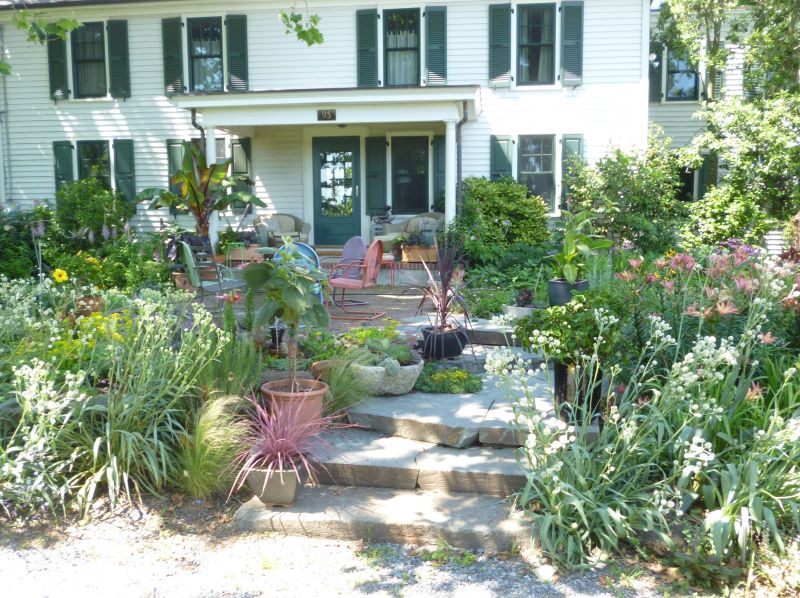
Well-landscaped house

A diverse, well designed landscape that will unlikely develop many pest problems. (Photo Credit: Steven K. Rettke, Rutgers Coop. Ext.)

[Read more…]

Greenhouse Sanitation Important for Disease Management

Proper greenhouse sanitation is important for healthy, disease-free vegetable transplant production.

Efforts need to be made to keep transplant production greenhouses free of unnecessary plant debris and weeds which may harbor insect pests and disease. Efforts need to be taken throughout the transplant production season to minimize potential problems.

  • All equipment, benches, flats, plug trays and floors should be properly cleaned and then disinfested prior to use.
  • Any weeds in or around the greenhouse structure should be removed prior to any production.
  • Any transplant brought into the greenhouse from an outside source needs to be certified ‘clean’, as well as, visually inspected for potential insects and diseases once it reaches your location.

Remember, disinfestants, such as Clorox, Green-Shield, or hydrogen dioxide products (Zerotol – for commercial greenhouses, garden centers and Oxidate – commercial greenhouse and field), kill only what they come into direct contact with so thorough coverage and/or soaking is necessary. The labels do not specify time intervals for specific uses, only to state that surfaces be ‘thoroughly wetted’. Therefore, labels need to be followed precisely for different use patterns (i.e., disinfesting flats vs. floors or benches) to ensure proper dilution ratios. Hydrogen dioxide products work best when diluted with water containing little or no organic matter and in water with a neutral pH.


United States Department of Agriculture (USDA) Harmonized Food Safety Audit Training

We are offering a final, for this spring, online Harmonized Audit Training Course on March 2, 2021 from 9:00 AM – 12:00 PM.  If you will need to obtain a USDA Harmonized Audit this year or want a refresher this is the course for you.

This three-hour virtual class will cover each question on the USDA Harmonized Audit allowing participants to hear how questions are interpreted by auditors.  New Jersey Department of Agriculture Auditors will also discuss how someone signs up for an audit and review common issues that auditors found during 2020.  Participants will have the opportunity have their questions answered to help make their audit run more smoothly.

The deadline to register for the class is Friday February 26. The registration form is on the Eventbrite page at rutgersonfarmfoodsafety.eventbrite.com