Archives for September 2019

Annual Bluegrass Control in Blueberry

Annual bluegrass (Poa annua L.) is an increasingly troublesome winter annual weed in some New Jersey blueberry fields. Native to Europe, this species is now worldwide distributed.

Identification and Life Cycle
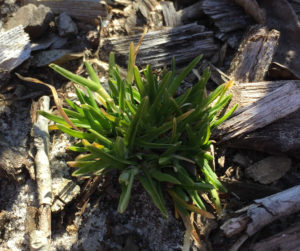
Annual bluegrass

Figure 1. Annual bluegrass. Thierry Besancon, Rutgers University

Annual bluegrass starts germinating in late summer as soil temperature drops below 70°F. If conditions are favorable, it will continue germinating throughout the winter. Annual bluegrass has light green leaves with a typical boat-shaped tip (Figures 1 and 2). Leaf blades are often crinkled part way down. It will produce greenish white inflorescences (seed heads) during the spring months. Annual bluegrass is a prolific and rapid seed-producing weed.

Each plant can produce up to 100 seeds that are viable just a few days after pollination, allowing multiple germination flushes during the cool season. Annual bluegrass tends to form dense clumps in areas with moist and/or compacted soil. Poor soil drainage, frequent irrigation, excessive fertilization, use of heavy equipment causing compaction, and shade are conditions that will encourage the development of annual bluegrass.
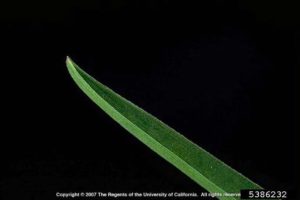
Annual bluegrass under a microscope

Figure 2. Annual bluegrass leaf tip. Joseph M. DiTomaso, University of California – Davis, Bugwood.org


Impact

While annual bluegrass may not be a strong competitor for blueberry bushes, it forms a dense mat that will persist until late spring. This mat will prevent proper application of residual herbicides in spring by intercepting the spray solution and reducing the amount of residual herbicide penetrating into the soil. Thus, control of established sod of annual bluegrass prior to spring herbicide applications is essential for successful residual weed control in spring and early summer.

Management

As for any other weed species, preventing the release of viable seeds that will replenish the soil seedbank is a primary objective for controlling this species. Cultivation or manual digging before annual bluegrass patches become well established and before the development of inflorescence will provide control of limited infestations if continued throughout the germination period. However, the use of chemical control may be required for large infested areas or where the species has become established for several seasons.

Application of effective preemergence herbicides may prevent annual bluegrass seedling survival. However, preemergence herbicides will not effectively control emerged plants. Timely application of preemergence herbicides is very important for effective control of annual bluegrass. Herbicides should ideally be applied in late-summer / early fall before annual bluegrass seeds germinate. However, crop injury may result if pre-emergence herbicides are applied at this time when blueberry bushes are not dormant. Therefore, a fall application of a preemergence herbicide tankmixed with a postemergence herbicide is often the most practical solution and should be considered when blueberry leaves start dropping.

  • Preemergence herbicides such as oryzalin (Surflan), norflurazon (Solicam), or napropamide (Devrinol) may effectively control annual bluegrass. Application of these herbicides can be split between fall and spring applications with half of the yearly rate applied in fall and the second half in spring.
  • Simazine (Princep) can provide early post-emergence control of leaf stage plants in addition to its residual activity.
  • Pronamide (Kerb SC) is also an excellent option that will provide both residual and postemergence control of annual bluegrass. Optimum pronamide activity occurs when applications are made under cool temperature conditions (55°°F or less).
  • S-metolachlor (Dual Magnum) is also effective at controlling annual bluegrass prior to germination. However, Dual Magnum can only be applied once per cropping season and will require grower to agree to the conditions of the indemnified label (https://www.syngenta-us.com/labels/indemnified-label-search).

All preemergence herbicides require incorporation from rainfall so that the herbicide can move into the first few inches of soil where it will be protected from degradation or volatility.

When annual bluegrass has emerged before residual herbicide is applied, a postemergence herbicide should be included in the tank. Use paraquat (Gramoxone or other labeled generic formulation) plus a nonionic surfactant at 0.25% v/v of the spray solution. Glufosinate (Rely 280) is also effective at controlling emerged annual bluegrass, especially when applied under bright sunlight, warm temperature, and high humidity conditions. Do not allow glufosinate spray mist to contact green bark, as injury will occur. None of the graminicides labelled on blueberry (Select, Poast) have sufficient activity for controlling annual bluegrass. The use of glyphosate (Roundup or other labeled generic formulation) is not recommended as failure to control emerged annual bluegrass has been reported in various New Jersey blueberry fields.


Consult the New Jersey Commercial Blueberry Pest Control Recommendations for rates and additional information (https://njaes.rutgers.edu/pubs/publication.php?pid=E265). As with all herbicides, read and follow all label instructions and precautions.


Hackettstown Livestock Auction Results for September 10, 2019

This auction sells: lambs, sheep, goats, calves, beef cattle, pigs, rabbits, and all types of heavy fowl. Auctions are held every Tuesday with the first sale beginning at 10:30 am and ending at the last sale 5:30 pm. Hay, straw, grain, and firewood are also for sale.

Farm Fresh Eggs available for purchase by the case (30 doz.) or by the flat (2&1/2 doz.) in the main office Tuesday, Wednesday & Thursday. Also available some Monday’s and Friday’s but please call office first (908)-852-0444.

Click on link for September 10 sale results:

Hackettstown 9.10.19


Vegetable IPM Update 9/11/19

Sweet Corn

European corn borer (ECB) moth captures remain scattered and very low, and no map will appear in this addition.  Feeding in late season pre-tassel corn in northern NJ continues, with some plantings exceeding the 12% threshold.   In combination with fall armyworm (FAW) feeding, action thresholds have been exceeded in all areas of the state.

Growers should continue to scout whorl and pre-tassel stage plantings weekly and consider treating when infested plants exceed 12% in a 50 plant sample.  As plantings proceed to the pre-tassel stage, ECB larvae may be found in emerging tassels.  It is a good idea to treat individual plantings as they move into the full tassel/first silk stage one time.  This eliminates any ECB larvae that have emerged with the tassels as they begin to move down the stalk to re-enter near developing ears.

Useful insecticides for this particular application include synthetic pyrethroids (IRAC Grp 3), spinosyns (including OMRI approved Entrust) IRAC Grp 5), and diamides such as Coragen (IRAC Grp 28) or materials such as Besiege which include the active ingredient in Coragen.  Synthetic pyrethroids alone should NOT be used for corn earworm (CEW) protection on silking corn.  Control with these materials is very inconsistent.

The highest nightly black light trap catches of ECB for the week ending 9/11/19 are as follows:

Allamuchy   1 Jones Island   1
Chester   1 Monroeville   1
Elm   1 Oldwick   1


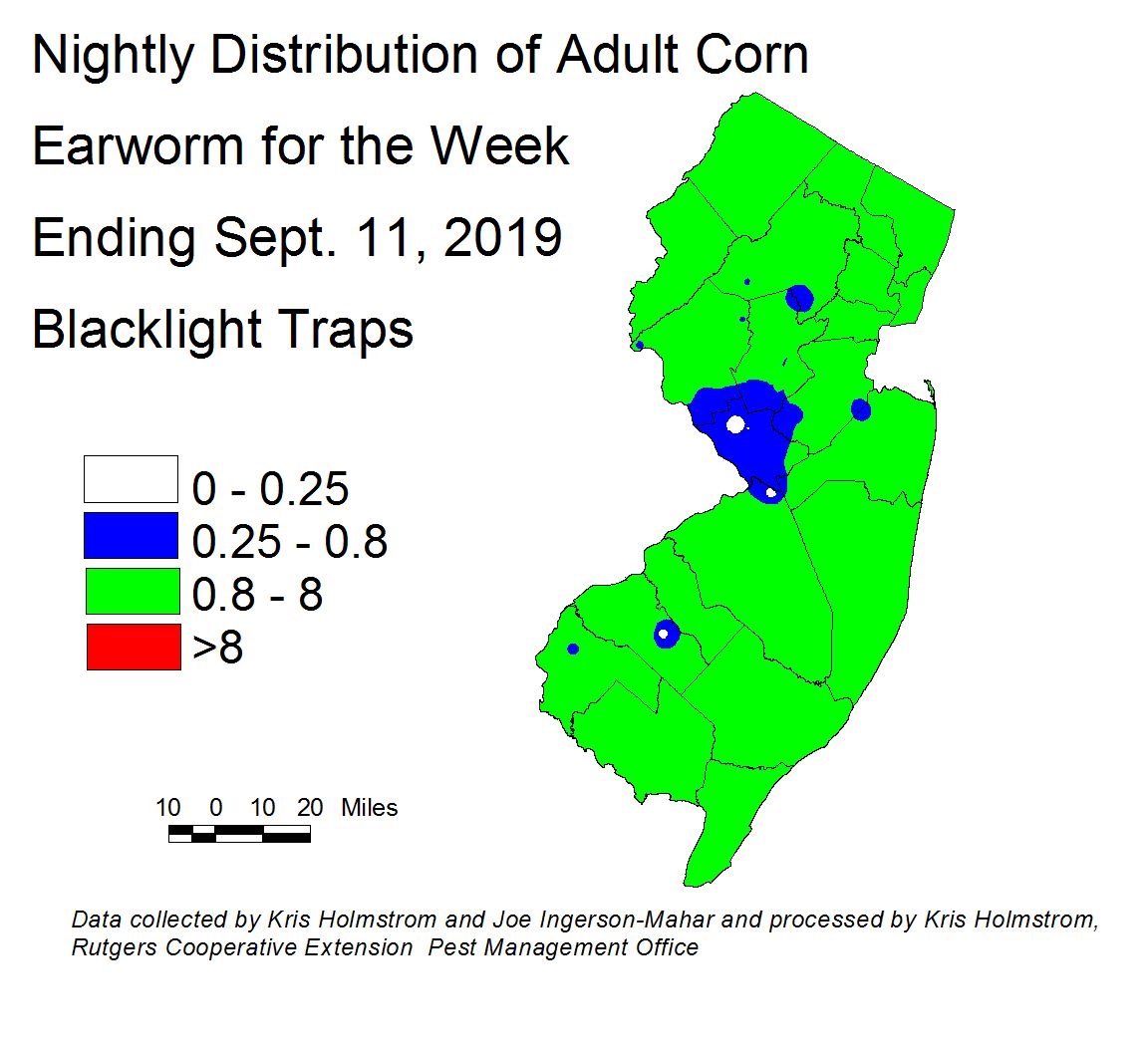
Corn earworm (CEW) moth catches have remained fairly stable in NJ this past week.  Blacklight catches are steady, while there was a slight decline in pheromone trap catches.  However, the effect on spray schedules is unchanged.  Overall, CEW numbers now represent a sizeable late summer migratory influx.  While moth counts will decline somewhat with cool night temperatures, look for strong rebounds when nighttime temperatures exceed 60F.  The green area on the blacklight map (left) represents a 3-day silk spray schedule zone.  Blue and white areas within the overall green zone are outliers, and corn growers in or near those areas should also adhere to 3-day silk spray schedules.     Economically damaging populations of this pest are present throughout the state, and all areas are at extreme risk of crop injury if strict silk spray schedules are not observed.   Red areas on the on the pheromone trap map (below at right) indicate a 3-day silk spray schedule, while green indicates a 4-5 day silk spray schedule.  Currently, the black light network is indicating a more conservative spray regime statewide, than is the pheromone network.  Taken together, blacklight and pheromone traps are indicating 3-day silk spray schedules throughout the state.  There are far fewer CEW pheromone traps than blacklights, and the resulting map has much broader color bands as a result.  It should also be noted that the pheromone traps are much more sensitive than blacklights.  Therefore, the number of moths caught in pheromone traps required to generate a specific spray interval is much higher than the number caught in blacklight traps.   It must be stressed that there is high variability in these catches, and growers should consult with their IPM practitioner on recommended spray schedules.


[Read more…]

Vegetable IPM Update 9/04/19

Sweet Corn

European corn borer (ECB) moth captures remain very low, and no map will appear in this addition.  Feeding in late season pre-tassel corn in northern NJ continues, with some plantings exceeding the 12% threshold.   In combination with fall armyworm (FAW) feeding, action thresholds have been exceeded in all areas of the state.

Growers should continue to scout whorl and pre-tassel stage plantings weekly and consider treating when infested plants exceed 12% in a 50 plant sample.  As plantings proceed to the pre-tassel stage, ECB larvae may be found in emerging tassels.  It is a good idea to treat individual plantings as they move into the full tassel/first silk stage one time.  This eliminates any ECB larvae that have emerged with the tassels as they begin to move down the stalk to re-enter near developing ears.

Useful insecticides for this particular application include synthetic pyrethroids (IRAC Grp 3), spinosyns (including OMRI approved Entrust) IRAC Grp 5), and diamides such as Coragen (IRAC Grp 28) or materials such as Besiege which include the active ingredient in Coragen.  Synthetic pyrethroids alone should NOT be used for corn earworm (CEW) protection on silking corn.  Control with these materials is very inconsistent.

The highest nightly black light trap catches of ECB for the week ending 9/04/19 are as follows:

Medford   2 Jobstown   1
Califon   1 Jones Island   1
Cinnaminson   1


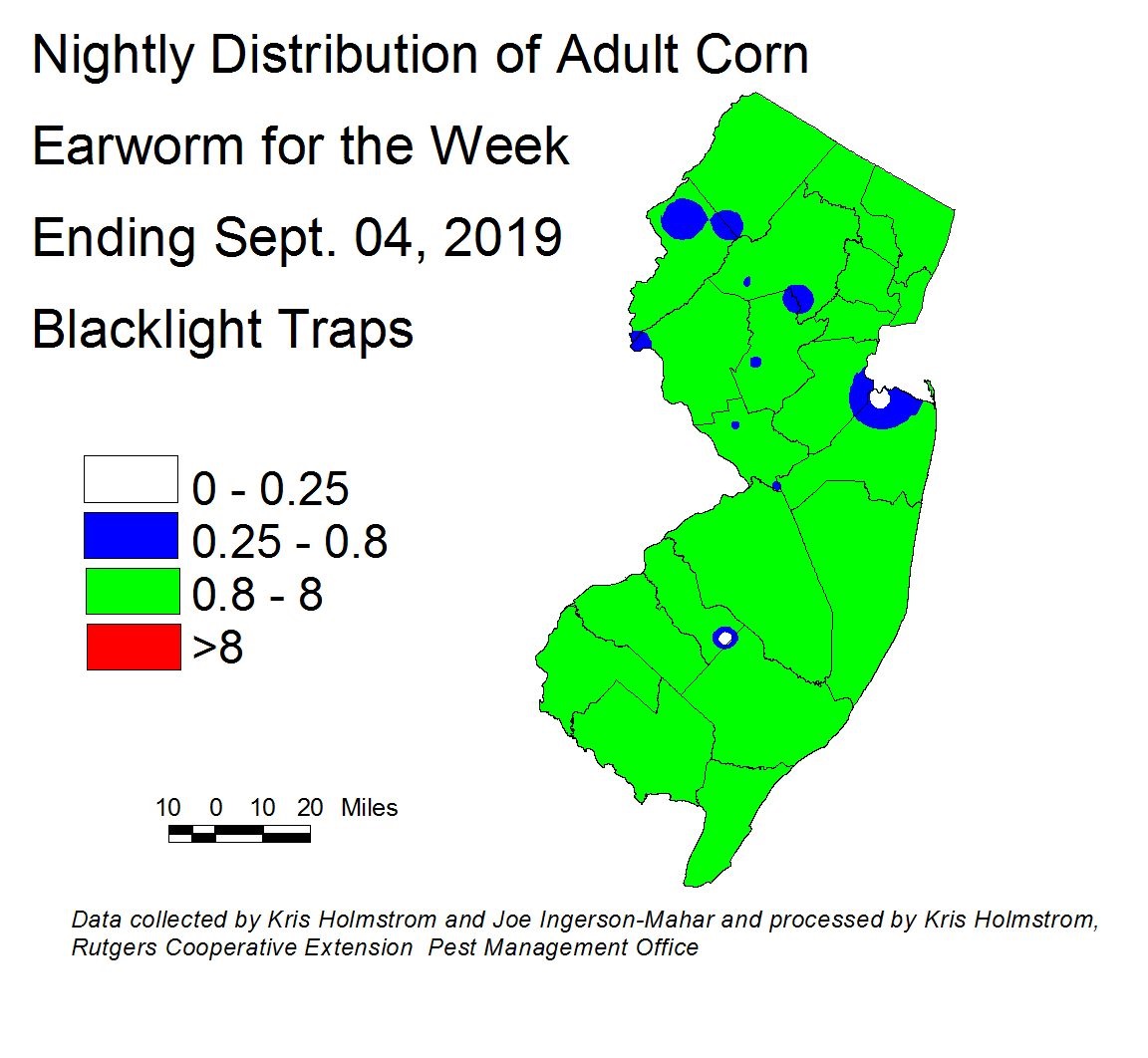
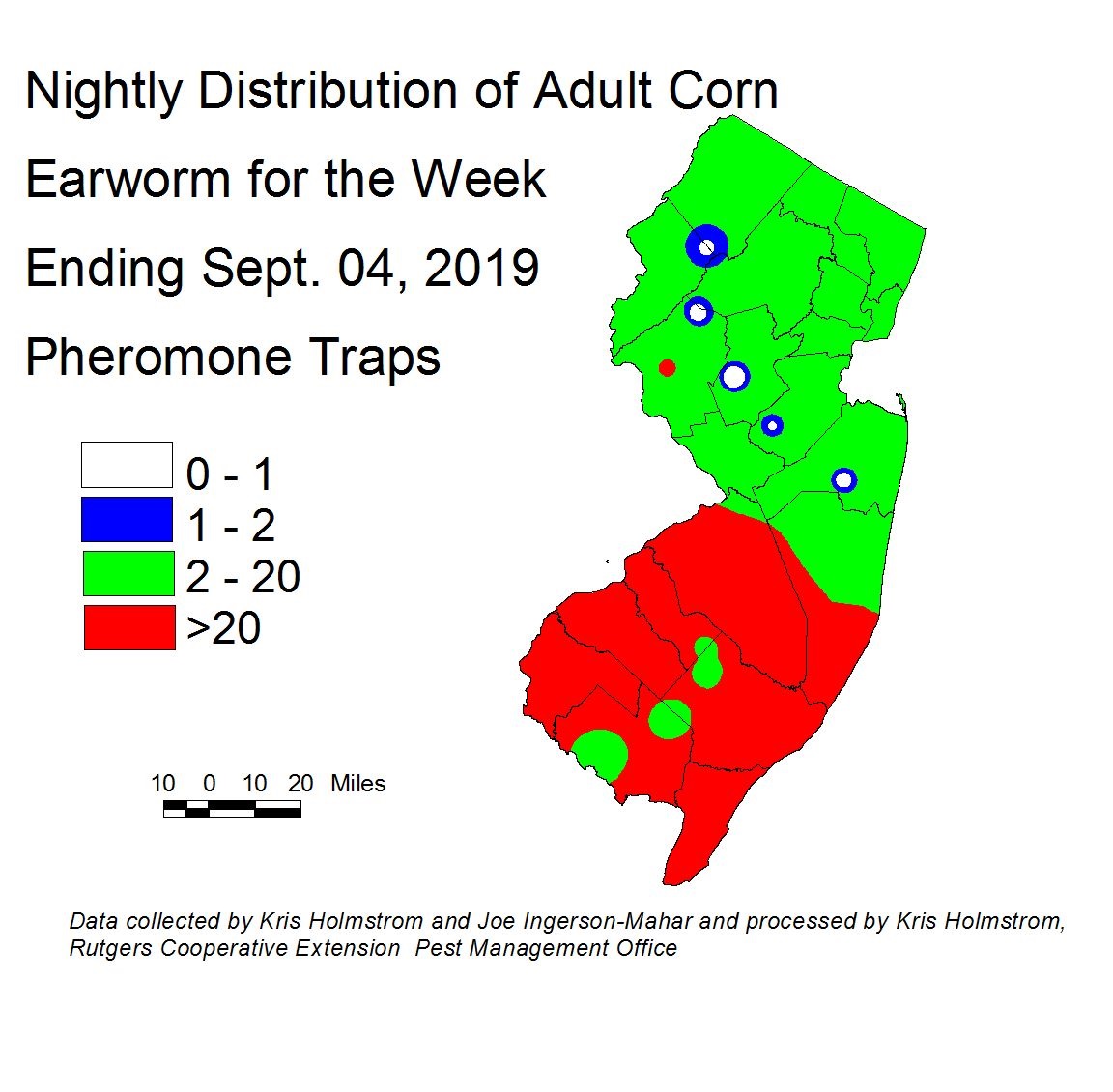
Corn earworm (CEW) moth catches increased in southern NJ this past week, while remaining stable in northern counties.  Overall, CEW numbers now represent a sizeable late summer migratory influx.  While moth counts will decline somewhat with cool night temperatures, look for strong rebounds when nighttime temperatures exceed 60F.  The green area on the blacklight map (left) represents a 3-day silk spray schedule zone.  Blue and white areas within the overall green zone are outliers, and corn growers in or near those areas should also adhere to 3-day silk spray schedules.  There continue to be some exceptionally high catches in southern NJ pheromone traps this past week (see pheromone trap map below at right).    Economically damaging populations of this pest are present throughout the state, and all areas are at extreme risk of crop injury if strict silk spray schedules are not observed.   Red areas on the on the pheromone trap map indicate a 3-day silk spray schedule, while green indicates a 4-5 day silk spray schedule.  Currently, the black light network is indicating a more conservative spray regime statewide, than is the pheromone network.  Taken together, blacklight and pheromone traps are indicating 3-day silk spray schedules throughout the state.  There are far fewer CEW pheromone traps than blacklights, and the resulting map has much broader color bands as a result.  It should also be noted that the pheromone traps are much more sensitive than blacklights.  Therefore, the number of moths caught in pheromone traps required to generate a specific spray interval is much higher than the number caught in blacklight traps.   It must be stressed that there is high variability in these catches, and growers should consult with their IPM practitioner on recommended spray schedules.


[Read more…]