Archives for July 2015

Potato | Tomato Disease Forecast 7-31-15

Click to View | Download Report 7-31-15

Potato Disease Forecasting Report

We will be tracking DSVs for Late blight development and calculating P-days for initiating the first early blight fungicide application.

The first late blight fungicide application is recommended once 18 DSVs accumulate from green row. Green row typically occurs around the first week in May in southern New Jersey. An early season application of a protectant fungicide such as mancozeb (Dithane, Manzate, Penncozeb) or Bravo (chlorothalonil) as soon the field is accessible is suggested. Please be vigilant and keep a look out for suspect late blight infections on young plants. No late blight has been reported in our region to date.

Remember the threshold for P-days is 300!  Once 300 P-days is reached for your location early blight fungicide applications should be initiated. Growers who are interested in using this model should chose the location above that is closest in proximity to their farming operation and should regularly check the Cornell NEWA website (http://newa.cornell.edu/) where this information is compiled from. Click on Pests Forecasts from the menu, select your weather station, and click on tomato diseases, set accumulation start date and a table of daily and total DSVs will be generated.

Tomato Disease Forecasting Report

Disease severity values (DSVs) for early blight, septoria leaf spot, and tomato anthracnose development are determined daily based on leaf wetness (due to rainfall, dew) and air temperature.

On a daily basis DSV values can range from 0 to 4 where 0 = no chance for disease development to 4 = high chance for disease development.
DSVs are accumulated during the production season.

Fungicide applications are based on an individually determined DSV threshold. The first fungicide application for the control of these three diseases is not warranted until 35 DSVs have accumulated from your transplanting date. After that, growers can base fungicide applications on different DSV thresholds.
Fruit IPM Report 7-28-2015

This week in Fruit IPM:

Click to View | Download PDF

Vegetable Twilight Meeting & Research Tour

Date: Thursday, August 20, 2015, 5:30 p.m.

Location: Meet at the trailer near parking lot
Rutgers Agricultural Research & Extension Center
121 Northville Road, Bridgeton, NJ (Upper Deerfield)

Agenda

  • 5:30: Taste the new tomato breeding lines that will be released soon and tour the tomato plots
    Tom Orton, PhD, Specialist in Vegetables
    Check out a mobile market/portable cooler trailer with CoolBot™’s alternative to high cost refrigeration units
    Rick VanVranken, Agricultural Agent Atlantic County
  • 6:00: *Summer/Winter Squash and Cucumber fungicide evaluations for Downy and Powdery Mildew Control
    C. Andrew Wyenandt, PhD, Specialist in Vegetable Pathology
  • 6:30: Advances in breeding lines and fungicide evaluation for basil Downy Mildew Control
    Rob Pyne, Graduate Student, Rutgers and C. Andrew Wyenandt, PhD
  • 7:00: Fungicides for controlling Phytophthora Blight control in cucurbits
    C. Andrew Wyenandt, PhD
  • 7:30: Evaluation of Bell Peppers cultivars and breeding lines for Phytophthora tolerance
    C. Andrew Wyenandt, PhD
  • 8:00: *Slicing and pickling cucumber variety evaluation for yield and Downy Mildew tolerance
    Wes Kline, PhD, Agricultural Agent
  • 8:30: Phomopsis Blight control in eggplant
    C. Andrew Wyenandt, PhD

*The cucurbit studies are funded in part through the Charles E. and Lena Maier Fund, the Vegetable Growers Association of New Jersey and the New Jersey Agricultural Experiment Station

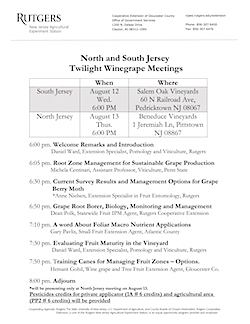
Winegrape Twilight Meetings: North & South Jersey

Dates: August 12 & 13, 2015
See flyer for locations and agenda.

Click to View Flyer

Click to View Flyer

Veg IPM Update: Week Ending 7/29/15

Sweet Corn

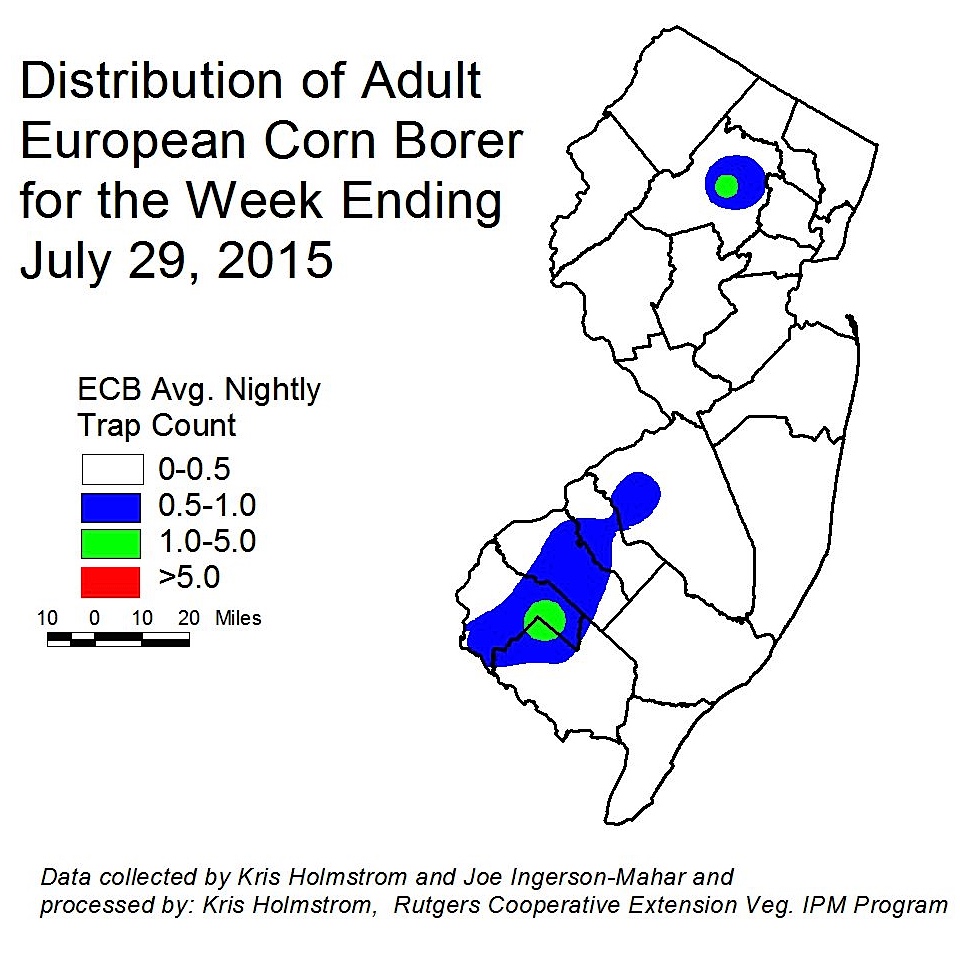
ECB 7-29-2015

Click to View

European corn borer (ECB) adult activity is stable, with low level activity in parts of the state now. This is the beginning of the second adult flight. Areas of highest activity are still along the Delaware Bay Shore and in central Morris County (see ECB map), but areas between should fill in over the next week.

As always, consider treating when the number of infested plants in a 50 plant sample exceeds 12%. Any planting remaining at or above threshold as it proceeds to full tassel should be treated, as this is the last stage at which ECB larvae will be exposed and vulnerable to insecticidal sprays.

See the 2015 Commercial Vegetable Recommendations Guide for insecticide choices.
[Read more…]

Brown Rot Management in a Wet Growing Season: Part III

Brown rot of peach and nectarine fruit results from the interaction of many different factors. In Part I of this series, we discussed the various sources of inoculum and their importance for disease development (see July 21 posting). In Part II, we examined the many facets of spray application technology and [Read more…]
