Archives for June 2013

Marucci Research in Cranberry: Insecticide Trials Against Blunt-nosed Leafhoppers

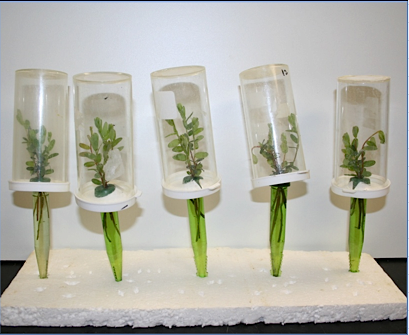
Semi-field bioassay testing efficacy of insecticides on leafhoppers.

Semi-field bioassay testing efficacy of
insecticides on leafhoppers.

Recently we conducted an experiment to test the efficacy of a newly-registered insecticide (Closer SC) in cranberries against blunt-nosed leafhopper nymphs.

Closer (Dow Agrosciences) is an insecticide for the control of sap-feeding insects, including leafhoppers, aphids, and whiteflies. It has both systemic and translaminar activity, belongs to a new class of insecticides (the sulfoximines), and has minimal impact on beneficial organisms.

Insecticide control for leafhoppers is best achieved pre-bloom when targeting the nymphal stage, i.e., immatures. Broad-spectrum insecticides (e.g. Lorsban) are currently recommended for their control. Thus, Closer may provide an alternative to broad-spectrum insecticides and likely be more compatible with biological control because it has less of an impact on natural enemies. [Read more…]

Cranberry: Insect Update 6/28/2013

As we approach the end of bloom, growers should consider the need for any post-bloom applications. The main pest targets for these applications are mainly Sparganothis fruitworm and spotted fireworm. [Read more…]

Tomato Disease Forecasting Report 6-28-13

6-28-13 Tomato Report – Click to Download

Disease severity values (DSVs) for early blight, septoria leaf spot, and tomato anthracnose development are determined daily based on leaf wetness (due to rainfall, dew) and air temperature.

On a daily basis DSV values can range from 0 to 4 where 0 = no chance for disease development to 4 = high chance for disease development.
DSVs are accumulated during the production season.

Fungicide applications are based on an individually determined DSV threshold. The first fungicide application for the control of these three diseases is not warranted until 35 DSVs have accumulated from your transplanting date. After that, growers can base fungicide applications on different DSV thresholds.

Potato Disease Forecasting Report 6-28-13

Potato Disease Forecasting Report 6-28-13 – Click to Download

We will be tracking DSVs for Late blight development and calculating P-days for initiating the first early blight fungicide application.

The first late blight fungicide application is recommended once 18 DSVs accumulate from green row. Green row typically occurs around the first week in May in southern New Jersey. An early season application of a protectant fungicide such as mancozeb (Dithane, Manzate, Penncozeb) or Bravo (chlorothalonil) as soon the field is accessible is suggested. Please be vigilant and keep a look out for suspect late blight infections on young plants. No late blight has been reported in our region to date.

Remember the threshold for P-days is 300!  Once 300 P-days is reached for your location early blight fungicide applications should be initiated. Growers who are interested in using this model should chose the location above that is closest in proximity to their farming operation and should regularly check the Cornell NEWA website (http://newa.cornell.edu/) where this information is compiled from. Click on Pests Forecasts from the menu, select your weather station, and click on tomato diseases, set accumulation start date and a table of daily and total DSVs will be generated.

Wheat Harvest and Storage

Wheat is being harvested, or is ready to be harvested, in a good portion of the state, but high temperatures, high humidity and predicted rain showers daily for the next week have the potential to cause problems.

Where large amounts of rain fall, getting combines into the field may be difficult. Where fields are passable, grain may be mature but high in moisture. It is important to get wheat out of the field quickly after the kernals have matured to avoid loss of yield, reduced quality and ultimately sprouting in the heads. Combines operate most efficiently and with less kernal damage when grain moisture is between 13-20%. If wheat is harvested much above 14% it needs to be dried relatively quickly to prevent sprouting in storage. Wheat is harder to dry than corn because of the high humidity this time of the year and because it packs tighter than corn thus grain depths in the bin need to shallower or fan speeds/volumes greater.

The following links to publications from Purdue University and the University of Missouri may be useful if the current weather conditions persist and problems are encountered.

Annual Bluegrass Weevil Adults Emerging: What Now?

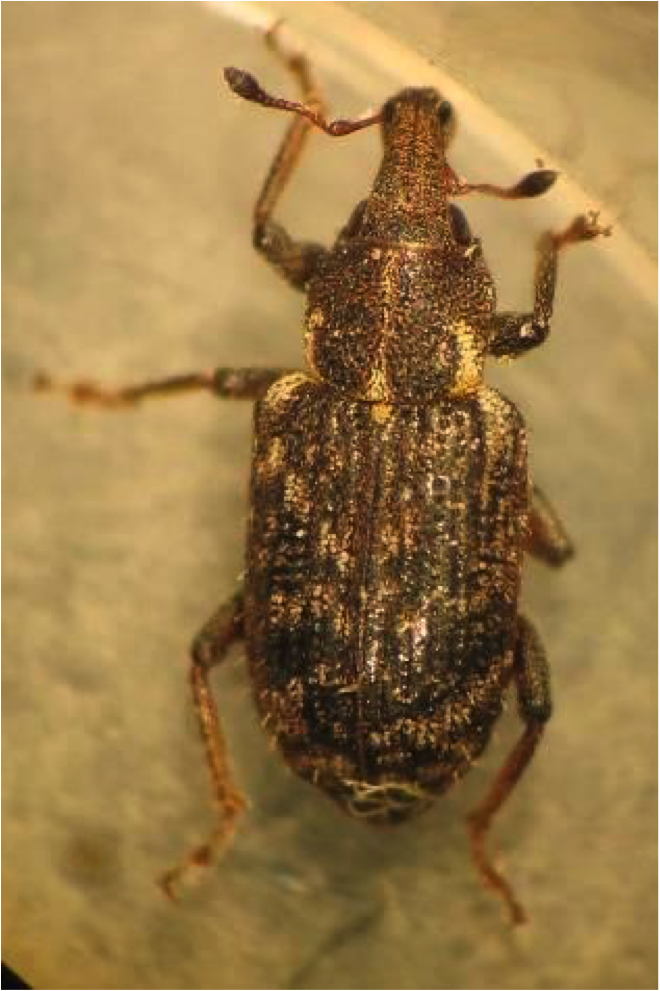
Annual Bluegrass Weevil

Annual Bluegrass Weevil
Photo: B. McGraw

Adults of the annual bluegrass weevil (ABW) spring generation have started to emerge in significant numbers over the last few days at Rutgers Hortfarm 2 in New Brunswick and at golf courses in North Jersey. Peak densities of new ABW adults should occur throughout the central and northern New Jersey and the NY metropolitan area over the next 1-2 weeks.

These spring-generation adults mate and will start laying eggs quickly. The resulting second generation is present predominantly as large larvae around late July-early August, when additional damage — usually less severe than spring damage — may occur. The second generation pupates in August and starts emerging as adults around mid-August.

Areas where significant adult densities are observed (directly, in clippings, with soap irritant, or by vacuum sampling) in late June-early July may need to be treated. However, overuse of insecticides, particularly of pyrethroids, is likely to lead to the development of pesticide-resistant ABW populations. To avoid this highly undesirable scenario insecticides should be applied only where and when necessary and pyrethroids should be used no more than once per year. [Read more…]