Vegetable Disease Briefs – Late blight reported, 9/8/14

  • Late blight was confirmed in an organic cherry tomato field near Lawrenceville, NJ in Mercer County on 9/8. All tomato growers should continue to scout on a daily basis. Weather conditions have been ideal with the heavy, scattered rain and humid conditions over the past few days across much of the state.
  • There have also been scattered reports of late blight have been reported in PA and VA over the past couple weeks.
  • Conditions for downy mildew development on many crops have been ideal this past week with the scattered heavy rains, cooler night temperatures and dewy mornings. Downy mildew has been reported on cucumber, basil, and crucifer crops in our area. Remember, the fungicides recommended for controlling downy mildew are specific and need to be incorporated into weekly maintenance applications.
  • Cucurbit powdery mildew remains active on many cucurbit crops.


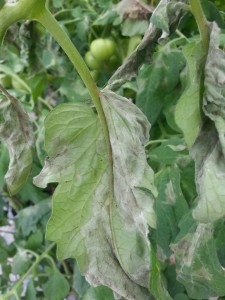
Late Blight on Tomato in Virginia

Late blight was reported on tomato in Leesburg, Virginia on 7/21. Leesburg is Northwest of Washington, DC. There have been scattered reports of late blight in the region this summer.

This is a good reminder for all tomato and potato growers in New Jersey and surrounding region to scout on a regular basis. No late blight has been reported in New Jersey to date. For more information on late blight and to track its progress in the US please visit USAblight.

Late Blight Reported in Erie County, NY and Cambria Couny, PA

Late blight was reported on potato in Erie County, New York and Cambria County, PA (west central) late last week. This is the first report of late blight in PA this season. There are also suspected cases of late blight are being reported on potato and tomato in Lancaster County, PA.

All tomato and potato growers in New Jersey should begin to scout their fields on a regular, if not daily basis. There have been no reported cases of late blight in New Jersey to date! However, all growers (conventional and organic) who have not initiated protectant fungicide maintenance programs should consider doing so. For organic growers, preventative copper applications should be considered. For more information on controlling late blight please see the 2014 Commercial Vegetable Fungicide Recommendations Guide.

Late Blight Confirmed on Organic Tomato in South Jersey

Late blight was confirmed in an organic tomato field late last week south of Bridgeton, New Jersey. As a note, growers who are still picking tomatoes should continue to scout up until the final pick and destroy field as soon as possible once harvesting is finished either by applying gramoxone or discing under plant material. Growers with late blight issues this growing season should be especially diligent. The threat of late blight in our area will remain up until the first frost. Late blight has the potential to overwinter in our area on infested potatoes left in cull piles or unharvested tubers left in the field.

Late Blight Reported: S.NJ Greenhouse Tomato – 9/21/13

An isolated case of Late blight has been confirmed in Southern New Jersey on a farm that was growing both field-grown and greenhouse-grown tomatoes. The pathogen originated in an old tomato planting that had been unsprayed since the last pick over 6 weeks ago. Left unscouted, the field developed Late blight and the pathogen moved into the greenhouse operation within days of an otherwise healthy-looking greenhouse tomato crop.

As a reminder any crop, conventional or organic, left standing in a field after last harvest will only act to serve as a source of potential incoculum for many diseases. As with tomatoes and other crops, all should be disced down, tilled, and/or mowed down as soon as possible after harvest. Conventionally, applying the herbicide, gramoxone, is also an easy way to achieve this. Organic growers need to be just as diligent and disc down, till, or pull old plantings soon after use.

For more on the control of Late blight in tomato please see the 2013 Commercial Vegetable Production Recommendations Guide.

Late blight in Greenhouse Tomato

Late blight in Greenhouse Tomato

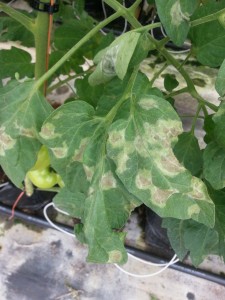
Late blight lesions developing on a greenhouse grown tomato plant.
Under dryer, less humid conditions the lesions may not have the characterstic dark, greasy appearance.

Late blight in GH Tomato; Leaf Underside

Late blight in GH Tomato
Leaf Underside

Late blight sporulating on the underside of an infected tomato leaf.
Note the pure white sporangia (spores) on the underside of the leaf.

Vegetable Disease Briefs – 9/20/13

Late blight has been reported in tomato on an organic farm near Long Valley in Morris County, New Jersey. The cooler weather along with longer periods of leaf wetness lasting into the morning hours this time of year makes conditions ideal for potential Late blight development. As a reminder, once fields or blocks of tomatoes are finished, care should be taken to burn down, remove, or disc down the foliage. Fields left un kept can act as a source of inoculum. Tomato fields should be scouted on a regular basis. Regular protectant fungicide programs should continue as long as fields or blocks are in production. Organic tomato growers can apply an OMRI-approved copper fungicides to help suppress late blight development.