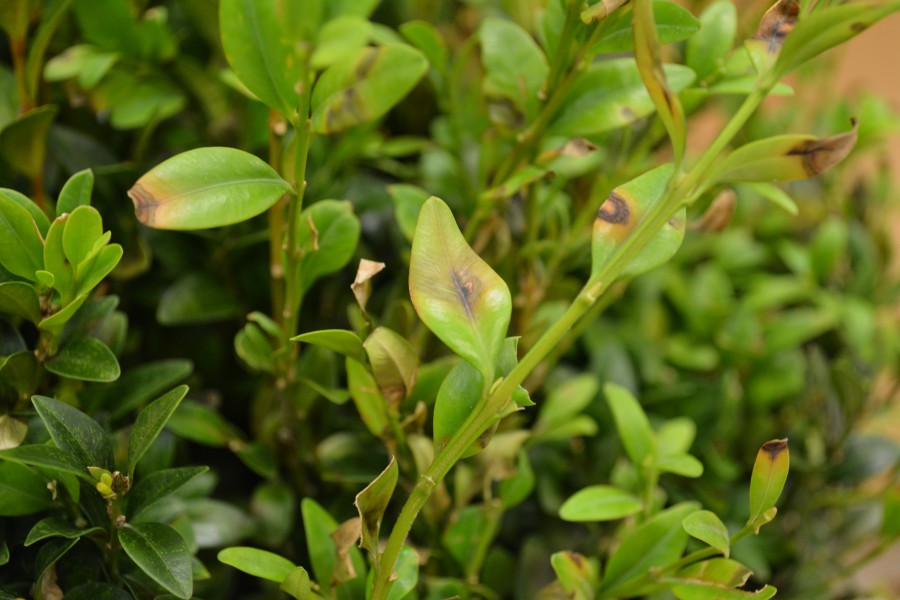
Infection potential for Boxwood Blight in the next 48h – PROTECTANT fungicide applications should remain in effect

There is a potential for new boxwood blight infections today and tomorrow with the rain/humidity and higher temperatures

– Protective fungicide applications should remain in effect or be initiated immediately for Boxwood Blight (nursery and landscape settings) –


Boxwood Blight risk-model information, considerations, and links:

Boxwood Blight Risk Assessment as of 5/4/2021
Region Location CODE 3-May 4-May 5-May 6-May 7-May 8-May
Southern Upper Deerfield NJ50 Very Low  Infection Risk Infection Risk Very Low  Very Low  Very Low 
Central Howell / Freehold NJ10 Very Low  Low  Low  Very Low  Very Low  Very Low 
Northern High Point NJ59 Very Low  Very Low Low  Very Low  Very Low  Very Low 
Please check your local boxwood blight risk here (click here and type in your area code – select closest station)


  • These advisories are general in nature and change rapidly so someone from your business should be using this risk model (CLICK HERE) daily if boxwood is important to your financial stability – In 30 seconds you can have a better idea of boxwood blight (and other pathogen) activity in your immediate area!
    • (click on the link – input area code – select closest weather station – check 7-14 prediction – click on graph / table) 

Fungicides; 

  1. You very well may have these materials already applied as ‘cover-sprays’ – But – be mindful that protectant fungicides loose efficacy the more rain they are subjected to, and reapplication may be warranted.
  2. ROTATE between Fungicide Resistance Action Committee (FRAC codes) whenever possible

Format: [FRAC code]: Chemical name (Trade names)

  • [M05]: Chlorothalonil (Daconil WS)
  • [M05 + 1] Chlorothalonil + Thiophanate methyl (Spectro 90WDG)
  • [11] Trifloxystrobin + [7] Fluopyram  (Broadform)
  • [11] Trifloxystrobin + [3] Triadimefon (Armada 50WDG)
  • [M03] Mancozeb
  • [12] Fludioxonil (Medallion WDG)
  • [3] Tebuconazole (Torque)


DISCLAIMER: The label is the law, always refer to it for allowable host crops, use-restrictions, application rates, reapplication intervals, re-entry intervals (REI), and mix compatibility information. Production and pesticide information on this site are for private/commercial pesticide applicators and landscape professionals only, and are NOT for home gardener use. Provided materials represent examples and do not cover all possible control scenarios. Trade-names listed do not imply endorsement and are used as examples only. Please contact your local agent or chemical sales representative for more information or to discuss additional pest management options.

Resources 

Nursery and Landscape Pest Scouting Guide: 150-250 Growing Degree-days and Boxwood Blight Risk ( currently = low risk )

Nursery and Landscape Pest Scouting Guide 150-250 GDD50:

Please print or download these resources (click on them)

Remember:

  • To determine your local growing degree-days, please review this postObtaining your local growing degree-day information”
  • The information provided in the downloads gives scouting GDD50 ranges (in growing degree days, base 50F) for specific insect pests harming nursery crop production and maintenance. It is important to note that these GDD50 are not exact, rather provide a range of GDD and subsequent calendar dates that can be used to scout for, and treat for, insect pests.
  • This document supports scouting, it does not replace it. Keeping good notes on pest development will help dial in scouting and treatment efforts at your local level.
  • Forecasting predictions (GDD50 accumulation) for calendar dates of multiple regions of New Jersey (S,N,C) are provided.
  • If you need more information, OR you are regularly seeing specific pest development stages at growing degree-days different than those listed here, please contact Tim Waller at twaller@njaes.rutgers.edu

GREAT RESOURCE from Steve Rettke:Landscape Pest Notes: Some Early Spring Insects/Mites”


Projected GDD50 accumulation as of 4/15/2021
Region Location 4/15/21 1-Apr 1-May 1-Jun 1-Jul Aug. 1st
Southern Upper Deerfield (NJ50) 141 75 230 636 1314 2156
Central Howell / Freehold (NJ10) 94 67 165 513 1135 1929
Northern High Point (NJ59) 50 21 56 268 721 1327
Forecast: NOAA NCEP Coupled Forecast System model version 2 (CFSv2) forecast system (3.5 months) (USPEST.ORG)


Pest Scouting – Growing Degree-day Ranges (150-250 GDD50)
CROP TYPE Common Name Scientific Name GDD Min (50F) GDD Max (95F) Reference Developmental / Target Stage
Malus, Prunus, many Eastern tent caterpillar Malacosoma americanum 90 190 2 Larvae treatment before tents apparent (near 150-GDD50)
Elm, Service berry Woolly elm aphid Eriosoma americana 121 246 2 (6) Control target
Conifer Hemlock woolly adelgid Adelges tsugae 150 150 RU Eggs and 10% hatch
Conifer Spruce spider mite Oligonychus ununguis 150 175 4 1st egg hatch
Conifer Spruce needleminer Endothenia albolineana 150 200 4 1st larvae active
Conifer Balsam gall midge Paradiplosis tumifex 150 300 4 Adults laying eggs
Witchhazel, River birch Spiny witchhazel gall aphid Hamamelistes spinosus 171 6 Control target
Birch Birch leafminer Fenusa pusilla  190 290 RU Larvae (1st generation)
Conifer Spruce spider mite Oligonychus ununguis 190 363 RU Immatures/Adults
Honeylocust Honeylocust pod gall midge Dasineura gleditchiae 192 229 RU Larvae
Holly Holly leafminer Phytomyza ilicis 192 290 RU Egg hatch
Holly *Native holly leafminer Phytomyza ilicicola 192 298 2 Egg hatch
Rhododendron Rhododendron borer Synanthedon rhododendri 192 298 2 Typical treatment window
Larch Larch sawfly Pristophora erichsonii 192 299 2 Typical treatment window
Andromeda Andromeda lacebug Stephanitis takeyai 192 303 RU Adults
Rhododendron Rhododendron gall midge Clinodiplosis rhododendri 192 363 RU Larvae
Willows, Cottonwood, Poplar Imported willow leaf beetle Plagiodera versicolora 192 448 RU Larvae/Adults
Privet Privet thrips Dendrothrips ornatus 192 618 2 Typical treatment window
Lilac, ash, privet, many Lilac / Ash Borer Podosesia syringae 200 299 RU Adults – 1st Treatment
Spruce Spruce budworm Choristoneura fumiferana 200 300 5 Larvae
Elm Elm leafminer Fenusa ulmi 215 240 5 Adult emergence
Wild and cultivated roses Roseslug sawfly Endelomyia aethiops 230 6 Egg hatch / early instars
Deciduous, many Hawthorn lacebug Corythucha cydoniae 239 363 RU Nymphs/Adults
Conifer Arborvitae leafminer Argyresthia thuiella 245 360 RU Larvae Treatments
Prunus American plum borer Euzophera semifuneralis 245 440 5 Adult flight, egg laying
Boxwood Boxwood mites Eurytetranychus buxi 245 600 RU All Stages
Lilac Lilac leafminer Caloptilia syringella 246 363 5 Larvae Treatments
Holly Holly leafminer Phytomyza ilicis 246 448 RU Larvae Treatment
Yew Taxus mealybug Dysmicoccus wistariae 246 618 RU Adults/Crawlers
Conifer Pine sawflies (Red-headed) Neodiprion lecontei 246 1388 RU Larvae (1st generation)
Boxwood Boxwood leafminer Monarthropalpusi flavus 249 6 Adult emergence
Conifer Eastern spruce gall adelgid Adelges abietis 250 310 5 egg hatch, galls begin forming (not a control target)
References RU Rutgers Cooperative Extension – IPM Notes
2 http://ccetompkins.org/resources/using-growing-degree-days-for-insect-management
3 https://extension.psu.edu/ipm-basics-for-christmas-trees#section-2
4 https://www.canr.msu.edu/ipm/agriculture/christmas_trees/gdd_of_conifer_insects
5 https://www.agriculture.nh.gov/publications-forms/documents/landscape-pests.pdf
6 https://extension.umd.edu/ipm/pest-predictive-calendar-landscapenursery
7 https://www.canr.msu.edu/ipm/agriculture/christmas_trees/gdd_of_landscape_insects


Boxwood Blight risk-model information, considerations, and links:

Boxwood Blight Risk Assessment as of 4/15/2021
Region Location CODE 15-April 16-April 17- April 18-April 19-April
Southern Upper Deerfield NJ50 Low  Very Low  Very Low  Very Low  Very Low 
Central Howell / Freehold NJ10 Low  Very Low  Very Low  Very Low  Very Low 
Northern High Point NJ59 Very Low  Very Low  Very Low  Very Low  Very Low 
Please check your local boxwood blight risk at (https://uspest.org/risk/boxwood_app)


Considerations:

Become a Boxwood Blight Advocate to receive quarterly updates (through the Horticultural Research Institution)

Heads Up, Boxwood Lovers!

A boxwood per day helps keep the doctors away! All of us here in the Plant Diagnostic Lab must be pretty healthy then–since the boxwood blight outbreak in 2013, we get a dose of dead boxwood almost every day.

Boxwood blight leaf lesions. Photo: Richard Buckley, Rutgers PDL

Boxwood blight leaf lesions. Photo: Richard Buckley, Rutgers PDL

[Read more…]

It’s Back!

Boxwood samples have been coming into the Plant Diagnostic Laboratory on a daily basis since the winter. Most of them have been diagnosed with winter damage, boxwood leafminer, or Volutella stem and leaf blight. Yesterday, we got our first sample with boxwood blight! The situation was typical of several others in New Jersey – new transplants this spring and then a bunch of dead shrubs mid-summer.

Boxwood blight infected sample is in the black plastic bag. Winter damaged boxwood sample is on the counter. Photo: Richard Buckley, Rutgers PDL

Boxwood blight infected sample is on the floor in the black plastic bag. Winter damaged boxwood sample is on the counter. Photo: Richard Buckley, Rutgers PDL

Just a short note today to keep you on your toes! And by the way, please notice how the sample was submitted – an entire plant, double-bagged…

Fly, Boxwood Leafminers Fly!

If you haven’t noticed, spring has sprung in earnest. Spring flowering trees and shrubs have popped and are already fading. The buds of many other plants are breaking everywhere. Right along with the plants come the critters.

Freshly emerged Boxwood leafminer adult and pupal exuviae

Freshly emerged Boxwood leafminer adult and pupal exuviae. Photo: Sabrina Tirpak, Rutges PDL

[Read more…]

BBR – Boxwood Blight Revisited

I heard through the grapevine about a site with some dead boxwoods, so I went to take a look and here is what I saw.

Boxwood garden. Photo: Richard Buckley, Rutgers PDL

Boxwood garden. Photo: Richard Buckley, Rutgers PDL

[Read more…]