Search Results for: basil downy mildew

IPM Update 6/19/19

Sweet Corn

European corn borer (ECB) moths catches have declined to very low levels over the past week and no map will appear in this edition.  The first flight is complete.  Feeding percentages have stabilized, and no new feeding should occur until the second flight arrives.

Growers should continue to scout whorl and pre-tassel stage plantings weekly and consider treating when infested plants exceed 12% in a 50 plant sample.  As plantings proceed to the pre-tassel stage, ECB larvae may be found in emerging tassels.  It is a good idea to treat individual plantings as they move into the full tassel/first silk stage one time.  This eliminates any ECB larvae that have emerged with the tassels as they begin to move down the stalk to re-enter near developing ears.

Useful insecticides for this particular application include synthetic pyrethroids (IRAC Grp 3), spinosyns (including OMRI approved Entrust) IRAC Grp 5), and diamides such as Coragen (IRAC Grp 28) or materials such as Besiege which include the active ingredient in Coragen.  Synthetic pyrethroids alone should NOT be used for corn earworm (CEW) protection on silking corn.  Control with these materials is very inconsistent.

The highest nightly trap catches of ECB for the week ending 6/19/19 are as follows:

Crosswicks   1 Milltown   1
Milford   1 South Branch   1


Scattered corn earworm (CEW) moths continue to be captured in southern NJ blacklight traps through early this week (see blacklight map at left) although these catches have declined since last week.   Early plantings, now silking, are at risk of infestation from this pest.

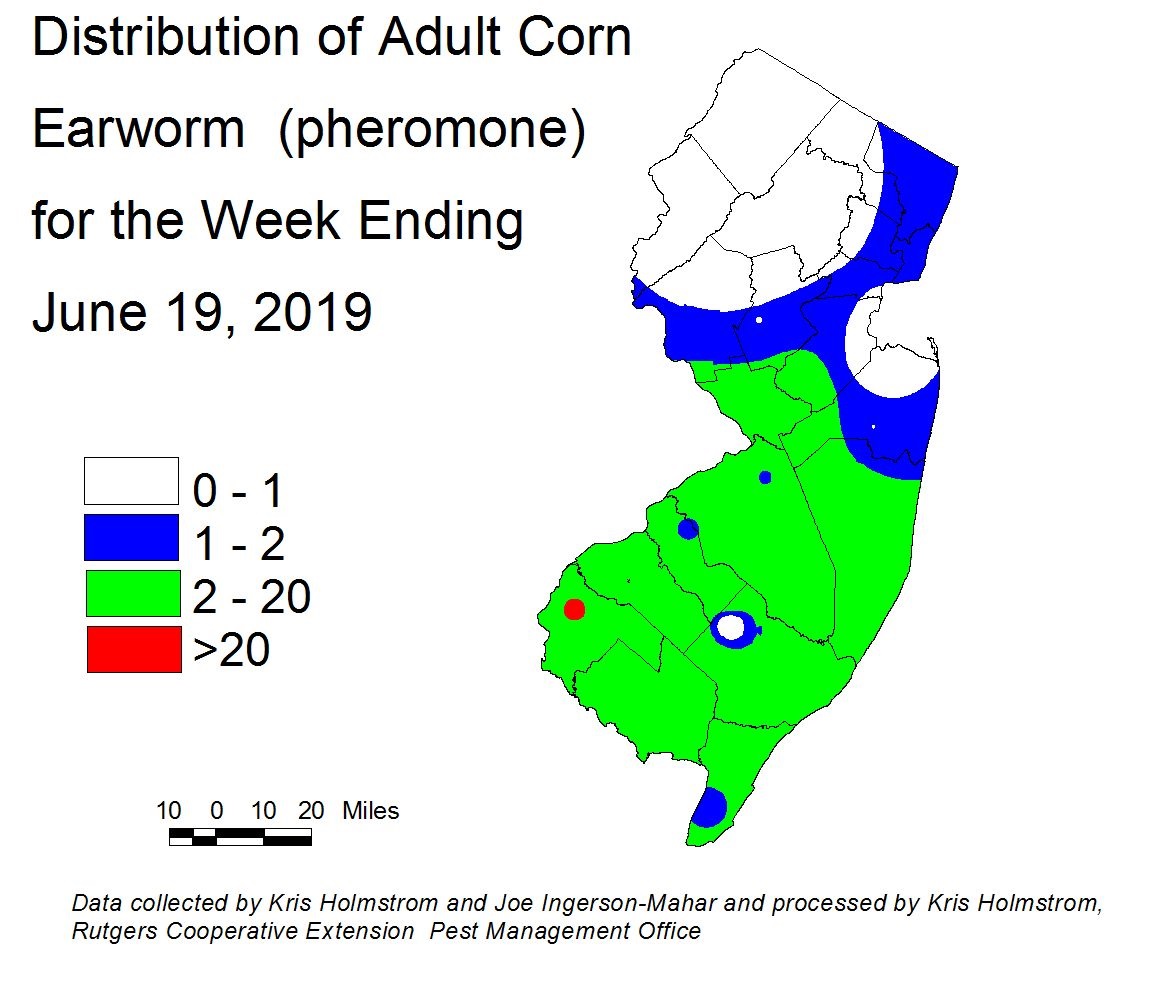
In the CEW pheromone trap network, catches have also declined but remain highly variable, with higher numbers in the south, and very low activity in northern NJ (see pheromone map  below at right). The green area on the pheromone trap map indicates a 4-5 day silk spray schedule. Blue areas represent a 5-6 day schedule, and white areas are 6-7 day.  There are far fewer CEW pheromone traps than blacklights, and the resulting map has much broader color bands as a result.  It should also be noted that the pheromone traps are much more sensitive than blacklights.  Therefore, the number of moths caught in pheromone traps required to generate a specific spray interval is much higher than the number caught in blacklight traps.   It must be stressed that there is high variability in these catches, and growers should consult with their IPM practitioner on recommended spray schedules.

[Read more…]

Vegetable Disease Update – 5/21/19

  • The cool, damp weather the past week has been ideal for downy mildew development on spring crops. Growers are advised to scout fields on a regular basis
  • The heavy rains and damp, cool weather have been ideal conditions for early-season damping off caused by Pythium. Growers should continue to scout on a regular basis and remain proactive in their fungicide programs as long as current weather patterns continue.
  • Cercospora leaf spot on swiss chard has been reported.
  • Bacterial leaf spot of parsley has been reported.
  • Basil downy mildew has been reported in greenhouses in North Carolina.
  • Cucurbit downy mildew has been reported as far north as St. Lucie County, Florida.
  • For more information on controlling these and other important diseases please see the 2019 Mid-Atlantic Commercial Vegetable Production Guide. The guide is available for FREE online by following the links on the Plant and Pest Advisory website. Hardcopies of the 2019 guide can be purchased through your local county Extension office.

Vegetable Disease Update – 10/01/18

  • Anthracnose fruit rot has been found on pumpkin.
  • Bacterial stalk rot in sweet corn has been reported.
  • Downy mildew has been reported in bok choy. Cole crops, as well as leafy greens, need to be scouted on a regular basis and preventative sprays applied as long as wet weather continues.
  • Pepper anthracnose has been reported. If found in field, weekly fungicide maintenance sprays are needed. Abandoned fields should be mowed down immediately.
  • Bacterial leaf spot and Phytophthora blight and fruit rot remain active in pepper and cucurbit crops.
  • Alternaria leaf spot has been reported on broccoli.
  • Anthracnose has been reported in turnip.
  • Cercospora leaf spot has been reported on swiss chard and beets.
  • Basil downy mildew is being reported. Recent weather has been ideal for its development. For more information on Rutgers newly-released DMR sweet basils Obsession, Devotion, and Thunderstruck please click here. Follow the Rutgers Basil Downy Mildew Breeding Program on Instagram at #RutgersBasil

Vegetable Disease Update – 9/18/18

  • Cucurbit downy mildew. All cucurbit growers should scout their fields on a regular basis and inlcude a downy mildew specific fungicide to their weekly maintenance sprays.
  • The 2018 FRAC Table for Cucurbit Downy and Powdery Mildew Control in the mid-Atlantic Region can be found and downloaded for FREE here and is essential for developing control strategies for both diseases.
  • Bacterial stalk rot in sweet corn has been reported.
  • Downy mildew has been reported in bok choy. Cole crops, as well as leafy greens, need to be scouted on a regular basis and preventative sprays applied as long as wet weather continues.
  • Pepper anthracnose has been reported. If found in field, weekly fungicide maintenance sprays are needed. Abandoned fields should be mowed down immediately.
  • Alternaria leaf spot has been reported on broccoli.
  • Anthracnose has been reported in turnip.
  • Late blight has been reported on tomato in Western PA. There have been no reports of late blight in the immediate region.
  • Bacterial leaf spot and Phytophthora blight and fruit rot remain active in pepper and cucurbit crops.
  • Cercospora leaf spot has been reported on swiss chard and beets.
  • A nice article by Dr. Beth Gugino, Penn State, on gray mold and late blight in high tunnel tomatoes can be found here.
  • Remember, copper applications on hot days with high relative humidity can cause phytotoxicity on a number of crops.
  • Basil downy mildew is being reported. Recent weather has been ideal for its development. For more information on Rutgers newly-released DMR sweet basils Obsession, Devotion, and Thunderstruck please click here. Follow the Rutgers Basil Downy Mildew Breeding Program on Instagram at #RutgersBasil

Vegetable Disease Update – 8/13/18

  • Cucurbit downy mildew has been confirmed on cucumber, butternut squash, and pumpkin in NJ this growing season. Recent weather has been ideal for its development. All cucurbit growers should scout their fields on a regular basis and consider adding a downy mildew specific fungicide to their weekly maintenance sprays.
  • CDM has been reported in giant pumpkin and cantaloupe in MD this past week, and in acorn, summer squash, watermelon and butternut squash as far north as North Carolina to date.
  • Cucurbit powdery mildew is being reported.
  • The 2018 FRAC Table for Cucurbit Downy and Powdery Mildew Control in the mid-Atlantic Region can be found and downloaded for FREE here and is essential for developing control strategies for both diseases.
  • There have been no new reports of late blight in the region.
  • Basil downy mildew is being reported. Recent weather has been ideal for its development. For more information on Rutgers newly-released DMR sweet basils Obsession, Devotion, and Thunderstruck please click here. Follow the Rutgers Basil Downy Mildew Breeding Program on Instagram at #RutgersBasil
  • Bacterial leaf spot and Phytophthora blight have been reported in pepper and cucurbit crops.
  • Remember, copper applications on hot days with high relative humidity can cause phytotoxicity on a number of crops.
  • Cercospora leaf spot has been reported on swiss chard and beets.

RAREC Vegetable Twilight Meeting and Research Tour

Wednesday, August 22, 2018, 4:00 pm (meet at the shelter near the parking lot)

Rutgers Agricultural Research & Extension Center

121 Northville Rd., Bridgeton, NJ (Upper Deerfield)

Tomato tasting will be at the picnic shelter and the wagon tour will leave at 4:30 pm to visit the trials

Taste the new fresh market tomato breeding lines – Tom Orton, PhD, Specialist in Vegetables

Evaluation of Bell pepper varieties and breeding lines for Bacterial Leaf Spot and Phytophthora Blight Management – Wes Kline, PhD, County Agricultural Agent

Cover crop in watermelon, weed trials in cantaloupe, summer squash and cucumber – Thierry Besancon, PhD, Extension Weed Specialist for Specialty Crops

Basil downy mildew fungicide control trial – Andy Wyenandt, PhD, Specialist in Vegetable Pathology

Basil downy mildew variety trial featuring new Rutgers bred Varieties Devotion DMR, Obsession DMR, and Thunderstruck DMR – Andy Wyenandt, PhD, Specialist in Vegetable Pathology

Basil trial featuring an organic and conventional basil downy mildew control program with new Rutgers DMR lines vs downy mildew susceptible lines. – AJ Noto, Graduate Student, Department of Plant Biology

Basil downy mildew breeding and chilling tolerance trial update – Robert Mattera, Graduate Student, Department of Plant Biology

Sweet Corn demonstrating the differences/effectiveness of Non-Bt, Providence Bt, and Attribute II Bt varieties for resistance to Corn Earn Worm and Fall Army Worm – Joe Ingerson-Mahar, PhD, Vegetable IPM Coordinator

Evaluation of Yacon as a Potential New Specialty Crop for New Jersey Farmers – Rick VanVranken, Rutgers Cooperative Extension of Atlantic County and Peter Nitzsche, Rutgers Cooperative Extension of Morris County

Fresh market tomato breeding lines and tomato tasting – Tom Orton, PhD, Specialist in Vegetables

Pesticide Credits Available                                                                                          Units

10                        Demonstration & Research                                                                  2
1A                       Agricultural Plant                                                                                   10
PRIV                    Private Applicator Exam                                                                         10