Organic Farm Advisory

The Plant & Pest Advisory serves NJ growers by reporting on important pests and recommending responses that are grounded in reproducible trials.

Articles in this section contain information helpful to the NJ commercial organic grower.


Sharing organic practice trial results between land-grant universities is a cost effective way to create a common knowledge base built on the strengths of individual programs. In the sidebar, find institutions with programs in organic agriculture which augment knowledge developed at the Rutgers New Jersey Ag Experiment Station.

Rutgers Cooperative Extension Field Guides: These concise guides help with decision making from pre-planting to harvest. For each crop listed, learn what pests to proactively look for as the season progresses, how to look for them, and when to take action.

Field Guide List

Vegetable IPM Update 7/06/22

Sweet Corn

Note:  No trap data from the southern counties is available this week, so maps will not appear in this edition.

European corn borer (ECB) moths remain a sporadic, low component of blacklight trap catches.  Feeding in pre-tassel stage is still present in some areas, but is now less common.  ECB injury over the threshold of 12% of plants infested, while still around, has been declining.

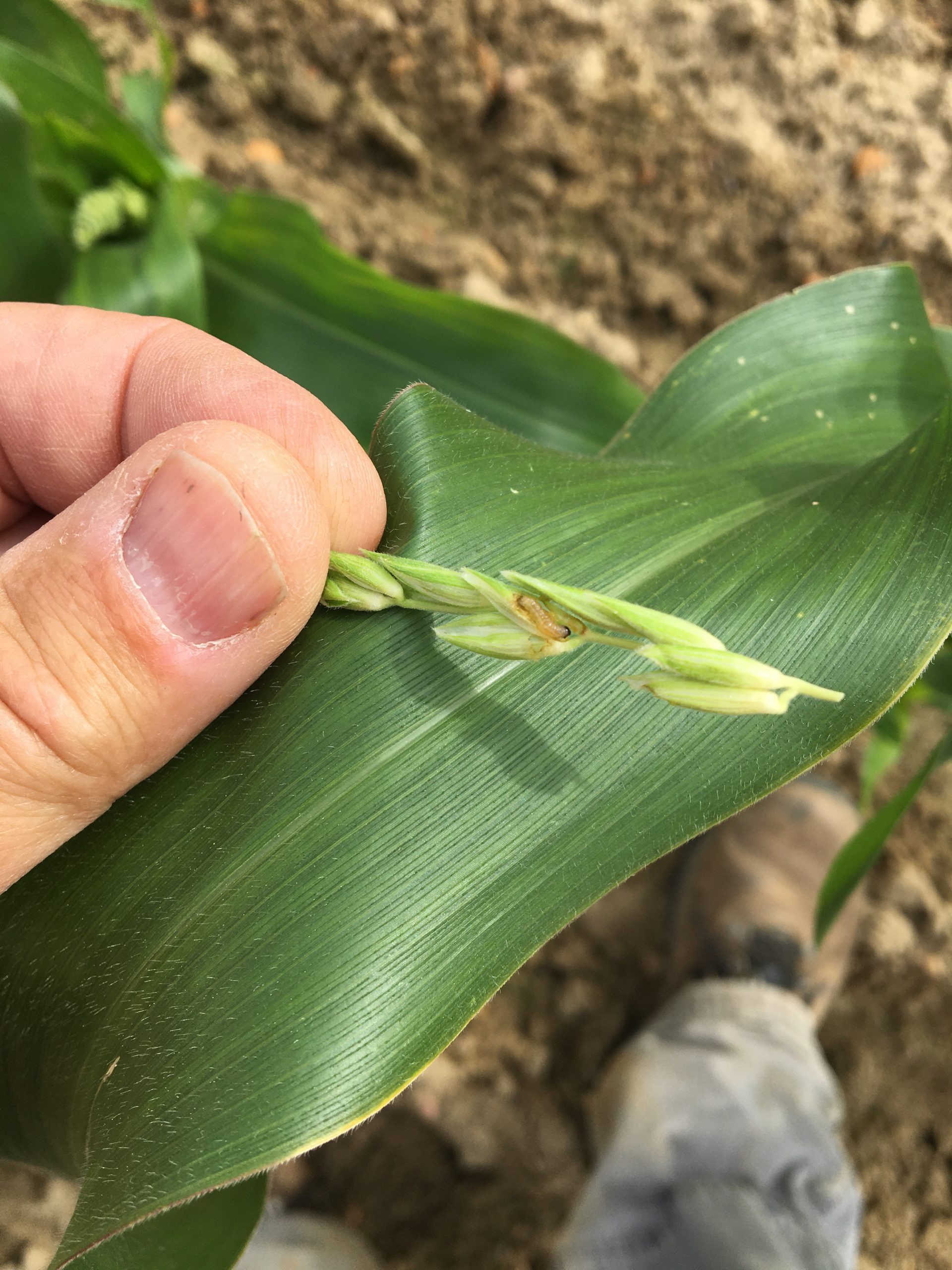
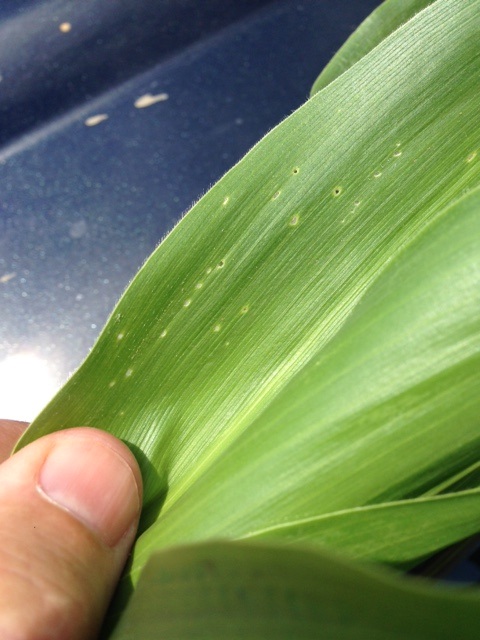
European corn borerGrowers should still examine plantings in whorl or pre-tassel stages for signs of ECB injury.  Look for the characteristic “shot-hole” type of feeding (photo  below at right) and consider treating when infested plants exceed 12% in a 50 plant sample.  As plantings proceed to the pre-tassel stage, ECB larvae may be found in emerging tassels (see photo at left)It is a good idea to treat individual plantings as they move into the full tassel/first silk stage one time.  This eliminates any ECB larvae that have emerged with the tassels as they begin to move down the stalk to re-enter near developing ears.


Useful insecticides for this particular application include synthetic Corn earwormpyrethroids (IRAC Grp 3), spinosyns (including OMRI approved Entrust) IRAC Grp 5), and diamides such as Coragen or Vantacor (IRAC Grp 28) or materials such as Besiege which include the active ingredient in Coragen.  Synthetic pyrethroids alone should NOT be used for corn earworm (CEW) protection on silking corn.  Control with these materials is very inconsistent. [Read more…]

Controlling basil downy mildew in the field in 2022

For over a decade, basil downy mildew (BDM) has caused significant losses in basil grown in organic and conventional field and greenhouse production across the United States. At the time of its introduction, there were very few fungicides labeled for its control making it nearly impossible to grow a successful crop in many areas of the country. [Read more…]

Vegetable IPM Update 6/29/22

Sweet Corn

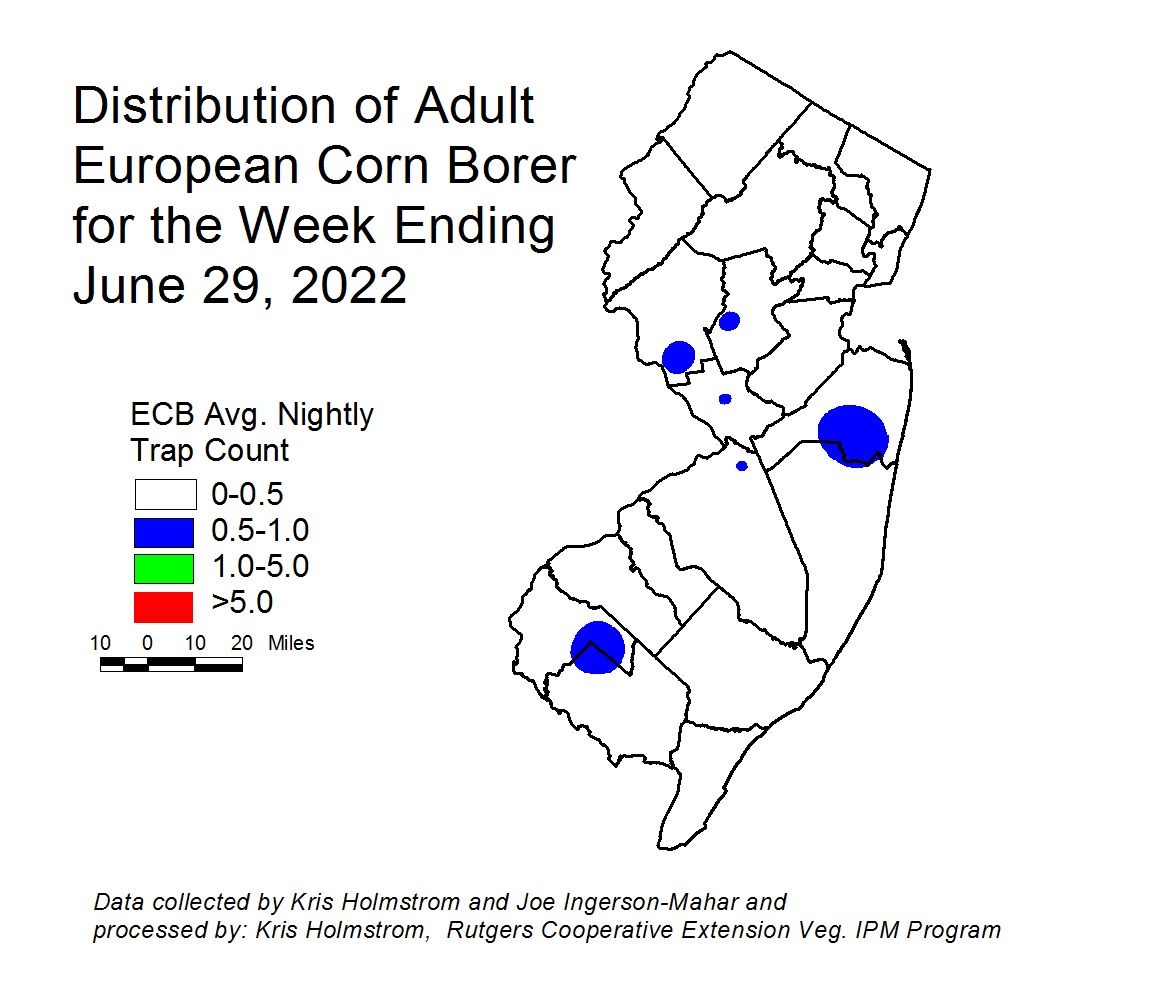
Low numbers of European corn borer (ECB) moths remain a sporadic, low component of blacklight trap catches.  Feeding in whorl and pre-tassel stage is now less common, as control has been applied to infested plantings and later blocks (now in whorl stage) have avoided most of the egg laying period.  Slightly higher adult activity is in scattered pockets around the state (see map below at right).  ECB injury over the threshold of 12% of plants infested, while still around, has generally been declining over this past week.   We expect feeding wind down over the next week or so as we move into the period between generations.European corn borer

Weekly distribution of European corn borerLook for the characteristic “shot-hole” type of feeding (photo  below at right) and consider treating when infested plants exceed 12% in a 50 plant sample.  As plantings proceed to the pre-tassel stage, ECB larvae may be found in emerging tassels (see photo at left)It is a good idea to treat individual plantings as they move into the full tassel/first silk stage one time.  This eliminates any ECB larvae that have emerged with the tassels as they begin to move down the stalk to re-enter near developing ears.


Useful insecticides for this particular application include synthetic European corn borerpyrethroids (IRAC Grp 3), spinosyns (including OMRI approved Entrust) IRAC Grp 5), and diamides such as Coragen or Vantacor (IRAC Grp 28) or materials such as Besiege which include the active ingredient in Coragen.  Synthetic pyrethroids alone should NOT be used for corn earworm (CEW) protection on silking corn.  Control with these materials is very inconsistent.

The highest nightly trap catches of ECB for the week ending 6/29/22 are as follows:

Bellemeade   1 Farmingdale   1 Morristown   1
Blairstown   1 Georgetown   1 New Egypt   1
Centerton   1 Lawrenceville   1 Princeton   1
Crosswicks   1 Matawan   1 Sergeantsville   1

[Read more…]

Organic Production: Suppressing Soil-borne Pathogens in 2022

Pathogens such as Fusarium, Pythium, Phytophthora, Thielaviopsis and Rhizoctonia that cause pre- and post-emergent damping-off can cause serious problems in organic (and conventional) production.
The key to controlling and/or suppressing damping-off pathogens with biological controls is keeping the biological populations high and continually present on root surfaces of the host, and by following good cultural practices. [Read more…]

Vegetable IPM Update 6/22/22

Sweet Corn

Low numbers of European corn borer (ECB) moths continue to be captured at levels similar to last week, and feeding in whorl and pre-tassel stage corn more common.  The highest adult activity remains in Hunterdon County (see map below at right).  ECB injury over the threshold of 12% of plants infested has been found in many areas this week.   It is typical for feeding percentages to rise as the moth catch declines.  We expect feeding to increase for the next week or so before peaking.European corn borer

Weekly distribution of European corn borerLook for the characteristic “shot-hole” type of feeding (photo  below at right) and consider treating when infested plants exceed 12% in a 50 plant sample.  As plantings proceed to the pre-tassel stage, ECB larvae may be found in emerging tassels (see photo at left)It is a good idea to treat individual plantings as they move into the full tassel/first silk stage one time.  This eliminates any ECB larvae that have emerged with the tassels as they begin to move down the stalk to re-enter near developing ears.


Useful insecticides for this particular application include synthetic European corn borerpyrethroids (IRAC Grp 3), spinosyns (including OMRI approved Entrust) IRAC Grp 5), and diamides such as Coragen or Vantacor (IRAC Grp 28) or materials such as Besiege which include the active ingredient in Coragen.  Synthetic pyrethroids alone should NOT be used for corn earworm (CEW) protection on silking corn.  Control with these materials is very inconsistent.

The highest nightly trap catches of ECB for the week ending 6/22/22 are as follows:

Sergeantsville   2 Califon   1 Old Bridge   1
Allentown   1 Clinton   1 Pedricktown   1
Asbury   1 Dayton   1 Princeton   1
Bellemeade   1 Hillsborough   1 South Branch   1

[Read more…]

Vegetable IPM Update 6/15/22

Sweet Corn

Low numbers of European corn borer (ECB) moths continue to be captured, and feeding in whorl stage corn is rising.  The highest adult activity is currently Hunterdon County (see map below at right).  ECB injury over 60% of plants infested has been found in southern Hunterdon County this week.  While this level of feeding is unusually high, ECB has become something of a local phenomenon in NJ, and growers should not assume that feeding is below economic levels in their area.   It is typical for feeding percentages to rise as the moth catch declines.  We expect feeding to increase for the next 1-2 weeks before peaking.

Look for the characteristic “shot-hole” type of feeding (photo  below at right) and consider treating when infested plants exceed 12% in a 50 plant sample.  As plantings proceed to the pre-tassel stage, ECB larvae may be found in emerging tassels (see photo at left)It is a good idea to treat individual plantings as they move into the full tassel/first silk stage one time.  This eliminates any ECB larvae that have emerged with the tassels as they begin to move down the stalk to re-enter near developing ears.


Useful insecticides for this particular application include synthetic pyrethroids (IRAC Grp 3), spinosyns (including OMRI approved Entrust) IRAC Grp 5), and diamides such as Coragen or Vantacor (IRAC Grp 28) or materials such as Besiege which include the active ingredient in Coragen.  Synthetic pyrethroids alone should NOT be used for corn earworm (CEW) protection on silking corn.  Control with these materials is very inconsistent.

The highest nightly trap catches of ECB for the week ending 6/15/22 are as follows:

Sergeantsville   2 Dayton   1 Pedricktown   1
Bellemeade   1 Downer   1 Pennington   1
Califon   1 Folsom   1 Port Murray   1
Crosswicks   1 Milltown   1 South Branch   1

[Read more…]