Traffic Alert: Damage Threat is High

Damage to landscapes from traffic can be severe during winter and especially now during the thaw. Soil conditions currently range from being frozen to partially thawed/frozen to thawed.

Partially frozen soil will be thawed and very wet at the surface while being frozen at some depth below. Under this condition, soil and turf will be extremely vulnerable to shearing and rutting damage. Traffic, even light foot traffic, must be withheld when this condition exists otherwise severe rutting (soil displacement) will occur.

Severe rut caused by a wheeled vehicle driving on partially thawed soil.

Severe rut caused by a wheeled vehicle driving on partially thawed soil.

[Read more…]

Winter Thaw about to Begin

If the 10-day forecasts are correct, the winter thaw we’ve all been waiting for is about to begin this weekend.

Turf-Winter-Thaw

Winter thaw: the most common time “nonpoint” or “runoff” phosphorus pollution enters lakes and streams.

 
As managers of landscapes, we need to keep in mind that:

  • Sediment is the primary source of phosphorus (large quantities of phosphorus are attached to sediment)
  • Most phosphorus runoff from turfgrass comes during winter
  • Improving soil quality is one of the most effective way to reduce nutrient losses from urban areas
  • Dense ground cover is good for the urban environment

[Read more…]

Plastic Pesticide Container Recycling Dates

The NJ Dept. of Ag, Helena Chemical, Allied Recycling, and the Cumberland County Solid Waste Complex are offering dates for free plastic pesticide container recycling disposal. These are offered to agricultural, professional and commercial applicators holding a NJDEP Pesticide Applicators License. State, county and municipal government agencies may also participate.

Dates and locations are listed below.

Questions? Contact:
Roberta C. Lang
New Jersey Department of Agriculture
Division of Agricultural and Natural Resources
Phone: 609.292.2242
Fax: 609.633.7229
[Read more…]

Soils Are Cooling – That’s Good and Bad

Recently, surface soil temperatures have been dropping below 70° F at night. While this is a good temperature range for growth of cool season grasses, it is a signal that much cooler soils are not far away. Grow of new seedings, overseedings, and turfs needing recovery will slow dramatically once soil temperatures break below the 60° F threshold. We have reached the time (October 1) where we no longer recommend seeding of most grasses except perennial ryegrass. Perennial ryegrass can be seeded as late as October 15 and still have high probability of develop a stand of turf.

Cool Weather Affects Seedling Establishment

Cool weather limits the establishment of new seedings. In this photo,
poor seed to soil contact will also inhibit establishment of new turf.


[Read more…]

Localized Drought Stress is Here

As stated in an early post, summer stress is developing throughout the state. Summer stress isn’t widespread or severe but it is developing, particularly wilt stress, within very localized areas of many landscapes. Landscapes that receive little to no irrigation are especially prone to wilt and drought stress right now.

Turf Subtle Wilt Stress

6-22: Symptoms of subtle wilt stress. Healthy turf will likely to tolerate this level of wilt stress.

Turf Advanced Wilt Stress

6-25: More advanced symptoms of wilt stress. Suspend mowing until rain or irrigation restores soil water.


[Read more…]

Crabgrass Emerging

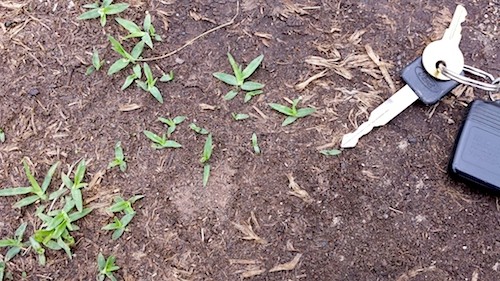
Crabgrass has been emerging for several weeks now, depending on the exposure. Warmer and more open turfs will likely have more advanced (larger) plants while cooler and denser turfs will have smaller plants.
Management options for this weed at this point in the season range from doing nothing to postemergence herbicide applications.

Emerging Crabgrass

Relatively small crabgrass plants (most pre-tillering stage) emerging
from a footpath on June 11th.

[Read more…]