Tree Fruit Edition

Seasonal updates on insects, diseases, weeds, maturity dates and cultural practices impacting only tree fruit.
 
Subscriptions are available via EMAIL and RSS.

Insecticide Trial Results for BMSB

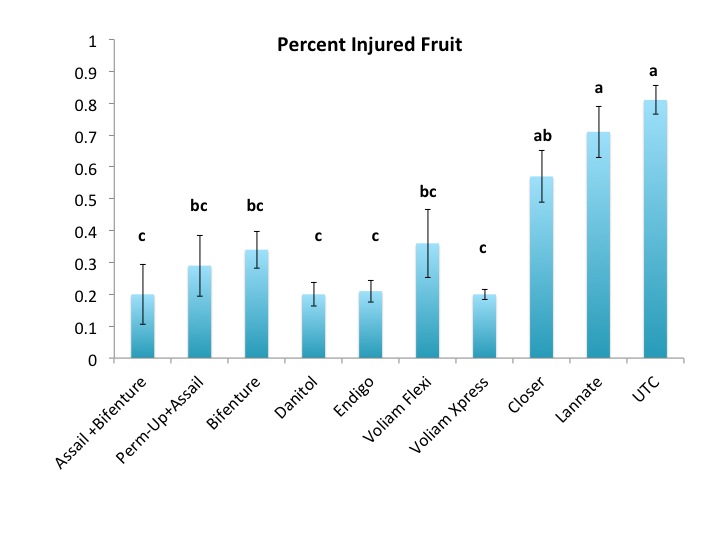
We have been conducting numerous insecticide trials at RAREC against BMSB in peaches (Encore variety). In particular, we are evaluating the efficacy of a a single insecticide sprayed on a 10 day schedule to see if we can identify differences in effectiveness of selected insecticides throughout the season. I understand that growers will not (and should not) spray the same chemical throughout the season but it helps to isolate the effect each chemical. This is complimented by laboratory trials using field collected bugs. Because of  limitations in the number of applications for certain chemicals I feel that this is an important component to developing IPM programs in NJ. We have evaluated Lannate LV, Bifenture (Sect 18 only), Bifenture+Assail (Sect 18 only), Assail+Perm-Up, Voliam Xpress, Voliam Flexi, Danitol, Endigo and Closer. Closer is a new neo-nicotinoid like compound (IRAC Class 4C) from Dow AgroSciences that is effective against green peach aphid. Because of its potential importance as a resistance management tool, we included this in the evaluation.

Our results thus far are interesting. We evaluate 3 ways:

  1. Percent of fruit with injury
  2. Severity of injury (ie. the number of feeding sites) and
  3. Mortality in the lab.

Percent BMSB Damaged Fruit in Mid July

Percent BMSB Damaged Fruit in Mid July
Click to View
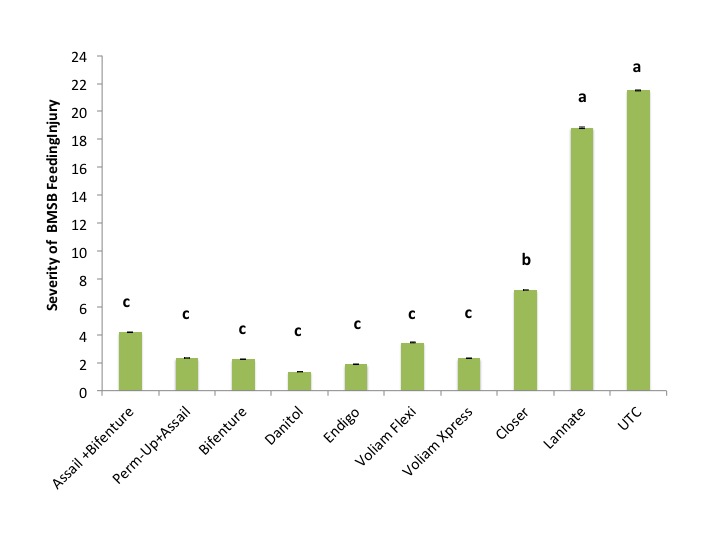
Severity of BMSB Injury in Mid July

Severity of BMSB Injury in Mid July
Click to View


What we have seen suggests that Perm-Up+Assail and Danitol are more effective early season but Bifenture and Voliam Xpress have not decreased in effectiveness from end of May to now. This suggests that for those chemistries, it would be best to use Perm-Up or Danitol early in the season against the adults that are just emerging from diapause and migrating to the orchard. From the fruit injury data, our data strongly suggests that Lannate is not an effective compound against BMSB. Closer performed ok, there was a lot of fruit with injury, but the injury was not severe. Danitol, Voliam Xpress, Assail+Bifenture and Endigo had the least percent injured fruit. Keep in mind that Bifenture/bifenthrin is ONLY allowable on peaches and apples with a Sect. 18 which we do not have yet!! Danitol has been very variable in previous studies, but is performing well this season at RAREC. Voliam Flexi, Assail+Perm-Up and Bifenture alone also significantly reduced injury. Assail by itself has not performed well against BMSB in previous trials. Feeding severity was significantly reduced for all insecticides other than Closer and Lannate, although Closer was better than Lannate. Bifenture causes 100% mortality in the lab so my guess is that in the field it may not have as long of residual but once available, it will be a great addition to use and will cause mortality of BMSB present in the orchard.

Please keep in mind that the BMSB pressure at RAREC is very high! Always follow label instructions.

Fruit IPM Report: Week Ending 7/27/13

Fruit IPM Report 7-27-13 – Click to View | Download | Print

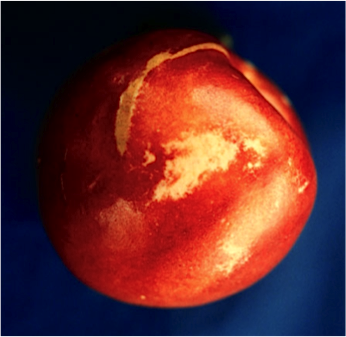
BMSB Damage in Pear

BMSB Damage in Pear

In this report:

  • Pear
  • Peach
  • Apple
  • Grape
  • Scouting Calendar
  • Blueberry
  • Trap Counts

Fruit IPM Report: Week Ending 7/20/13

Fruit IPM Report 7-20-13 – Click to View | Download | Print

Early Season Thrip Injury in Peach

Early Season (top) and Late Season (silvering)  Thrips Injury on Peach

In this report:

  • Brown Marmorated Stink Bug
  • Peach
  • Apple
  • Grape
  • Scouting Calendar
  • Blueberry
  • Trap Counts

Brown Marmorated Stink Bug

BMSB adults nymphs and egg masses are present in orchards, although far from a uniform pattern. Black light trap captures indicate a significant increase in trap captures over the past 2 weeks, but individual insects may be difficult to find in many locations. Early pickings of Sentry show significant feeding damage, depending on tree location. We are monitoring this insect in commercial orchards with a several methods. These include random 3 minute counts, 3 minute counts on transect lines, use of a new USDA experimental pheromone in several trap types, and the black light traps in the vegetable IPM network. The bottom line for growers is that every treatment should include a BMSB active material. These treatments should be frequent. If treatments are applied on more than a 7 day schedule, then a 7 day border spray should supplement whole block treatments. Pyrethroid insecticides (permethrin, Baythroid, Mustang, Warrior, Danitol) can be very effective, but with the high temperatures we are having, they should be avoided this week. The neonicotinoids, Belay and Actara can also be very effective. Lannate has a short residual, but can have knock down ability.

We are hoping that the 2 best insecticides will be able to be used soon. These are dinotefuran (Venom and Scorpion) and bifenthrin (Brigade and Bifenture). These products had section 18 labels during 2012 (Venom and Scorpion had them in 2011), and were requested again for 2013. Although Venom and Scorpion are currently labeled in peach and nectarine, they are not labeled in apples. Nor are they labeled at the rate required to control BMSB, which is almost double the current labeled rate. The current maximum rate for Scorpion is 7 oz/A, and 10-12 oz/A is needed for BMSB control. The current maximum rate for Venom is 4 oz/A, and 6-6.9 oz/A is needed for BMSB control. Section 18 label requests originate in the individual states (usually a DEP) and are authorized by EPA in Washington, D.C. The bifenthrin package is currently in Washington. The dinotefuran package is with the NJDEP and has yet to be submitted. Brigade and Bifenture are the best materials we have for BMSB control. Since there will be a 14 day PHI, and a maximum of 2 applications not less than 30 days apart, let’s hope we get them soon, or they will see only minimal use.

Fruit IPM Report: Week Ending 7/12/13

Fruit IPM Report 7-12-13 – Click to View | Download | Print

Periodical Cicada: Shoot Flagging

Periodical Cicada: Shoot Flagging

In this report:

  • Peach
  • Apple
  • Grape
  • Scouting Calendar
  • Blueberry
  • Trap Counts

Integrated Preharvest Fungicide Programs for Brown Rot

There was a time when selection of a fungicide for brown rot control was based solely on efficacy and cost of the product. However, the brown rot pathogen, Monilinia fructicola, has become resistant to DMI fungicides and to some extent QoI fungicides in many stone fruit growing regions in the eastern United States. This occurrence has underscored the need for a greater degree of integration of different fungicide chemistries as a resistance management strategy. [Read more…]

Fruit IPM Report: Week Ending 7/5/13

Fruit IPM Report 7-5-13 – Click to View | Download | Print

In this report:

  • Peach
  • Apple
  • Grape
  • Scouting Calendar
  • Blueberry
  • Trap Counts