During the fall and winter months of 2016-17 the NJAES Tree Fruit Working Group put together a grower survey with the objective of NJ tree fruit growers ranking various tree fruit research and extension activities done by Rutgers/NJAES. The survey consisted of separate discipline or program areas with rankings for each area. A first draft survey was vetted using input from a small grower advisory group in southern counties, and again at the Hershey meetings by the NJ State Horticultural Society board of directors. Comments from the 2 advisory meetings were incorporated into the survey prior to it being given out at the South Jersey Fruit Meeting (February 16, 2017) and the North jersey Fruit Meeting (March 1, 2017). A total of 34 responses were collected, representing 12 counties, plus 1 out of state grower. NJ responses represented 2,480 acres of tree fruit production. The survey combined stone fruit and pome fruit activities under most discipline areas; so tabulated results are combined under both crop types. [Read more…]
Fruit Crops Edition
Seasonal updates on diseases, insects, weeds impacting tree fruit and small fruit (blueberry, cranberry, and wine grape). Fruit Pest Alerts are also available via this category feed.
Subscriptions are available via EMAIL and RSS.
Webinar on Best Practices for Pesticide Aerial Application

Register for September 27 Webinar on Best Practices for Pesticide Aerial Application
EPA is hosting a webinar titled “Best Practices for Aerial Application” on September 27, 2018, from 2 – 3:30 pm ET. This webinar is tailored for growers, pesticide applicators, pest management professionals, and other interested stakeholders who work in crop production.
Webinar presenter, Dr. Bradley Fritz, is an agricultural engineer from the United States Department of Agriculture (USDA), and serves as the Research Leader of the Aerial Application Technology Research Unit at USDA’s Agricultural Research Service. The presentation will cover different methods of aerial application, best practices for reducing spray particle drift when using aerial application equipment, nozzle selection, and the use of adjuvants as they relate to aerial application.
Learn more about reducing pesticide drift.
Fruit IPM for 9/19/18
Apples:
Brown Marmorated Stink Bug (BMSB): BMSB presence is spotty and still much higher than it was earlier in the summer. Now that apples (and pears) are the only fruit present for BMSB to feed on, growers must have a program to address this pressure. [Read more…]
Fruit IPM for 09/06/18
Peach:
Peachtree Borer (PTB) and Lesser Peachtree Borer (LPTB): Now is the time to treat for peachtree borers and lesser borers. PTB has one generation per year, while LPTB and 2 generations per year. Over the last 10 years PTB has caused more problems than LPTB. It is not unusual to find multiple borer larvae in a single mature tree. At minimum this is a stress that the trees do not need to survive the winter and be productive for the following season. Too many larvae can kill the tree, and in young trees only 1-2 larvae can kill the tree. The trick is to apply insecticide soon after most of the eggs have been laid, which is now, and before the larvae get too established in the trunk. Lorsban has been the best product available for this use, and must be used now after the fruit is off and while the larvae have just emerged. Make sure to apply liberal amounts of water in a high volume soaking spray directed at the trunk. This is likely the last year that Lorsban will be able to be used. When Lorsban is gone, mating disruption will need to take its place, and applied in the Spring. Other insecticides are also labeled for this pest, but they have been shown to be less effective. [Read more…]
Stinger 24(c) Special Local Need Label for Perennial Weed Control in Blueberries
The 24(c) Special Local Need Label for Stinger® that had expired on December 31, 2017 has finally been renewed up to December 31, 2020.
Stinger® is especially useful in blueberry for controlling composite and legume weeds. Common composite weeds found in our orchards include Canada thistle and other thistles, goldenrod species, aster species, common dandelion, mugwort (wild chrysanthemum), horseweed (marestail), and ragweed species. Legume weeds include vetch species and clover species.
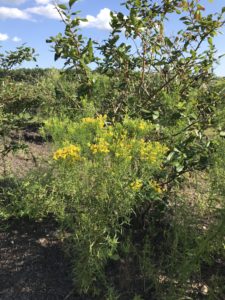
Deep rooted perennials like goldenrod require multiple Stinger applications
The 24(c) Special Local Need Label for Stinger® is associated with some restrictions:
- Preharvest Interval (PHI): 30 days
- Maximum Stinger® amount per acre per year: 10.6 fl oz
- Maximum Stinger® amount per application: 4 to 5.3 fl oz/a depending upon weed species
- Rainfastness: 5 hours
- Maximum Stinger® amount per acre per year: 10.6 fl oz
- Stinger® can not be air-applied or chemigated
The application of Stinger® should be timed to match the emergence of the perennial weeds in the spring when the carbohydrate food reserves in the plant are at the lowest point. Treatment at this time reduces the weed’s chance of recovery and survival. Optimum results controlling deep rooted and hard to control perennial weeds, including Canada thistle, perennial asters, goldenrod species, and mugwort (wild chrysanthemum) will be obtained if the Stinger®® application is split.
- First application: apply Stinger® at the rate of 1/3 pint/acre after blueberry bloom, in late April when the weed is emerging. Some weeds can “survive” for months on established existing foliage even though Stinger® suppresses all new growth. Tank-mix with Gramoxone to increase the spectrum of weeds controlled and kill existing foliage of perennial asters, goldenrod species and mugwort.
- Second application: Apply another one third pint of Stinger® immediately after harvest in mid-summer. Spray the second application even though no growth of the target weed is evident. The second application is essential for the elimination of the hard to kill established perennial weeds. If the second application is skipped, expect to see the weed re-emerge in late August or September.
Stinger® is both preemergence residual herbicide and a postemergence foliar absorbed herbicide. The initial twisting and curling observed after application to susceptible species is due to the foliar absorption. Control of established perennials is due to residual activity of Stinger® in the soil which prevents regrowth from the roots. In certain species, such as mugwort, Stinger® prevents regrowth but does not kill the mature leaves. The plant will survive unless another herbicide, such as Gramoxone® SL 2.0 or Rely® 280, is used to defoliate the plant.
Do NOT apply Stinger® in a hand held sprayer used to “spray until wet”. Stinger® is a residual herbicide that must be applied on a rate per acre basis. When treating “patches” of perennial weeds, apply the recommended rate per acre with a calibrated sprayer. Treat ten to fifteen feet beyond the weed “patch” on all sides. Spray the sod or row middles adjacent to the weed “patch” in the row.
The label is available online on the CDMS website at the following address: http://www.cdms.net/ldat/ld02P048.pdf
The use of any pesticide inconsistent with the label directions is a violation of Federal law.®
Fall control of perennial weeds with herbicides
Late summer and fall are perfect times to work on tough-to-control perennial weeds such as Virginia creeper vine, bindweed, green-brier, Canada thistle, goldenrod, and poison ivy. These perennials are among the most difficult weeds to eradicate, especially because of their ability to generate new shoots from their root systems. Successful management strategies will mostly rely on herbicide that can move from the leaf to the below-ground plant parts. Timely initial application and consistency at controlling any regrowth with follow-up spot treatments are crucial for long-term control of these weeds.
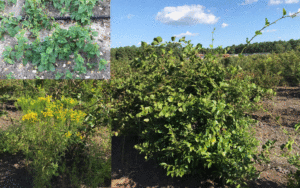
Field bindweed (upper left), goldenrod (lower left) and green-brier (right) are some tough weed species of NJ blueberry and will warrant extra time for achieving successful control
Glyphosate (Roundup or other generic products) is the only postemergence herbicide labeled on blueberry that can provide good control of perennial weeds. Late summer and fall are good times for applying glyphosate as plant sap movement is mostly directed toward the roots where nutrients will be stored in anticipation of next season. Therefore, large volume of glyphosate can easily be translocated from the leaves to the roots, improving the efficiency of the herbicide at killing below-ground storage organs. It is VERY IMPORTANT for glyphosate to be applied when weed leaves are still green before fall colors appear.
Use extreme care not to contact crop green tissues (stems and leaves) with glyphosate. Glyphosate absorbed by crop green leaves and bark moves within the plant and can severely damage or kill above-ground and below-ground parts of annual crop and perennial treess. Weeds such as bindweed, Virginia creeper, and greenbrier may need to be pulled out of the trees so they can be treated safely. This may seem too slow to be practical, but consider what these weeds cost in lost income. For example, blueberry bushes covered by Virginia creeper vine may yield just 20% of their potential. This easily equates to a $5 to $10 loss per bush. The loss is incurred each year and increases as the vines spread to neighboring bushes. Investing 15 minutes to carefully pull vines out of that bush and safely treat them on the ground is money well spent.
Glyphosate should be applied through low pressure spot treatment to limit drift movements. Glyphosate absorption will be improved if ammonium sulfate (17 lbs / 100 gal water) is added to your spray mixture. For effective control, at least 50% of the foliage should be wet with glyphosate applied as a 2% solution (see your product’s label for rate necessary to reach this concentration).
Consider also “cut stump” applications for Virginia creeper or poison ivy that have large diameter stems. Apply a 2% glyphosate solution to the cambium (inner bark area) IMMEDIATELY after cutting the stem. Don’t let time for cutting to dry as this would prevent glyphosate absorption and translocation to below-ground plant parts.
Always apply glyphosate on weeds that are actively growing and not under drought stress.
Always refer to the commercial product label for rates and additional information.

