Changes in Consumer Price Indexes for food, 2019 through 2022

Food Price Outlook
“The Consumer Price Index (CPI) for food is a component of the all-items CPI. The CPI measures the average change over time in the prices paid by urban consumers for a representative market basket of consumer goods and services. While the all-items CPI measures the price changes for all consumer goods and services, including food, the CPI for food measures the changes in the retail prices of food items only. ERS’s monthly update is usually released on the 25th of the month; however, if the 25th falls on a weekend or a holiday, the monthly update will be published on either the 23rd or 24th.” – USDA Economic Research Service.

Click here to download the excel spreadsheet ‘Consumer Price Index’ 

For more information go to https://www.ers.usda.gov/data-products/food-price-outlook/
Next Generation Fertilizer Awards Announced

WASHINGTON, October 19, 2021 – Today, the U.S. Department of Agriculture and the U.S. Environmental Protection Agency (EPA) announced the winners of the Next Gen Fertilizer Innovations Challenge, the second of a two-part, joint USDA-EPA Partnership and Competition on Enhanced Efficiency Fertilizers (EEFs) to Advance Agricultural Sustainability in the United States. The goal of the competition is to improve the efficiency of fertilizers to increase crop yields while reducing the impacts of fertilizers on the environment. – USDA Press Release 0224.21, December 19, 2021

To read the full report and winners, go to https://www.usda.gov/media/press-releases/2021/10/19/usda-and-epa-announce-winners-next-gen-fertilizer-innovations

Direct to Consumer Grass Fed and Pasture Raised Reports

“USDA Market News works with State Departments of Agriculture and local and regional food systems to provide prices, volume, and other information on agricultural commodities sold at local and regional markets throughout the United States. Information gathered from Farmers Markets, Farmers Auctions, Food Hubs, Direct to Consumer sales, Retail advertisements, and Farm-To-School programs is currently available for select locations.  More reports and locations will be added in the future.” – https://www.ams.usda.gov/market-news/local-regional-food

Click on the links below to see monthly grass fed beef, lamb, goat, pork, poultry and dairy reports from around the nation. Go to the link above to see other market reports for national and regional Farmers Markets, Farmers Auctions, Farm-to-School, and Retail.

Bees, Wasps, And Hornets In The Agriculture Workplace

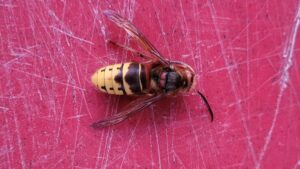
European Hornet

European Hornet Photo by Sal. Mangiafico

The website, Insect Identification.Org has a list of eighty seven Hymenoptera species found in New Jersey. Hymenoptera are ants, bees, wasps, and sawflies. It’s quite amazing that these species have been apart of the evolutionary record for more than 260 million years. Many are predatory species that feed on other insects. And not surprisingly at first glance, several insects have evolved camouflage to look like the stinging biting insects we learn to avoid. There are currently three theories to explain these body shapes and coloring choices. Mimicry, Masquerading, and what I would call ‘Mob Camouflage’ for lack of a better term as the authors of A Hypothesis to Explain Accuracy of Wasp Resemblances’  state.

Mimicry by less aggressive wasps and non-stinging insects like moths is known as Batesian mimicry and Müllerian mimicry. Batesian mimicry is a phenomenon observed by Sir Henry Walter Bates a British Naturalist who studied butterflies in the late 19th century. In Batesian mimicry, non-harmful species known as the mimic have evolved to model the appearance of a species whose potential predators have learned is harmful (venomous sting, biting injury, poisonous) and thus avoid consuming.

Müllerian mimicry is named after German naturalist Fritz Müller and involves two different but similar species purposefully mimicking each other’s appearances and bad taste to confuse predators.

A third hypothesis proposed in the 2016 paper ‘A Hypothesis to Explain Accuracy of Wasp Resemblances’ suggests that non-aggression by wasps towards sisters during hunting is innate and on sight and is a means to confuse or slip by the sight of the selecting agent (the bird) in a crowd.

A good example of these three adaptations on display in 2021 was the emergence of cicada broods and multiple grasshopper broods. These species are food for many Hymenoptera species and when food is abundant bee, wasp and hornet populations soar. This resulted in significant number of calls to extension offices for assistance in identifying similar patterned species. Many callers wanted to know if their hornet encounter was an asian giant hornet (Vespa mandarinia), a new introduction first found in the Pacific Northwest in 2019 that is not known to be present elsewhere in the U.S. at this time.

On another note, it remains to be seen if any of these common predatorory wasp and hornets develop a taste for spotted lanternflies. In their native range, the parasitic wasp Dryinus browni has developed a taste for lanternflies and biologists are studying the logistics of bringing this species to the U.S. The gypsy moth Ooencyrtus kuvanae introduced to the U.S. in 1908 has also been observed to prey on lanternflies.

Another surprising revelation about mimicry in wasp species, is that for some of these common North American species, both prey and predator can change their color banding from yellow and black to red and black as their range changes. Species commonly seen as yellow and black in New Jersey are red and black in Florida and most likely do so to maximize the benefits of mimicry, masquerade, and mob camouflage relative to the abundance of one particular color pattern over another in that ecological niche. As much of the work force in hand harvest agriculture migrates with the crop harvest, workers maybe familiar with the same species venomous sting but associate it with a different color pattern as seen in a different region or country.

Regardless of where in the world we are from, vertebrates like ourselves innately associate these color patterns with avoidance. In human societies, these warning stripes are incorporated into clothing and infrastructure as social cues to both protect the wearer (safety vests) and alert others to safety hazards.

General Body Color Pattens in Stinging and Non-Stinging Bees, Wasps, and Hornets

Green Body and Yellow: Three different types of sweat bees, cuckoo wasp

Red and Black: Red velvet wasp also known as ‘cow killer’ or as ‘red velvet ant’

Yellow and Black: Eastern yellow jacket hornet, southern yellow jacket hornet, common yellow jacket wasp, asian horntail, five-banded thynnid wasp, ichneumon wasp, hyperparasitic wasp, leucospid wasp, bumble bee, pigeon tremex, square head wasp, weevil wasp

Yellow and Brown: Cicada wasp, paper wasp, european hornets, long tailed ichneumon wasp

Black and White: White faced hornets, mason wasp, leaf cutter bee, potter wasp, scoliid wasp

Brown and Black: Great golden digger wasp, honey bee

Have specific questions about these species or want to learn more? Check out the research at the Department of Entomology at Rutgers https://entomology.rutgers.edu/ and faculty and research program focus at https://entomology.rutgers.edu/personnel/faculty.html or find an extension pest specialist at https://entomology.rutgers.edu/personnel/research-extension-staff.html.

Several companies have published wall posters available on the internet of common bees, wasps, and hornets that may be useful in the workplace. These visual aids would be a useful addition to worker bulletin boards in facilities processing the preferred sugar source (vegetable sugars) many of these species feed on throughout the summer.

Concerned about severe reactions to bee, wasp, ant, or hornet stings? Here is an informative article by Merk Manual https://www.merckmanuals.com/home/injuries-and-poisoning/bites-and-stings/bee,-wasp,-hornet,-and-ant-stings?redirectid=12.

The CDC has an employer fact sheet on how to reduce worker exposure to stinging members of the bee, wasp, and hornet families. https://www.cdc.gov/niosh/topics/insects/beeswasphornets.html.

Talk to your occupational health nurse about adding over the counter antihistamines like diphenhydramine, famotidine, and prescription epinephrine to your agriculture workforce first aid kit. Bee venom medical alert necklaces, bracelets and arm bands can be worn by hyper-sensitive workers in the workforce to aid in rapid response if someone is stung and unable to articulate they need medical attention.

Lastly, keep in mind that as climate changes, the seasons become longer, and temperatures are more favorable to yielding higher populations of queens and workers, the time frame to destroy nests when stinging flying insects are hybernating is also changing.


Rainy day recap: Past rainfall, fall grain planting considerations

Looking back on last fall’s planting conditions and comparing to current conditions is a useful tool in evaluating how weather patterns influenced the 2021 winter small grain quality and yields.

Statewide: Last fall was a wet September with 4.41 inches of rain on average statewide according to the monthly total precipitation charts compiled by http://climate.rutgers.edu/stateclim_v1/nclimdiv/. At the beginning of September, 93,000 acres of soybean ground was already harvested and ready for a winter cover crop planting but only 25,000 acres went into wheat production (September 2021 Grain Crop Report). This is partly due to the above average (30 year normal) precipitation that continued into the October (5.02 inches) and November (4.09 inches) planting window for winter cover crops. Fields were wet when harvested, wet when fitted, wet when planted, and hardly had time to dry out in January before an excessive amount of rainfall fell in February (4.81 inches). Fall applied fertilizer measures were likely depleted by this pattern.

Then what happened? Temperatures below and above 41 degrees Fahrenheit (F) inducing and breaking dormancy in winter wheat did not occur until the end of December (arrested growth) and beginning of March (active growth) but was sufficient (>45 days) to allow for good tillering and to vernalize crops to flower. The below average precipitation in March (3.84 inches) most likely had little impact on wheat as soil moisture capacity was adequate, but April’s (2.35 inches) dry spell coincided with first applications of winter-spring annual weed control and nitrogen applications. If moisture is not present, herbicide uptake is limited and nitrogen applications can volitilize.

May (3.84 inches) precipitation was on par with the 30-year normal but dipped into a pattern of significant drought stress in several areas of the state through June (3.37 inches). June was also the ninth warmest on record (85.8 max). Temperature stretches above 82 degrees F are not conducive to increasing wheat yields and the average temperature in July was 85.6 F with a high of 90 and a low of 80. However, grain fill recovers quickly after short durations of high heat and drought stress. The critical factor is stage of kernel development. November planted wheat most likely saw more yield loss in the milk stage at this time than September planted which was well into dough stage.

The cumulative effect of the drought and high heat in April and June-July may have produced white blanched seed heads. On the flip side, the weather conditions from flag leaf to grain fill limited significant problems with foliar and head diseases. In fields where problems were noted, be mindful residues of the prior crop contribute to the buildup of sporulating pathogens that are rain and wind splattered onto actively growing leaves during spring green-up.

Yield fertility check: Producers were able to take advantage of a break in August to harvest wheat at 15.5% moisture and bin dry which reduced any further yield loss.

How did local weather conditions and progression of your wheat crop compare to the state average of 67 bu/acre? Were your local conditions more in line with Delaware (70 bu/acre), Pennsylvania (77 bu/acre), or Maryland (79 bu/acre). Did soil PH, potassium, copper, manganese, and zinc levels change? The excessive rainfall pattern of the 2020 crop season may have leached away the calcium, magnesium, potassium, and sodium that influences soil acidity and essential micronutrients necessary for reproductive fitness in small grains. Migratory bird grazing denuded many fields in February and March and yield differences between over grazed and un-grazed areas should be recorded and factored into how varieties performed. Particularly take note of the stage of wheat development when bird damage occurred. 

The 2021 fall planting season (6.20 inches September) has started out in a similar pattern as the 2020 cover crop planting start and continues this week with a late October Nor’easter. A 1987 publication ‘The effects of of grazing by Canada geese on winter wheat yield’ gives some insight into how snow geese grazing may or may not decrease yield and could actually increase yield. When they return, a simple and cost-effective way to evaluate the impact of snow geese on small grain yields is to install several meter square exclusion cages prior to their arrival that exclude beaks, remove them after they leave, mark the area with painted stones and a boom flexible taller than the wheat flag and collect yield data ahead of the combine.

Swine, Chicken, Turkey Producer Pandemic Assistance Deadline

” Pandemic Livestock Indemnity Program

Are you a swine, chicken, or turkey producer who suffered losses due to insufficient access to processing facilities during the coronavirus pandemic? USDA’s Pandemic Livestock Indemnity Program (PLIP) provides financial relief for those losses and costs associated with depopulation due to COVID-19. This new program is part of USDA’s Pandemic Assistance for Producers initiative.

USDA’s Farm Service Agency will accept PLIP applications from July 20 through October 12, 2021. FSA extended the original signup deadline, which was September 17, 2021.” – https://www.farmers.gov/coronavirus/pandemic-assistance/plip
