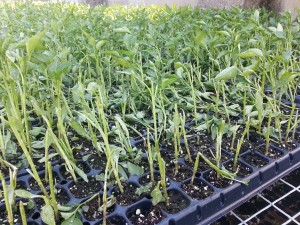
Severe hail damage on pepper transplants.
Rutgers Cooperative Extension
Severe hail damage on pepper transplants.
Now that the weather is beginning to cooperate and temperatures are warming up, be cautious about sunscald developing on the stems of transplants, especially those being set onto black plastic mulch. With a little planning ahead potential losses to sunscald injury can reduced significantly.
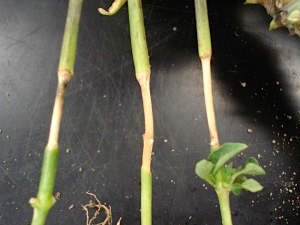
Sunscald injury on stems of newly transplanted pepper seedlings caused by stems laying against edges of black plastic mulch on hot, sunny days.
Sunscald typically appears as the slow bleaching out of the stem that will typically appear only on one side. Often this starts to appear right where the stem meets the black plastic mulch. In many cases if the stem is touching the mulch, the sunburn will start there and the transplant will begin to fall over as if the stem was broken.
When transplanting, make sure the holes in the plastic are wide enough to keep the stem from coming into contact with it. In some cases growers will fill in the transplant hole with soil to help keep the transplant upright before between-row herbicides are applied. ‘Leggy’ transplants that lay across plastic mulch and even those transplanted onto bare ground are prone to sunscald injury.
The 2014 Potato and Tomato Reports are now available! Just scroll over the Vegetable Crops tab on the Plant and Pest Advisory homepage and links for each report will appear.
Like in years past, both reports will be updated twice a week for those interested in timing their fungicide applications according to Tom-Cast and Blightcast from NEWA information. Real-time updates can also be obtained by going directly to the NEWA site, selecting the nearest weather station to your farm operation, and clicking on the appropriate model. It is that simple! As always, should Late Blight appear in our region sometime this season a PPA Alert will be sent out to those signed up.
Basil downy mildew was reported in a greenhouse in Virginia last week. The first question I asked myself was, “How can that be?”
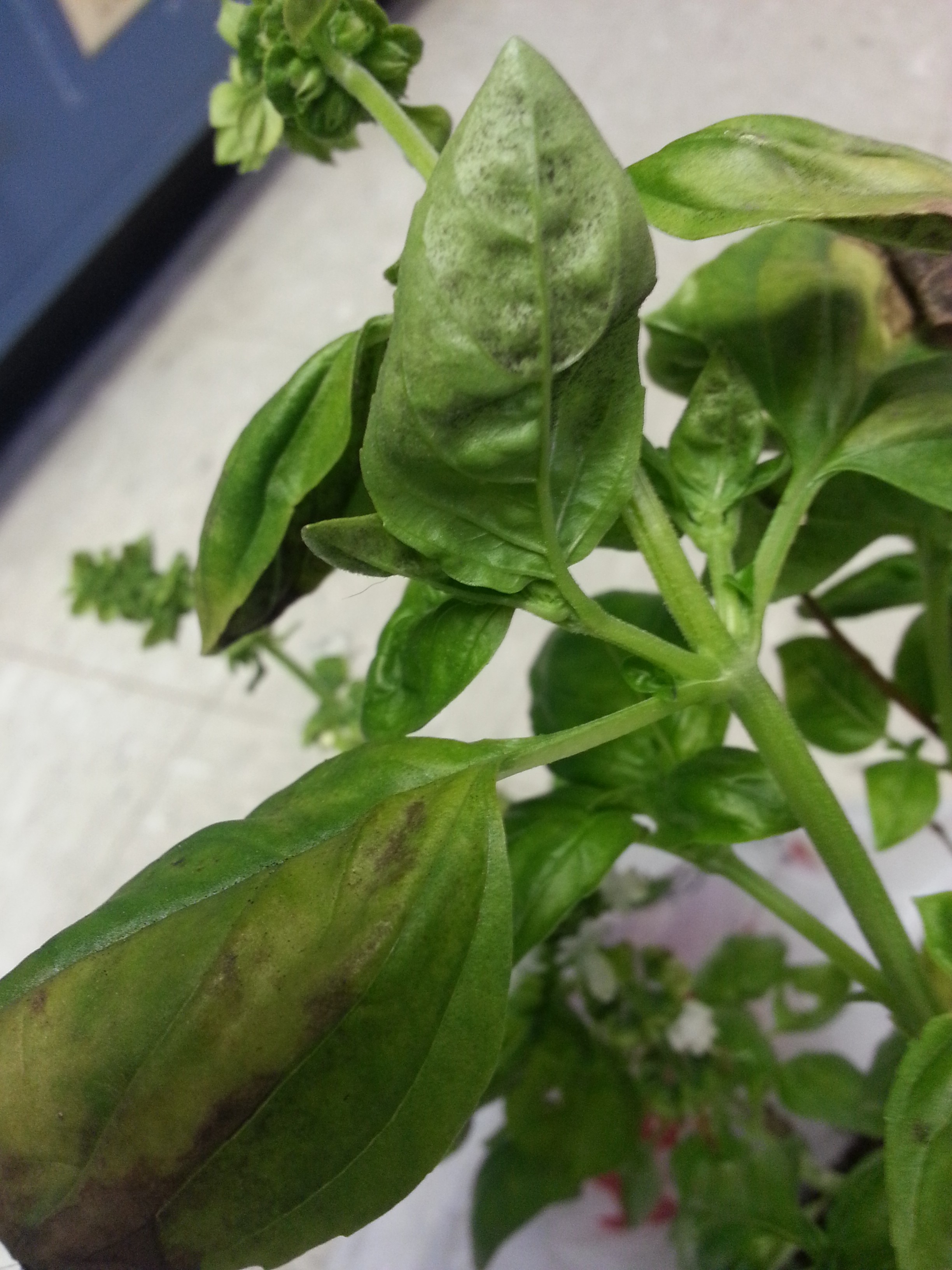
Basil downy mildew on overwintered sweet basil plant.
Note symptoms on leaf top side and downy mildew spores on leaf underside.
The infected plants in question, roughly 12 mature potted sweet basil plants, were just a few plants that were left over from last fall and carried over the winter in a non-heated high tunnel on benches with heated mats and row cover. The heated mats and row cover were for protecting other crops. Interestingly, the basil did not freeze out, somehow managed to survive the winter without much heat, and produce downy mildew spores once the outside temperatures rose.
[Read more…]
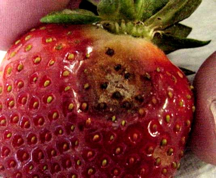
Anthracnose Fruit Rot of Strawberry
Pathogens such as anthracnose, gray mold (Botrytis), and leather rot can become systemic problems in strawberry plantings once established. All three fungal diseases are soil-borne and once in fields can be difficult to manage over the lifetime of the planting.
The use of mulch (matted rows) to prevent/reduce soil splashing and keeping fruit from coming into direct contact with the soil surface can be beneficial in organic production systems where conventional fungicides cannot be used. Use of long crop rotations and staying away from areas of the farm with known instances of any of these pathogens is also important. Remember that same species of Colletotrichum that causes fruit rot in pepper and other crops can also infect strawberry.
Efforts have been made in recent years in New Jersey and the surrounding mid-Atlantic region to help vegetable growers understand and manage potential fungicide resistance development on their farm.
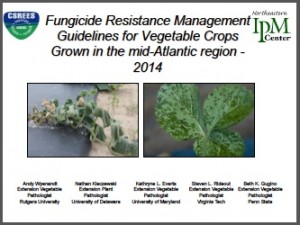 Since 2007, Fungicide Resistance Management Guidelines have been available and distributed to vegetable growers throughout the region. Over, 20,000 FRAC guides have been distributed over the past 8 years at local, state, and regional vegetable meetings and conferences. Much of this work has been funded by the Northeast IPM Center.
The 2014 Fungicide Resistance Management Guide can be found on the right sidebar of the Vegetable Crops Online Resource Center and downloaded FREE. In order to understand and use fungicide resistance management strategies effectively one must first understand how and why fungicide resistance may develop. A series of articles is available on this website by clicking the links below.
Growers guide to understanding protectant fungicides (M1-M9)
Growers guide to understanding DMI fungicides (FRAC group 3)
Growers guide to understanding Strobilurin fungicides (FRAC group 11)
