Andy Wyenandt

This is an archive of Dr. Wyenandt's posts on the Plant and Pest Advisory.

Identifying and Controlling Early-Season Damping-off Pathogens

It is extremely important to know which pathogen is causing damping-off problems and which fungicide to properly apply. The key to controlling damping-off is being proactive instead of reactive. Always refer to the fungicide label for crop use, pathogens controlled, and application rates.

Damping-off is caused by a number of important vegetable pathogens and is very common during the spring. Damping-off can kill seedlings before they break the soil line (pre-emergent damping-off) or kill seedlings soon after they emerge (post-emergent damping-off). Common pathogens that cause damping-off include Pythium, Phytophthora, Rhizoctonia and Fusarium spp.

Control of damping-off depends on a number of factors. First, is recognizing the conditions which may be leading to the problem (i.e., weather/greenhouse growing conditions) and second, identifying the pathogen causing the problem.

Conditions Favoring Damping-off

Although all four pathogens are associated with damping-off, the conditions which favor their development are very different. In general, Phytophthora and Pythium are more likely to cause damping-off in cool, wet or overwatered soils that aren’t allowed to dry out due to cloudy weather or cooler temperatures. Conversely, Rhizoctonia and Fusarium are more likely to cause damping-off under warmer, drier conditions especially if plug trays are kept on the dry side to help reduce transplant growth. [Read more…]

Manage your transplant watering schedule

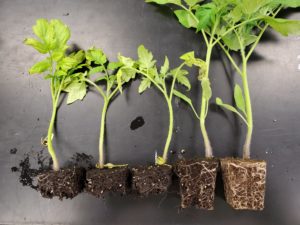
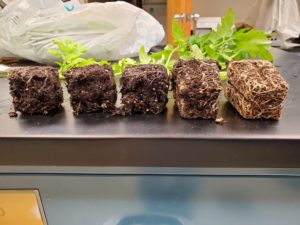
The weather this spring has been relatively normal to date. However, we have had some dry weather these past few weeks. Unfortunately, weather patterns can cause problems in transplant production, especially when it comes time for watering. Hot days may require more than one watering, and cloudy days may require no water. In either case, growers need to anticipate their transplant water needs without over or under estimating watering. Of course, other factors include the growing media and the plant itself. Lets focus on media, for example, growers using a lighter soilless media, these will dry out much quicker than a heavier media and will require more daily watering (e.g., once in AM, afternoon, and evening). Growers using a heavier media may only have to water once a day, or early in the AM and maybe once more in the PM. Either type of media works fine as long as the weather doesn’t change and it fits the growers needs. Proper transplant watering is all about adjustment. If you have stuck to the same daily watering schedule this spring its very likely you have grossly over or under watered your transplants at some point. And, in all likelihood, grossly over or under watered trying to correct the situation. Uniformity is also key when it comes to proper transplant watering. If you find yourself spot watering out of schedule because some flats dry out quicker than others then most likely your uniformity is off. This is easily done when watering is done by hand with a wand. Poor uniformity can also be the result of transplant flats being set on uneven benches or uneven floors. Much like a field, low spots tend to collect the most water. All of this can lead to uneven transplant growth as well as disease and pest pressure, such as fungus gnat problems. If you are experiencing uneven transplant growth, then most likely your watering is uneven. For transplant growth to remain even, flats need to be watered each time to maximum water holding capacity, where each cell in the flat holds the maximum amount of water. An easy way to see this is to watch for water dripping out the bottom of the flat. As important, flats should also uniformly dry out. Below is an example of tomato transplants that have been pulled from the same flat. You can see the differences in plant height as well as root system formation as a result of uneven watering in a “heavy” soilless media. Cells that have remained on the wet side show poor growth and poor root system development because of a waterlogged cell; whereas cells that have been receiving the appropriate amount of water have much better growth and a nice root ball. The weight test. When was the last time you picked up a transplant tray? Picking up a transplant flat every once in a while will give you an idea of how well your watering schedule and uniformity is! Everyone has picked up a tray that has felt like it has the weight of a rock or the tray breaks apart because of the weight, or when you pick it up and it feels as light as a feather. Doing this is a good way to determine if your soilless media is “heavy” – holds more water than you think or if you have been overwatering on days you shouldn’t be or if you have not watered enough. Consistency is key when watering. Going from an extremely wet to an extremely dry transplant tray is not what you want for the transplant production season. You want consistent soil moisture as much as possible, thus proper transplant watering is all about the proper adjustments and knowing your media.

Root growth in tomato transplants

Differences in soil moisture across a single flat of tomato transplants.

Root growth in tomato transplants

Roots of tomato transplants in a flat that has irregular soil moisture.

Grower’s Guide: Understanding the DMI fungicides (FRAC code 3) in 2022

The DMI (DeMethylation Inhibitors) or Sterol Biosynthesis Inhibiting (SBI’s) fungicides belong to FRAC code 3 which include the triazoles and imidazoles. Some of these fungicides are commonly known as Tilt (propiconazole), Rally (myclobutanil), Folicur (tebuconazole), and Procure (triflumizole) and are widely-used in agriculture.

DMI’s work by inhibiting the biosynthesis of ergosterol which is a major component of the plasma membrane of certain fungi and needed for fungal growth. Resistance by fungi to the DMI fungicides has been characterized and is generally known to be controlled by the accumulation of several independent mutations, or what is known as ‘continuous selection’ or ‘shifting’, in the fungus.

In any given field population, the sensitivity to the DMI fungicide by the fungus may range from extremely high (highly sensitive, and will be controlled by fungicide) to moderate (partially sensitive to the fungicide) or low (mostly resistant to fungicide).

This type of resistance is also known as quantitative resistance. With quantitative resistance, as stated above, there are different levels of resistance to the fungicide due to independent mutations, which, is unlike the target mutations that occur in qualitative resistance associated with the QoI (FRAC code 11) fungicides. Because different levels of resistance to the DMI fungicide may exist in the field, control of fungal population may widely vary based on the rate of the DMI fungicide being applied. It is suggested that using a higher rate of a DMI fungicide, may improve control when lower rates have failed.

For example, let’s say that a cucurbit powdery mildew population on pumpkin consists of 25% highly sensitive, 50% moderately sensitive, and a 25% low sensitive (resistant) population to a DMI fungicide. If fungicide is applied at the low rate, only 25% of the population (highly sensitive) may be controlled. Where, if the high rate was used, 75% (the 25% highly sensitive + 50% moderately sensitive) of population would have been controlled. The main point is that if low rates of DMI fungicides have been used and control seems to be weakening, increasing to a higher rate may improve control.

Unfortunately, it is difficult to determine what proportion of the powdery mildew population is sensitive or not sensitive by just looking at the field until you have begun a proper spray program. The best advice, if you are using low rates and think those rates are not working, is to increase to the high rate the next time the fungicide is sprayed, and if the high rate still doesn’t work it may be safe to assume the fungal population has grown mostly resistant. Importantly, if the high rate fails, whether you bumped up to a high rate or started with one, and control does not seem adequate, DO NOT continue to use the DMI fungicide.

Recognizing if and when fungicide chemistries are failing and when fungicide resistance is developing is critically important to producing successful crops and why scouting on a regular basis, at least before and after each fungicide application, is important. Regular scouting can help reduce unwarranted and ineffective fungicide applications and help reduce wasted costs.

Remember to always tank mix DMI fungicides with protectant (M) fungicides (i.e., chlorothalonil, manzate) to help reduce the chances for fungicide resistance developing. Always apply DMI fungicides according to label rates and resistant management recommendations and always be aware of the fungicide rate you are applying.

Copper resistance in bacterial leaf spot found in New Jersey during 2020 growing season

Copper resistance has been detected in bacterial leaf spot of tomato and pepper and in Pseudomonas chicorii, the causal agent of bacterial leaf spot in basil, in New Jersey. While not surprising, copper resistance has been known to develop for decades now; however, this is the first time it has been confirmed in vegetable crops in New Jersey. Copper applications for the control of bacterial diseases in many crops has been a mainstay for decades now and is often applied in weekly protectant fungicide programs. In 2019 and 2020, with help from Dr. Nrupali Patel and Dr. Don Kobayashi, bacteriologists in the Department of Plant Biology located on the New Brunswick campus, a survey was begun to determine which species of bacterial leaf spot are most prevalent in New Jersey vegetable crops. Bacterial leaf spot can be caused by four species of Xanthomonas: X. euvesicatoria, X. vesicatoria, X. perforans, and X. gardneri. Currently, there are four races of BLS found in tomato (T1-T4; one for each of the 4 species stated above) and eleven races found in pepper (0-10). Differential tests in southern New Jersey using various bell pepper lines over the past 15 years has suggested that the number of races of BLS in pepper has increased over time; with all races present in the State to date. Lab testing results from samples collected from the small number of NJ vegetable farms the last two summers has shown the presence of X. euvesicatoria in pepper, as well as X. euvesicatoria and X. perforans in both tomato and pepper in the state, with ~50% of all samples testing positive for copper resistance.

How do you know what species of bacteria are present on your farm?

The only way to determine which species of bacteria are present in tomato or pepper crops on your farm are to have them identified through laboratory methods.

How do you know what races of the pathogen are present on your farm?

That’s a difficult question to answer. Up to now, the only way to know is through differential testing. That means planting a number of different bell peppers with varying BLS resistance packages and monitoring which cultivars develop symptoms. For example, if you detect BLS development in Aristotle X3R (which has resistance to races 1,2, & 3); then you possible have races 4-10 present on your farm. If you were to plant Turnpike in that same field and you have BLS development in it, then you possibly have race 6 or 10 present, because Turnpike has resistance to BLS races 0-5 and 7,8,9. It’s extremely important to know what races of BLS are present so you can chose the proper cultivars to grow. Choosing the proper cultivar will do two things: significantly reduce the chances of BLS development and significantly reduce the number of copper applications on your bell pepper crop. As a note, there are a few non-bell peppers available with BLS resistance packages (see 2020/2021 Commercial Vegetable Production Recommendations Guide).

How do you know if copper resistance is present on your farm? 

Growers who have used copper applications for controlling bacterial leaf spot in crops such tomato or pepper for many years should always monitor for efficacy. If you notice or have noticed a loss in copper efficacy over time, then there is a good chance copper resistance is present. Once copper resistance is detected, further applications will be unwarranted and ineffective. The only method to truly determine if copper resistance is present is through laboratory testing, however growers who pay close attention to efficacy should have a good idea if copper is still effective.

What can you do to mitigate bacterial leaf spot development on your farm?

In crops such as bell pepper, it comes down to growing cultivars with resistance to BLS and knowing what races are present on your farm. Many of the recommend commercial cultivars have varying resistance packages to the different races of the pathogen. Some cultivars, such as Paladin which has Phytophthora resistance has no resistance to BLS. Other “older” cultivars such as Aristotle X3R has resistance to races 1-3; newer cultivars such as Turnpike has resistance to races 0-5,7-9; while cultivars such as Playmaker and 9325 have resistance to 0-10 (also known as X10R cultivars). Unfortunately, BLS resistance in commercial tomato varieties are lacking, but efforts from around the world are making progress.

Moving forward in 2021.

More sampling and surveying are planned for the 2021 production season in New Jersey. Growers who are interested having tomato or pepper samples collected from their farm for species determination and copper resistance testing are encouraged to contact their county agent so arrangements can be made.


Understanding Protectant Fungicides
(FRAC groups M01 – M11)

Protectant (contact) fungicides, such as the inorganics (copper, FRAC group M01) and sulfur (FRAC code M02); the dithiocarbamates (mancozeb, M03), phthalimides (Captan, M04), and chloronitriles (chlorothalonil, M05) are fungicides which have a low chance for fungicide resistance to develop. Protectant fungicides typically offer broad spectrum control for many different pathogens.

Why wouldn’t fungi develop resistance to protectant fungicides? Protectant fungicides are used all the time, often in a weekly manner throughout much of the growing season.

[Read more…]

Damping-off: Identifying and Controlling Pathogens in Transplant Production in 2022

It is extremely important to know which pathogen is causing damping-off problems and which fungicide to properly apply. The key to controlling damping-off is being proactive instead of reactive. Always refer to the fungicide label for crop use, pathogens controlled, and application rates.

Damping-off is caused by a number of important vegetable pathogens and is very common during transplant production. Damping-off can kill seedlings before they break the soil line (pre-emergent damping-off) or kill seedlings soon after they emerge (post-emergent damping-off). Common pathogens that cause damping-off include Pythium, Phytophthora, Rhizoctonia and Fusarium spp.

Control of damping-off depends on a number of factors. First, is recognizing the conditions which may be leading to the problem (i.e., watering schedule/greenhouse growing conditions) and second, identifying the pathogen causing the problem. Reducing the chances for damping-off always begins with good sanitation practices prior to transplant production.

Conditions Favoring Damping-off

Although all four pathogens are associated with damping-off, the conditions which favor their development are very different. In general, Phytophthora and Pythium are more likely to cause damping-off in cool, wet or overwatered soils that aren’t allowed to dry out due to cloudy weather or cooler temperatures. Conversely, Rhizoctonia and Fusarium are more likely to cause damping-off under warmer, drier conditions especially if plug trays are kept on the dry side to help reduce transplant growth. [Read more…]