Archives for September 2015

Veg IPM Update: Week Ending 9/30/15

Sweet Corn

European corn borer (ECB) adults were nearly nonexistent this past week. No map image will be produced. There should be little, if any, remaining impact from ECB this season.

Corn earworm moth (CEW) activity declined over the previous week, with low temperatures prevailing (see CEW Map). The current warmer, disturbed weather pattern and tropical storm forecast to hit our area within the next week may result in increased activity. At current levels, CEW remains a significant threat to silking sweet corn plantings.

The highest nightly CEW blacklight trap catches for the previous week are as follows:
Crosswicks  2 Georgetown  1 Pedricktown  1
Belvidere  1 Milltown  1 Sergeantsville  1
Chester  1 New Egypt  1 Springdale  1
East Vineland  1 Newton  1 Tabernacle  1

[Read more…]

Update on Ag Worker Protection Standard

A pre-publication version of the Ag Worker Protection Standard Revisions has been posted on the EPA’s website. In addition, a document comparing new protections to existing protections is available. Per Nancy Fitz, US EPA – Office of Pesticide Programs, compliance with most of the new standards will be required in mid-December 2016. Thanks to Pat Hastings, Rutgers NJAES Pesticide Safety Education Program Coordinator, for the heads-up.

Agricultural Worker Protection Standard Revisions (314pp, 880K)

Veg IPM Update: Week Ending 9/23/15

Click to View

Click to View

Sweet Corn

Cool night temperatures and a declining late European corn borer (ECB) generation have resulted in very few moth captures this past week (see ECB map). Damage from this pest is largely being overshadowed by that of the fall armyworm. Very few plantings remain that are not silking. However, consider treating when the number of infested plants in a 50 plant sample exceeds 12% in any planting that has not reached the silk stage yet.

See the 2015 Commercial Vegetable Recommendations Guide for insecticide choices.

[Read more…]

Sunscald Injury on Cucurbit Fruit

Extended periods of long, hot dry weather can cause pumpkin fruit to seemingly mature quicker (i.e., turn orange). Sunscald injury occurs when cucurbit fruit are suddenly exposed to direct sunlight during the latter stages of fruit ripening during the fall. Sunscald injury often occurs after plants prematurely defoliate due to powdery mildew or downy mildew infection or when vines collapse due to Phytophthora blight or bacterial wilt.

Symptoms of sunscald injury include the collapsing of rind tissue on the side of the fruit which is in direct afternoon sunlight. Sunscald injury often develops as a pinkish-red color on exposed fruit which becomes flat in appearance. Over time fruit tissue may become tan to brown and secondary pathogens often invade the sunscald injured areas of the fruit.

To help reduce the potential for sunscald injury on pumpkin and other winter squash fruit, maintain weekly protectant fungicide programs to help retain foliage for as long as necessary, especially if fruit are going to be left in the field for long periods.

Vegetable Disease Briefs – 9/21/15

  • Downy mildew remains active on all cucurbit crops. All cucurbit growers should include downy as well as powdery mildew specific fungicides in their weekly maintenance sprays. Please remember different modes-of-Action (i.e., FRAC groups) to help manage fungicide resistance develop in both pathogens. To track the progress of CDM in the US please visit http://cdm.ipmpipe.org/
  • There have been no new reports of late blight in New Jersey. Remember as fall approaches and night temperatures become cooler and light fogs begin to develop conditions for late blight development improve. All abandoned tomato blocks/fields need to be disked under as soon as harvesting is done or sprayed with gramoxone to kill all living foliage. To track late blight in the US please visit http://usablight.org/
  • Downy mildew was reported on turnip greens this past week. The cool, damp mornings with lingering dew have been ideal for downy mildew development across many crops.
  • Basil downy mildew remains active.

Veg IPM Update: Week Ending 9/16/15

Click to View

Click to View

Sweet Corn

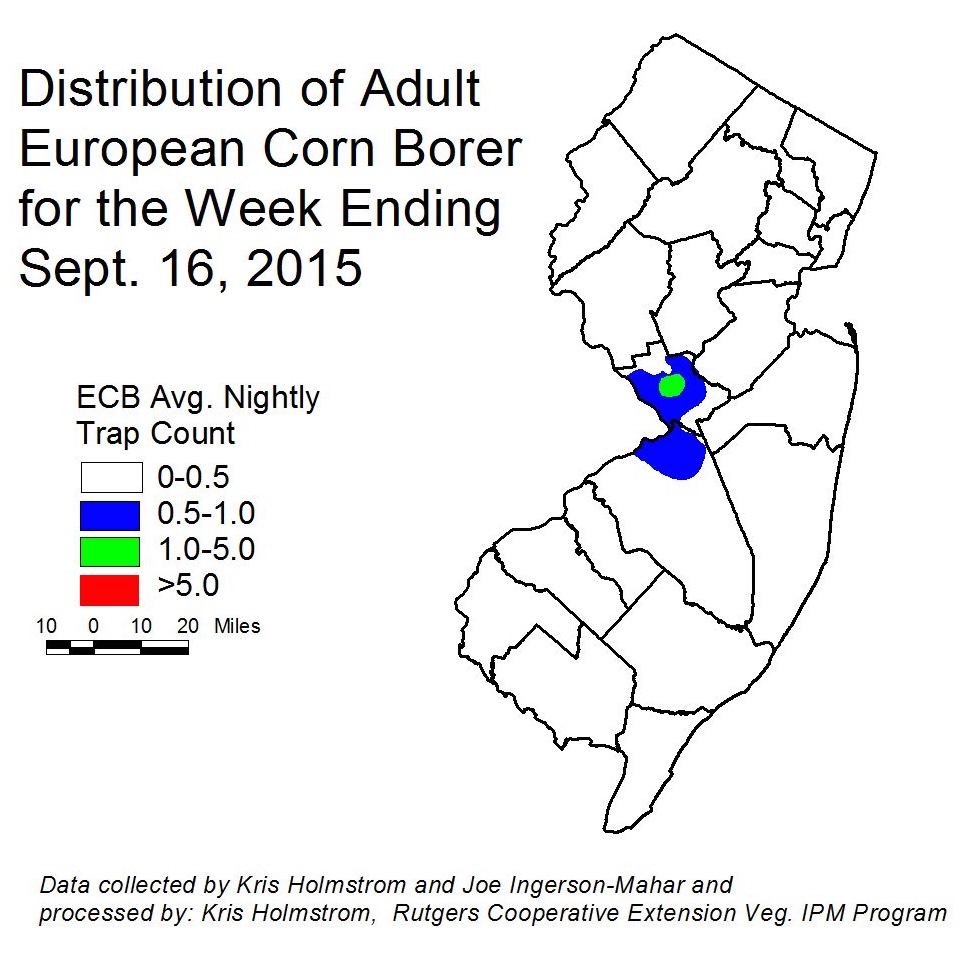
Only a scattering of European corn borer (ECB) moths are being captured now, with somewhat more consistent catches in Mercer County (see ECB map). Damage from this pest is largely being overshadowed by that of the fall armyworm.

As always, consider treating when the number of infested plants in a 50 plant sample exceeds 12%. Any planting remaining at or above threshold as it proceeds to full tassel should be treated, as this is the last stage at which ECB larvae will be exposed and vulnerable to insecticidal sprays.

See the 2015 Commercial Vegetable Recommendations Guide for insecticide choices.

[Read more…]