Archives for May 2014

Strawberry Producers Twilight Meeting

Growers and produce industry members are invited to Specca Farms on Wed. May 28th at 6:00 PM.

Click to Download Program Flier

Click Image View Program

Join us for food and taste testing the latest Rutgers NJAES strawberry cultivar evaluations. Share a field tour and discussion of new strawberry cultivars. Includes growing systems and marketing tips to renew profitable strawberries with varieties bred for flavor and localized production adaptation.

Specca Farms is located 870 Jacksonville-Mt. Holly Road, (Burlington Co. Route 628), Springfield Twp. NJ 08505. For information call (732) 398-5262 or email Bill Hlubik hlubik@aesop.rutgers.edu or Peter Nitzsche nitzsche@aesop.rutgers.edu. Sponsored by Rutgers NJAES Cooperative Extension and partially supported by cooperating farmers, the Walmart Foundation, Univ. of Arkansas and NJ Small Fruits Council.
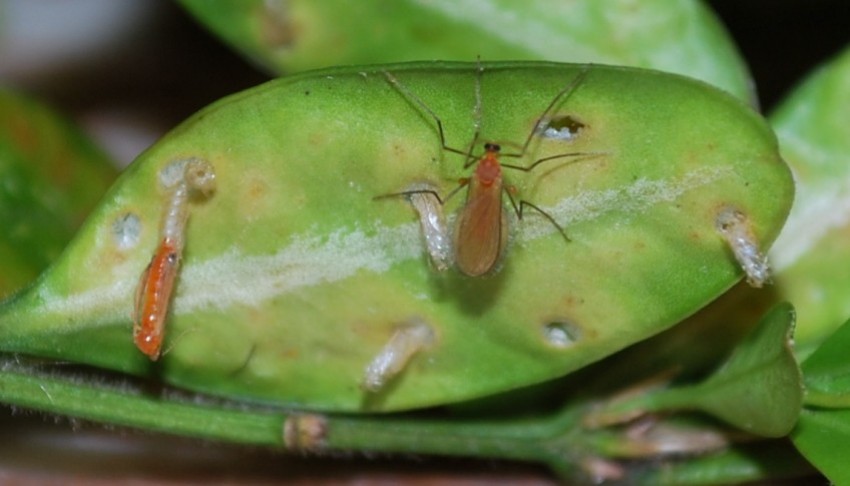

Fly, Boxwood Leafminers Fly!

If you haven’t noticed, spring has sprung in earnest. Spring flowering trees and shrubs have popped and are already fading. The buds of many other plants are breaking everywhere. Right along with the plants come the critters.

Freshly emerged Boxwood leafminer adult and pupal exuviae

Freshly emerged Boxwood leafminer adult and pupal exuviae. Photo: Sabrina Tirpak, Rutges PDL

[Read more…]

Potato Disease Forecasting Report 5-16-14

Potato Disease Forecasting Report 5-16-14 – Click to Download

We will be tracking DSVs for Late blight development and calculating P-days for initiating the first early blight fungicide application.

The first late blight fungicide application is recommended once 18 DSVs accumulate from green row. Green row typically occurs around the first week in May in southern New Jersey. An early season application of a protectant fungicide such as mancozeb (Dithane, Manzate, Penncozeb) or Bravo (chlorothalonil) as soon the field is accessible is suggested. Please be vigilant and keep a look out for suspect late blight infections on young plants. No late blight has been reported in our region to date.

Remember the threshold for P-days is 300!  Once 300 P-days is reached for your location early blight fungicide applications should be initiated. Growers who are interested in using this model should chose the location above that is closest in proximity to their farming operation and should regularly check the Cornell NEWA website (http://newa.cornell.edu/) where this information is compiled from. Click on Pests Forecasts from the menu, select your weather station, and click on tomato diseases, set accumulation start date and a table of daily and total DSVs will be generated.

Tomato Disease Forecasting Report 5-16-14

5-16-14 Tomato Report – Click to Download

Disease severity values (DSVs) for early blight, septoria leaf spot, and tomato anthracnose development are determined daily based on leaf wetness (due to rainfall, dew) and air temperature.

On a daily basis DSV values can range from 0 to 4 where 0 = no chance for disease development to 4 = high chance for disease development.
DSVs are accumulated during the production season.

Fungicide applications are based on an individually determined DSV threshold. The first fungicide application for the control of these three diseases is not warranted until 35 DSVs have accumulated from your transplanting date. After that, growers can base fungicide applications on different DSV thresholds.

Pesticide Worker Protection Inspection Warning

The New Jersey Department of Environmental Protection Pesticide Control Program (NJDEP) has announced that federal agricultural Worker Protection Standard (WPS) compliance farm inspections will be conducted mid-May through July. Be a prepared agricultural employer. Take the necessary actions this week to make sure your farm is in compliance to avoid citations.

Two outstanding farm employer resources on agricultural WPS compliance are:
1. EPA Ag Employer Quick Reference Guide (2005)
2. EPA website How to Comply with the Worker Protection Standard for Agricultural Pesticides: What Employers Need to Know

These are inspections by the US EPA, although NJDEP inspectors may accompany them. Approximately 20 to 30 inspections are slated to be conducted any time from May through July.


Fruit IPM Report May 14, 2014

This week in Fruit IPM

Brown Marmorated Stink Bug (BMSB):
Emergence from overwintering sites has started!

Both male and females are being found in pheromone traps and blacklight traps throughout the state. Any insecticides or insecticide mixes that are used for oriental fruit moth, plum curculio, codling moth or other pests should now include materials effective for BMSB.
  • Peach
  • Apple
  • Blueberry
  • Scouting Calendar
  • Trap Counts

[Read more…]