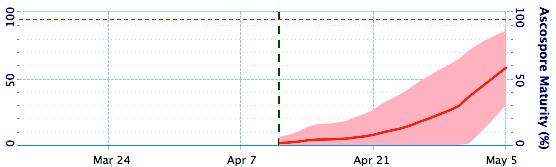
See NEWA for Ascospore Maturity Graphs for your orchard.
This week in Fruit IPM
- Peach
- Apple
- Pear
- Scouting Calendar
- Trap Counts
Click to Download PDF version
Peach
Brown Rot: [Unchanged from last week] Blossom infections from the brown rot fungus can occur whenever pistils are exposed and a favorable climate exists. Infections can occur during any wetting period when temperatures are between 41 and 86°F. However optimum conditions (See WVU Kearneysville, Brown Rot of Peach and Nectarine) for infection occur with wetting and temperatures in the mid 70’s. During long wetting periods (several days or more) blossoms can be infected regardless of temperature. Generally infections that occur when conditions are sub optimal are less severe. Blossoms and fruitlets will remain susceptible until the pistil desiccates (sometime between petal fall and shuck split).
Petal Fall Insect Complex: An OFM biofix was set for April 14 at the research station at Centerton. Trap captures in commercial orchards only began over the weekend, so low population orchards will have plenty of time to wait until all the bloom is off before applying petal fall insecticides. Treatments for the first flight will be due at 170-200 degree days after the first trap captures or “biofix.” This timing usually coincides with late petal fall to shuck split. We have accumulated 112 degree days since 4/14.
Avaunt is one of the better materials for plum curculio (PC) at this time, and also covers Oriental fruit moth and tarnished plant bug. Any covers that include Imidan will also do a good job with PC. While the synthetic pyrethroids (Asana, Ambush/Pounce, Warrior, Baythroid) are rated for control of petal fall insect pests, experience has shown that the pyrethroids may be weak at lower rates against plum curculio (PC), especially in hot weather. If using any pyrethroids (Ambush, Asana, Baythroid, Danitol, Perm-Up, Pounce, Warrior, Lambda-Cy, or any of the other generics), use a high rate in order to control both OFM and PC. Endigo, a premix for stone fruit; contains the active ingredients for warrior and actara and is a good choice around shuck split for the entire insect complex. Rotate pyrethroids (IRAC group 3) and O.P.’s (IRAC group 1B) with different chemistries for resistance management (see IRAC groups below).
The key arthropod targets at petal fall are OFM, PC and various catfacing insects, primarily tarnished plant bug and native stinkbugs.
Rusty Spot: An effective material should be included at petal fall on rusty spot sensitive varieties. Rally at 2.5 – 5 ozs./acre is the standard, however other effective materials include Gem, Topsin-M, and Quadris Top when used at the higher rates. Both Gem and Quadris top will control all diseases at petal fall.
Apple
Diseases: Apple Scab, Powdery Mildew, Cedar Apple Rust, are diseases of concern at this time.
The wetting conditions due Tuesday 4/29 through Thursday 5/1 should produce a severe scab infection period. The NEWA scab models are predicting 79-83% ascospore maturity during this period in southern NJ and 26-36% maturity in Hunterdon County. Any way you cut it, this will be a severe infection period. Primary apple scab spores are released during any substantial wetting and infection period. Make sure you are well covered. Cedar apple rust infections can occur anytime between pink and 3rd cover. The DMI fungicides Rally, Procure, and Indar are standard scab, rust, and mildew materials. The premix Inspire Super contains a DMI fungicide premixed with an AP. Rotate the DMI’s with different chemistries such as: Vangard or Scala (AP); Fontellis (SDHI); Luna Sensation, or Merivon (SDHI + QoI); and Luna Tranquility (AP+SDHI).
More information can be found in our recent blog post (Apple Scab Alert) and on Dr. Dave Rosenberger’s blog (Scab Warning | Plant Pathology at the Hudson Valley Lab). While it may not be necessary to combine the premixed products with a protectant such as Manzate, doing so will provide an extra layer of resistance management, as well as improve rust control. Watch the amount of green tissue that is showing. If you are barely at green tip, as on some varieties in northern counties, then infection periods will not be as severe. If you are at pink to bloom, then infection periods will be more severe.
Fire Blight: The first blossoms opened in southern counties on April 11. From a calendar perspective, blossom sprays using Streptomycin should be applied on a 3-7 day schedule or anytime temperatures are 65° F or above and the relative humidity is 60% or above. Mycoshield now has a supplemental label allowing use on apples. Rotations of Streptomycin and Oxytetracyclene will help manage resistance.
Pear
Pear Psylla: Pear Psylla nymphs are still hatchingin southern counties, but only eggs are present in northern counties. Nymphs will feed on developing clusters through bloom. The best option for control at popcorn is Surround @ 25-50#/ac. Esteem may also be used through bloom.
Fire Blight: Fire blight conditions will be favorable for later this week. See apple section above.
Scouting Calendar
The following table is intended as an aid for orchard scouting. It should not be used to time pesticide applications. Median dates for pest events and crop phenology are displayed. These dates are compiled from observations made since 1995 in Gloucester County. Events in northern New Jersey should occur 7-10 days later.
| Pest Event or Growth Stage | Approximate Date | 2014 Observed Date |
| 1/4″ Green Tip Red Delicious | March 27 +/- 10 Days | April 11 |
| Tight Cluster Red Delicious | April 8 +/- 10 Days | April 17 |
| Oriental Fruit Moth Biofix | April 8 +/- 10 Days | April 14 |
| Pink Peach (Redhaven) | April 10 +/- 9 Days | April 13 |
| Pink Apple (Red Delicious) | April 13 +/- 11 Days | April 24 |
| Full Bloom Peach (Redhaven) | April 16 +/- 7 Days | April 21 |
| Green Peach Aphid Observed | April 16 +/- 16 Days | Not yet observed |
| Oriental Fruit Moth – 175 DD target | April 19 +/- 12 Days | Not yet observed |
| Full Bloom Apple (Red Delicious) | April 20 +/- 9 Days | Not yet observed |
| Petal Fall (Redhaven) | April 21 +/- 9 Days | Not yet observed |
| Petal Fall (Red Delicious) | April 27 +/- 13 Days | Not yet observed |
| Shuck Split (Redhaven) | April 29 +/- 7 Days | Not yet observed |
| Tufted Apple Bud Moth Biofix | May 4 +/- 10 Days | Not yet observed |
| Plum Curculio Oviposition Begins | May 5 +/- 16 Days | Not yet observed |
| Oriental Fruit Moth – 375 DD target | May 10 +/- 10 Days | Not yet observed |
| Codling Moth Biofix | May 14 +/- 16 Days | Not yet observed |
Trap Counts – Southern Counties
| WEEK ENDING | STLM | TABM-A | CM | AM | OFM-A | DWB | OFM-P | TABM-P | LPTB | PTB |
| 4/19 | 0 | 0 | 0 | |||||||
| 4/26 | 37 | 13 | 0 |
Trap Counts – Northern Counties
| WEEK ENDING | STLM | TABM-A | CM | AM | OFM-A | DWB | OBLR | OFM-P | TABM-P | LPTB | PTB |
| 4/12 | 0 | ||||||||||
| 4/19 | 3 | ||||||||||
| 4/26 | 44 | 0 | 0 |

