Vegetable Crops Edition

Seasonal updates and alerts on insects, diseases, and weeds impacting vegetable crops. New Jersey Commercial Vegetable Production Recommendations updates between annual publication issues are included.
 
Subscriptions are available via EMAIL and RSS.
 
Quick Links:

NJ Commercial Vegetable Production Recommendations

Rutgers Weather Forecasting - Meteorological Information important to commercial agriculture.

Understanding Combination Insecticide Products

When using blended products:

  • Know the pest that you need to control.
  • Use an appropriate insecticide that will do the job with as little negative impact as possible.
  • Avoid broad spectrum insecticides when possible.
  • Avoid using redundant materials.

Over the past decade, the number of vegetable insecticides (both commercial products and insecticide classes) has increased significantly.  Included in these are a number of materials with novel modes of action (MOA), and high degrees of pest specificity. For example, some newer materials have efficacy against caterpillars only, while others may control caterpillars and some fly larvae. Other examples are detailed in the chart, Combination Insecticide Products for Commercial Vegetable Crops. This article clarifies the options in the Commercial Vegetable Recommendations so that growers may make more informed choices as to the most useful product for specific pests. [Read more…]

2014 Potato and Tomato Reports Available

The 2014 Potato and Tomato Reports are now available! Just scroll over the Vegetable Crops tab on the Plant and Pest Advisory homepage and links for each report will appear.

Like in years past, both reports will be updated twice a week for those interested in timing their fungicide applications according to Tom-Cast and Blightcast from NEWA information. Real-time updates can also be obtained by going directly to the NEWA site, selecting the nearest weather station to your farm operation, and clicking on the appropriate model. It is that simple! As always, should Late Blight appear in our region sometime this season a PPA Alert will be sent out to those signed up.

Basil Downy Mildew Reported – NJ 5/5/14

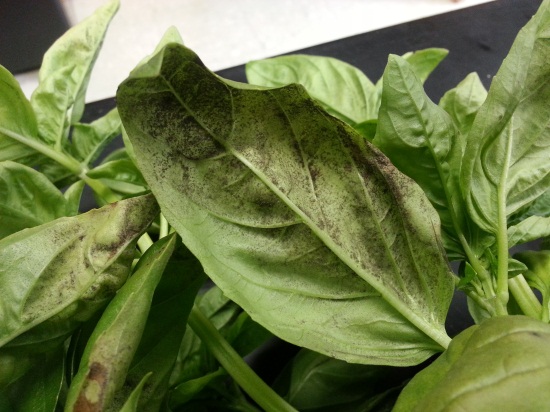
Basil downy mildew was reported in a greenhouse in Virginia last week. The first question I asked myself was, “How can that be?”

BDM_OW_GH

Basil downy mildew on overwintered sweet basil plant.
Note symptoms on leaf top side and downy mildew spores on leaf underside.

Well, before I could come up with a good answer, basil downy mildew was found in a high tunnel in Salem County today. I don’t have any of the details from the VA report yet, but I do have a lot of information from New Jersey.

The infected plants in question, roughly 12 mature potted sweet basil plants, were just a few plants that were left over from last fall and carried over the winter in a non-heated high tunnel on benches with heated mats and row cover. The heated mats and row cover were for protecting other crops. Interestingly, the basil did not freeze out, somehow managed to survive the winter without much heat, and produce downy mildew spores once the outside temperatures rose.
[Read more…]

Strawberry Fruit Rots

Anthracnose fruit rot of strawberry

Anthracnose Fruit Rot of Strawberry

Fruit rots in strawberry can cause significant losses if not recognized early and controlled. The use of good cultural practices such as: keeping fields weed-free and promoting good drainage; long crop rotations, and preventative fungicide applications are critical.

Pathogens such as anthracnose, gray mold (Botrytis), and leather rot can become systemic problems in strawberry plantings once established. All three fungal diseases are soil-borne and once in fields can be difficult to manage over the lifetime of the planting.

The use of mulch (matted rows) to prevent/reduce soil splashing and keeping fruit from coming into direct contact with the soil surface can be beneficial in organic production systems where conventional fungicides cannot be used. Use of long crop rotations and staying away from areas of the farm with known instances of any of these pathogens is also important. Remember that same species of Colletotrichum that causes fruit rot in pepper and other crops can also infect strawberry.

[Read more…]

Pepper Weevil Trap Counts

The map shows the general location of traps and the number of weevils caught between April 17 and 28

The map shows the general location of traps and the number of weevils caught between April 17 and 28

Adult pepper weevils have been caught in some of the traps that are set at or near produce handling facilities in southern New Jersey.   Since Florida vegetable crops newsletters indicate severe populations of pepper weevils in some regions of that state, this is not surprising.  Pepper weevils escaping into the environs around these facilities may be a problem if they are able to find solanaceous weeds before crops like peppers, tomatoes and eggplant are transplanted.

We will report weekly the numbers of weevils caught in the area and their general location in a map like the one here.  Between April 17 and April 28, 5 weevils have been caught.  Pepper farmers near these areas should consider monitoring for the presence of weevil once they have transplanted their peppers to the field.  For more information contact Joe Ingerson-Mahar at mahar@njaes.rutgers.edu

BMSB Survey

“Are you a grower? Got stink bugs? We need your help! We’re surveying growers to assess the impact of BMSB on crops and gathering information that will help us defeat this pest.

Receive a free Guide to Stink Bugs* if you complete the 10-minute BMSB survey”
https://cornell.qualtrics.com/SE/?SID=SV_5ssnjXLNhvp6v1H
Thanks in advance! – From the Northeast IPM Center

The BMSB Working Group, through NE IPM Center and Cornell University, is collecting information from farmers on BMSB impact and management. If you have time, please fill out this short survey. It will help to gather information that we can use to identify what’s working and what we still need to do.