Vegetable Crops Edition

Seasonal updates and alerts on insects, diseases, and weeds impacting vegetable crops. New Jersey Commercial Vegetable Production Recommendations updates between annual publication issues are included.
 
Subscriptions are available via EMAIL and RSS.
 
Quick Links:

NJ Commercial Vegetable Production Recommendations

Rutgers Weather Forecasting - Meteorological Information important to commercial agriculture.

Veg IPM Update: Week Ending 7/13/16

Sweet Corn 

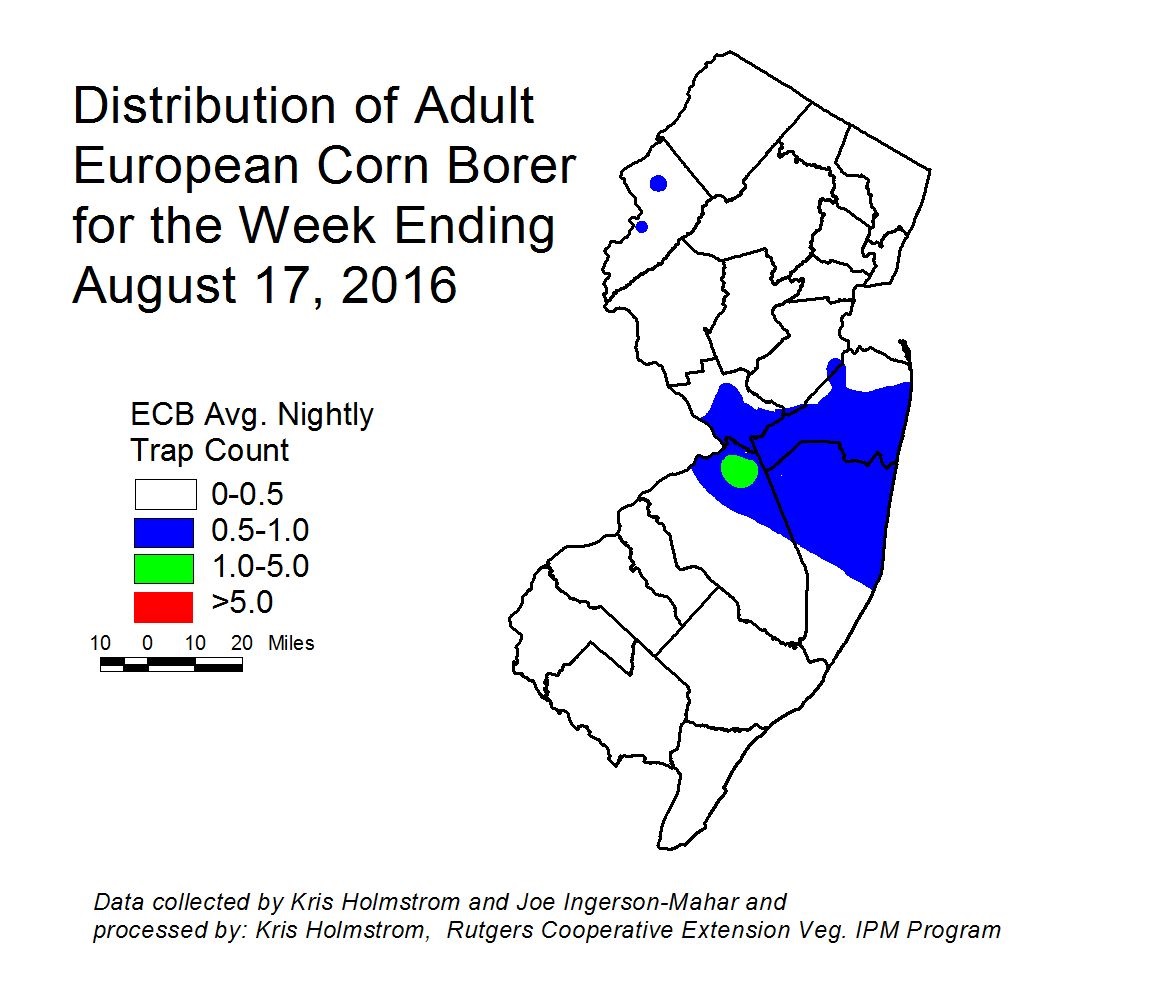
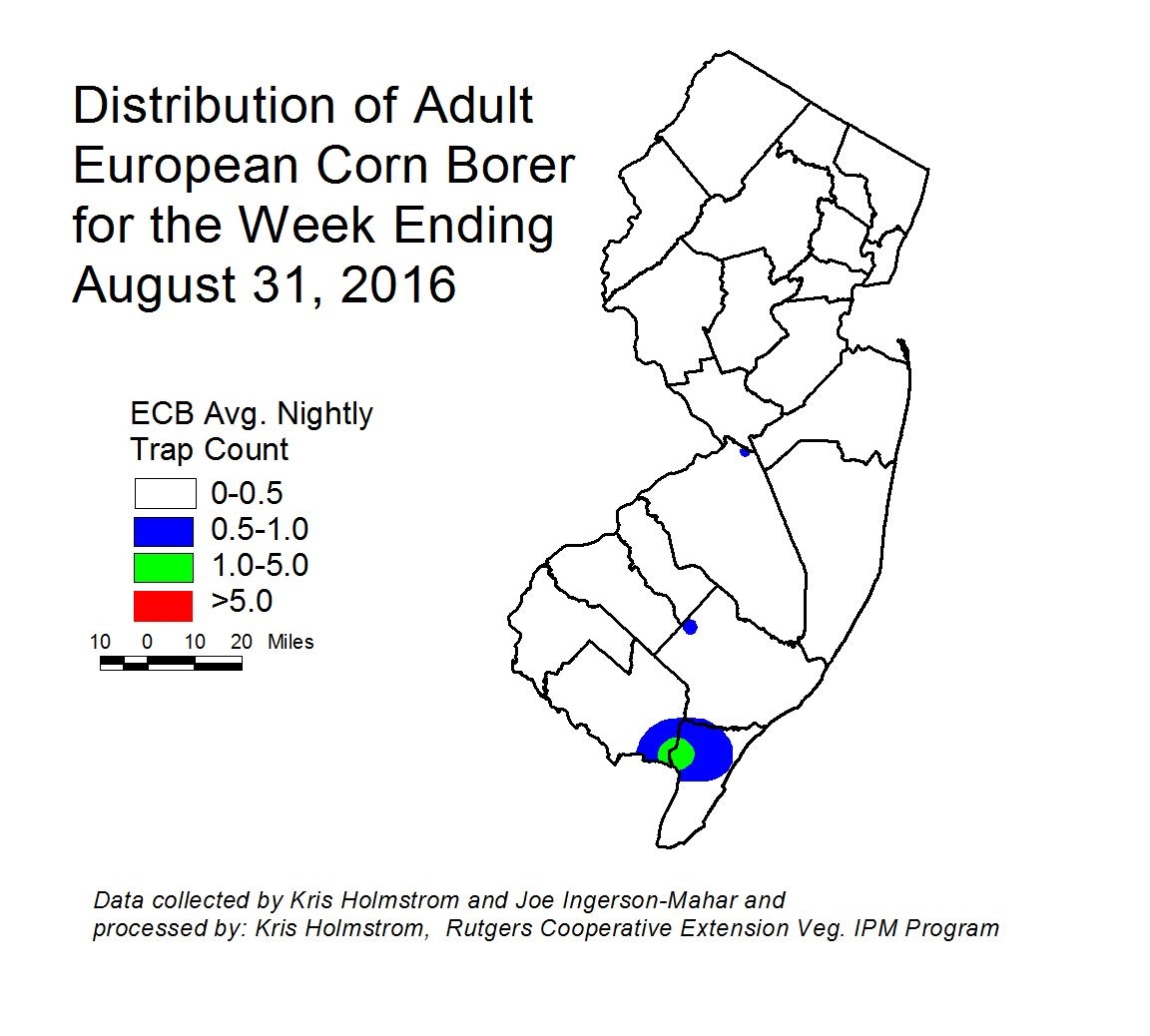
 16ecb0713aEuropean corn borer (ECB) moth catches are very low, but showing signs of increase on the Cape May/Cumberland Co. border (se ECB map) .  Most larval infestations, have passed.  Be sure to begin monitoring plantings for ECB feeding while they are still in the whorl stage.  Consider treating when the number of infested plants in a 50 plant sample exceeds 12%.  Feeding in the whorl stage will appear as numerous small holes (called “shot-hole”) on leaves, with damage present on consecutively younger leaves. As plants progress to pre-tassel and beyond, droppings and  larvae may be found in or on the emerging tassels.  Any planting remaining at or above threshold as it proceeds to full tassel should be treated, as this is the last stage at which ECB larvae will be exposed and vulnerable to insecticidal sprays.    [Read more…]

Cucurbit downy mildew confirmed on cucumber in Southern New Jersey – ALERT – 7/11/16

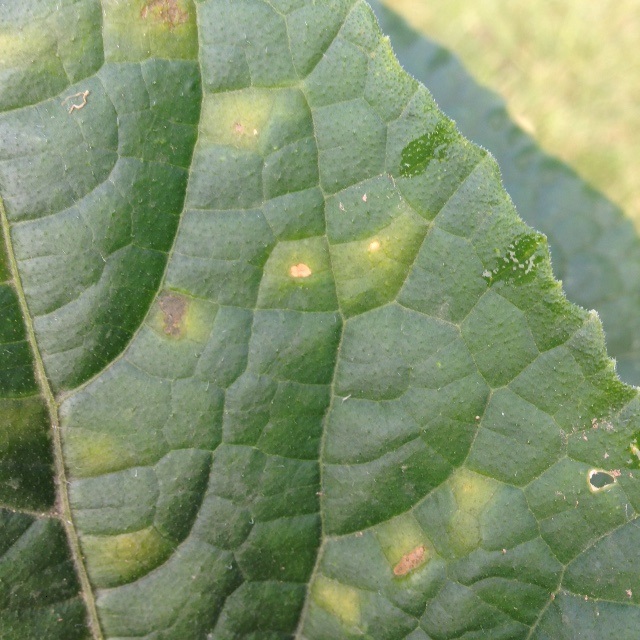
Cucurbit downy mildew has been confirmed on cucumber near Cedarville in Cumberland County, New Jersey. This is the first report of cucurbit downy mildew this growing season. All cucumber growers who have not included a downy mildew-specific fungicide in their weekly spray program should do so. For more in formation on controlling cucurbit downy mildew please see the 2016 Mid-Atlantic Commercial Vegetable Production Recommendations Guide.

Dickeya dianthicola affecting potato growers throughout Mid-Atlantic region and elsewhere – Updated 7/11/16

In addition to Dickeya dianthicola being found in ‘Superior’, ‘Reba’, ‘Snowden’, and ‘Norwis’ on 3 farms in New Jersey this year, the pathogen has also been detected in fields with seed originating from Maine on 5 farms on Long Island in ‘Reba’, ‘Vivialdi’, ‘Superior’, ‘Norwis’, and ‘Waneta’. Other varieties such as ‘Yukon Gold’ have also tested positive for Dickeya. The pathogen has been detected in MA, DE, PA, MD, VA, NC, WV, and FL this summer on seed from Maine and New Brunswick, Canada (NJ and VA). Maine potatoes are currently shipped to over 20 states across the country (CA, CT, DE, FL, ID, IN, KY, MD, MA, MS, NH, NJ, NY, NC, OH, PA, RI, TN, VT, VA, WA, WV, and WI). Potato growers, crop consultants, and Extension personnel in states which grow Maine potatoes should remain vigilant by scouting their fields for Dickeya symptoms on a regular basis and by submitting any suspect samples for diagnostic testing. Dickeya dianthicola has been detected in the US in the past, and because of this, APHIS just recently announced that the pathogen has been designated as a non-reportable/non-actionable pathogen despite its potential to cause 100% crop loss. A link to the USDA/APHIS website for information on Dickeya dianthicola detection and control can be found here.

For more information on Dickeya please see the following articles posted online – source(s) of information:

Dickeya: A new potato disease – Growing Produce

Blackleg is Once Again Being Observed in Potato Fields Across the Mid-Atlantic Region – Penn State University

Update on Dickeya detections in potato – University of Delaware

Dickeya Blackleg: New potato disease causing major impact. – Cornell University

Watch for Dickeya – a new potato disease – The Ohio State University

High security Aroostook farm advances tater technology. – Maine Potato Board

Slowing Dickeya, other pathogens in Canada. – North Dakota State University

Dickeya: A new threat to potato production in North America. – SPUDsmart

Dickeya is coming. – University of Wisconsin/North Dakota State University

Maine ‘Ground Zero’ for new potato disease. – Maine Department of Ag.

Maine seed potato growers looking to protect brand against disease. Maine Department of Ag./Maine Potato Board

Vegetable Disease Briefs – 7/11/16

  • Basil downy mildew has been confirmed in southern and central New Jersey. All conventional basil growers should be on a preventative spray program prior to the arrival of the disease.
  • Cucurbit downy mildew has been confirmed on cucumber as far north as Caroline County, Maryland and Sussex County, DE this past week. Cucurbit growers need to scout on a daily basis. All cucumber growers need to add a downy mildew-specific fungicide to their weekly fungicide programs.
  • Reports of Dickeya dianthicola in potato continue across the east coast. Dickeya dianthicola has been confirmed in 10 states to date on potato seed originating from Maine and New Brunswick, Canada this growing season. All potato growers are encouraged to scout fields and report any suspect plants/tubers.

Veg IPM Update: Week Ending 7/06/16

Sweet Corn  16ecb0706a

European corn borer (ECB) moth catches remain very low now.  Only scattered individuals are now being captured, and growers are managing residual infestations.  At the present, the highest adult activity is in Salem county, although it is quite low even there (see ECB map).  Larval feeding ranges from single digits to above 20% in areas where IPM personnel are operating.  Be sure to begin monitoring plantings for ECB feeding while they are still in the whorl stage.  Consider treating when the number of infested plants in a 50 plant sample exceeds 12%.  [Read more…]

Dickeya dianthicola affecting potato growers throughout Mid-Atlantic region and elsewhere – Updated 7/11/16

In addition to Dickeya dianthicola being found in ‘Superior’, ‘Reba’, ‘Snowden’, and ‘Norwis’ on 3 farms in New Jersey this year, the pathogen has also been detected in fields with seed originating from Maine on 5 farms on Long Island in ‘Reba’, ‘Vivialdi’, ‘Superior’, ‘Norwis’, and ‘Waneta’. Other varieties such as ‘Yukon Gold’ have also tested positive for Dickeya. The pathogen has been detected in MA, DE, PA, MD, VA, NC, WV, and FL this summer on seed from Maine and New Brunswick, Canada (NJ and VA). Maine potatoes are currently shipped to over 20 states across the country (CA, CT, DE, FL, ID, IN, KY, MD, MA, MS, NH, NJ, NY, NC, OH, PA, RI, TN, VT, VA, WA, WV, and WI). Potato growers, crop consultants, and Extension personnel in states which grow Maine potatoes should remain vigilant by scouting their fields for Dickeya symptoms on a regular basis and by submitting any suspect samples for diagnostic testing. Dickeya dianthicola has been detected in the US in the past, and because of this, APHIS just recently announced that the pathogen has been designated as a non-reportable/non-actionable pathogen despite its potential to cause 100% crop loss. A link to the USDA/APHIS website for information on Dickeya dianthicola detection and control can be found here.

For more information on Dickeya please see the following articles posted online – source(s) of information:

Blackleg is Once Again Being Observed in Potato Fields Across the Mid-Atlantic Region – Penn State University

Update on Dickeya detections in potato – University of Delaware

Dickeya Blackleg: New potato disease causing major impact. – Cornell University

Watch for Dickeya – a new potato disease – The Ohio State University

High security Aroostook farm advances tater technology. – Maine Potato Board

Slowing Dickeya, other pathogens in Canada. – North Dakota State University

Dickeya: A new threat to potato production in North America. – SPUDsmart

Dickeya is coming. – University of Wisconsin/North Dakota State University

Maine ‘Ground Zero’ for new potato disease. – Maine Department of Ag.

Maine seed potato growers looking to protect brand against disease. Maine Department of Ag./Maine Potato Board