- Late blight has not been reported on tomato or potato in NJ to date. If you suspect Late blight on your farm please contact your county Extension agent. To track the progress of Late blight in the US please visit USAblight.
- Cucurbit downy mildew (CDM) on cucumber continues to be reported throughout the region. All cucumber growers should add downy mildew specific products to their regular maintenance programs. CDM has also been reported on giant pumpkin, cantaloupe, and butternut squash in PA and on pumpkin and watermelon in DE, VA, and MD to date. All pumpkin and watermelon growers are encouraged to include downy mildew specific fungicides in their regular weekly maintenance programs. To track CDM movement in the US please visit the North Carolina State University’s CDM Forecasting Website.
Vegetable Crops Edition
Seasonal updates and alerts on insects, diseases, and weeds impacting vegetable crops. New Jersey Commercial Vegetable Production Recommendations updates between annual publication issues are included.
Subscriptions are available via EMAIL and RSS.
Quick Links:
 NJ Commercial Vegetable Production Recommendations
Rutgers Weather Forecasting - Meteorological Information important to commercial agriculture.
August 30, 2017 Andy Wyenandt
Vegetable Disease Update – 8/30/17
August 23, 2017 Kris Holmstrom and Joe Ingerson-Mahar
Veg IPM Update: Week Ending 8/23/17
Sweet Corn
European corn borer (ECB) catches have again declined to levels that do not permit a map image. This flight has been very sporadic. ECB feeding in NJ sweet corn plantings is very low, and has been largely obscured by fall armyworm (FAW) feeding. Check 5 plants each in 10 random locations for a 50 plant sample. Look for “shot-hole” injury, and consider treating when the number of infested (from ECB or FAW) plants in a 50 plant sample exceeds 12%. As infested plants proceed to the pre-tassel stage, live larvae and damage may be found in the emerging tassels. Once plants hit full tassel, ECB larvae will move downward on the stalk and re-enter the plant near the area where ears are forming. This can result in direct injury to the ear. Growers should consider an insecticide application at the full tassel stage to target ECB larvae as they migrate downward. This application can eliminate larvae that have escaped any earlier insecticide applications. [Read more…]
August 22, 2017 Andy Wyenandt
Vegetable Disease Update – 8/22/17
- There have been a few reports of late blight in PA this past week. Late blight has not been reported in NJ to date. If you suspect Late blight on your farm please contact your county Extension agent. To track the progress of Late blight in the US please visit USAblight.
- Cucurbit downy mildew (CDM) on cucumber continues to be reported throughout the region. All cucumber growers should add downy mildew specific products to their regular maintenance programs. CDM has also been reported on giant pumpkin, cantaloupe, and butternut squash in PA and on watermelon in VA and MD to date. To track CDM movement in the US please visit the North Carolina State University’s CDM Forecasting Website.
- Bacterial canker and bacterial leaf spot in tomato are being reported.
- Bacterial leaf spot is also being reported in pepper.
- Pepper anthracnose has been reported in the past week.
- Cucurbit powdery mildew and anthracnose in cucurbit crops have been reported.
August 16, 2017 Kris Holmstrom and Joe Ingerson-Mahar
Veg IPM Update: Week Ending 8/16/17
Sweet Corn
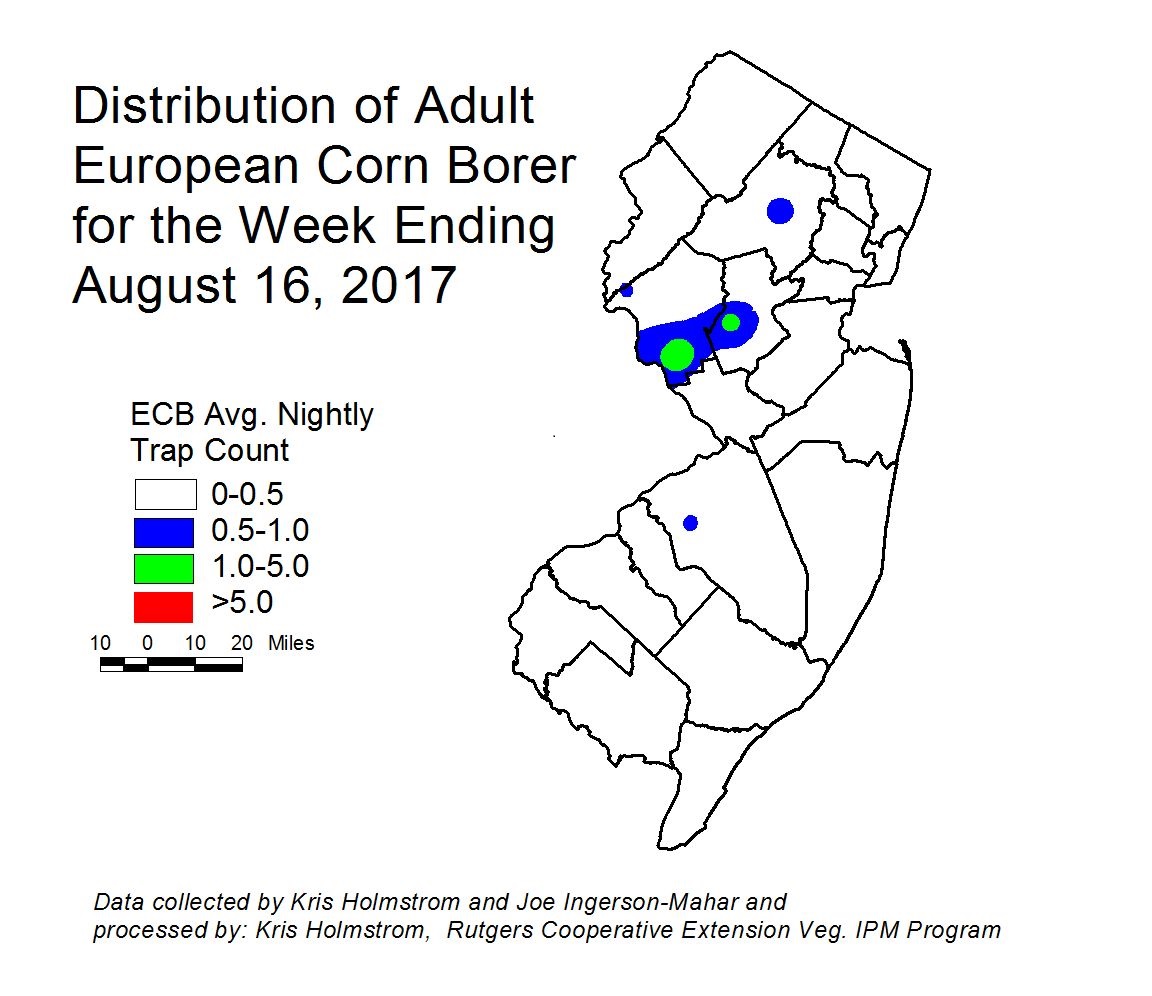 European corn borer (ECB) catches have been largely contained to Hunterdon and Somerset counties this past week (see ECB map at left). This flight has been very sporadic. ECB feeding in NJ sweet corn plantings is very low, and has been largely obscured by fall armyworm (FAW) feeding. Check 5 plants each in 10 random locations for a 50 plant sample. Look for “shot-hole” injury, and consider treating when the number of infested (from ECB or FAW) plants in a 50 plant sample exceeds 12%. As infested plants proceed to the pre-tassel stage, live larvae and damage may be found in the emerging tassels. Once plants hit full tassel, ECB larvae will move downward on the stalk and re-enter the plant near the area where ears are forming. This can result in direct injury to the ear. Growers should consider an insecticide application at the full tassel stage to target ECB larvae as they migrate downward. This application can eliminate larvae that have escaped any earlier insecticide applications. [Read more…]
August 10, 2017 Andy Wyenandt
Vegetable Disease Update – 8/10/17
- Late blight (US-23) was reported on tomato in Chester County in Southeastern PA this week. US-23 is active on both tomato and potato. All NJ tomato and potato growers are encouraged to scout their fields on a daily basis. Late blight has not been reported in NJ to date. If you suspect Late blight on your farm please contact your county Extension agent. To track the progress of Late blight in the US please visit USAblight.
- Cucurbit downy mildew (CDM) on cucumber continues to be reported throughout the region. All cucumber growers should add downy mildew specific products to their regular maintenance programs. CDM has also been reported cantaloupe and Butternut squash in PA. CDM has also been reported in pumpkin as far north as North Carolina. To track CDM movement in the US please visit the North Carolina State University’s CDM Forecasting Website.
- Bacterial canker and bacterial leaf spot in tomato are being reported. Bacterial leaf spot is also being reported in pepper.
- Pepper anthracnose has been reported in the past week.
- Dickeya dianthicola has been reported in 6 states and in 9 potato varieties to date including Dark Red Norland, Red Pontiac, Silverton, Yukon Gold, Kennebec, Norwis, Superior, Marcy, and Vivaldi.
- Surveying for Dickeya dianthicola in potato fields and irrigation sources in NJ is currently on-going. If you suspect Dickeya, please contact your county agent. The best method for controlling Dickeya dianthicola in your operation is to adopt a zero-tolerance policy.
- Want more information of what is going on around the mid-Atlantic region? Just click on the links to articles written by Extension personnel from PA, DE, VA, and WV on the right side of the page! You can also sign-up with and have information sent directly to you just like the NJ – Plant and Pest Advisory.
August 9, 2017 Joe Ingerson-Mahar
Vegetable IPM Update: Week Ending 8/9/2017
Note: Due to technical difficulties, only sweet corn related maps and information will appear in this edition of the IPM Update. We hope to resume full coverage next week.
Kris Holmstrom and Joe Ingerson-Mahar
Sweet Corn
European corn borer (ECB) adult numbers have again subsided, and no map will appear here. As with last year, the second flight of ECB in New Jersey is low and sporadic. While we are beginning to see limited feeding from this pest, it is relatively insignificant compared to fall armyworm (FAW) feeding that is now occurring on whorl stage sweet corn. Insecticide applications should be made when 12% or more plants exhibit signs of ECB and/or FAW feeding. FAW is, and will remain the dominant pest of vegetative stages of sweet corn for the remainder of the season. Damage is extensive in the southern most counties, while it has increased only slightly over the past week in central and northern NJ.
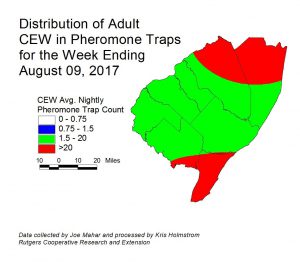
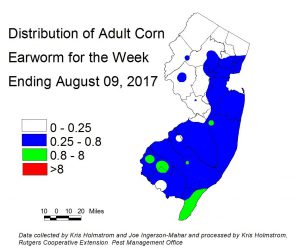
Corn earworm (CEW) catches have gotten slightly more consistent in blacklight traps around the southern half of the state, while pheromone trap catches have risen dramatically in some areas (see CEW blacklight and pheromone trap maps). Growers now treating silking sweet corn should adhere to silk spray schedules to limit damage.
The following are recommended silk spray schedules by region:
South – 3 days
Central – 4-5 days
North – 5-6 days
With frequent rains, the incidence of rust is increasing in some sweet corn plantings. Additionally, northern corn leaf blight has also been discovered in the northern counties. These diseases can be economically significant, particularly if they first appear in whorl stage plants. Should this situation occur, growers need to consider fungicide applications to limit damage. See the latest Commercial Vegetable Production Recommendations for suitable fungicides on this crop.