Organic Farm Advisory

The Plant & Pest Advisory serves NJ growers by reporting on important pests and recommending responses that are grounded in reproducible trials.

Articles in this section contain information helpful to the NJ commercial organic grower.
Sharing organic practice trial results between land-grant universities is a cost effective way to create a common knowledge base built on the strengths of individual programs. In the sidebar, find institutions with programs in organic agriculture which augment knowledge developed at the Rutgers New Jersey Ag Experiment Station.

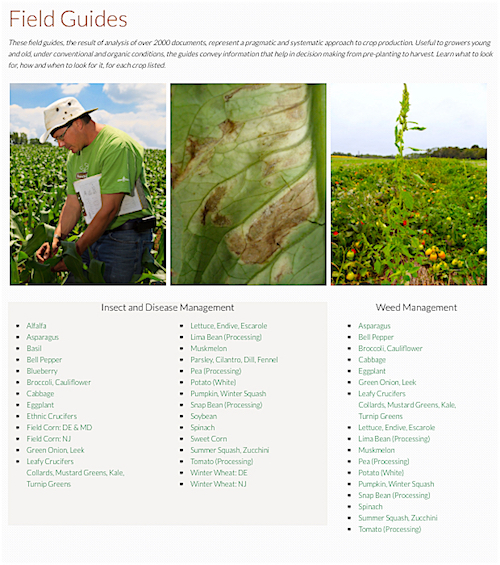
Rutgers Cooperative Extension Field Guides: These concise guides help with decision making from pre-planting to harvest. For each crop listed, learn what pests to proactively look for as the season progresses, how to look for them, and when to take action.

Field Guide List

Intro to Organic Vegetable Production Field Day from Penn State, Aug 6, 2015

Location
Good Work Farm
4791 Rock Road
Zionsville, PA 18092

Date: August 6, 2015 from 4 to 7 pm
4:00 PM Farm Tour
4:45 PM Scouting and Identification Exercise
5:45 PM Disease Management and Discussion
6:30 PM Dinner

Registration
This field day is part of the Introduction to Organic Vegetable Production series. No pre-registration is required. Walk-in to join us. $10 walk-in fee covers dinner and materials.

Penn State Extension is offering An Introduction to Organic Vegetable Production Field Day focusing on plant disease scouting, identification, and management on the evening of August 6th at Good Work Farm in Zionsville, PA located about an hour north of Philadelphia. For more information see Organic Vegetable Production Field Day.
Leaf Mold in Tomato

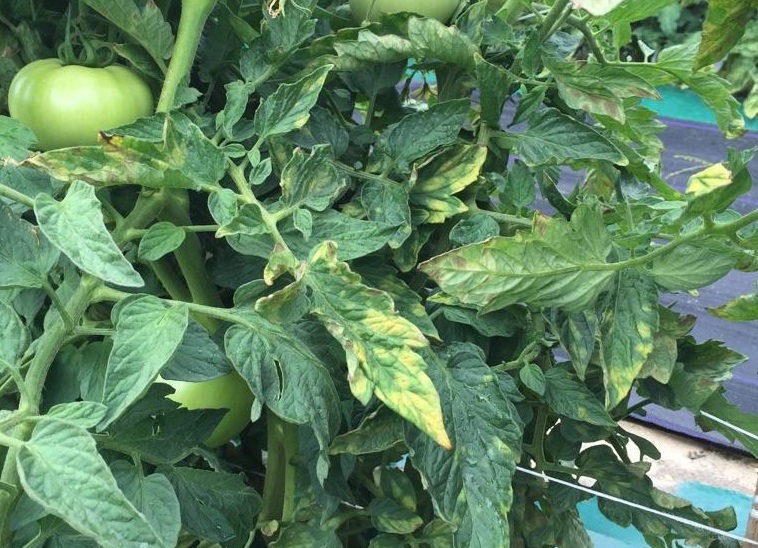
Leaf mold (formerly Fulvia fulva) has been confirmed in field-grown tomatoes in Cape May County.

Leaf mold occasionally appears in high tunnel or greenhouse tomato production in New Jersey. However, under ideal conditions the disease will develop in field-grown crops. The fungus will cause infection under prolonged periods leaf wetness and when relative humidity remains above 85%. If relative humidity is below 85% the disease will not occur. The pathogen can survive (overwinter) as a saprophyte on crop debris or as sclerotia in the soil. Conidia (spores) of the fungus can also survive up to one year in the soil.

Symptoms of leaf mold on infected tomato plant. Note the bright yellow leaves and the olive-green spores developing on the undersides of leaves.

Symptoms of leaf mold on infected tomato plant. Note bright yellow leaves and olive-green spores developing on undersides of leaves.

[Read more…]

Anthracnose and Alternaria Leaf Blight in Cucurbit Crops

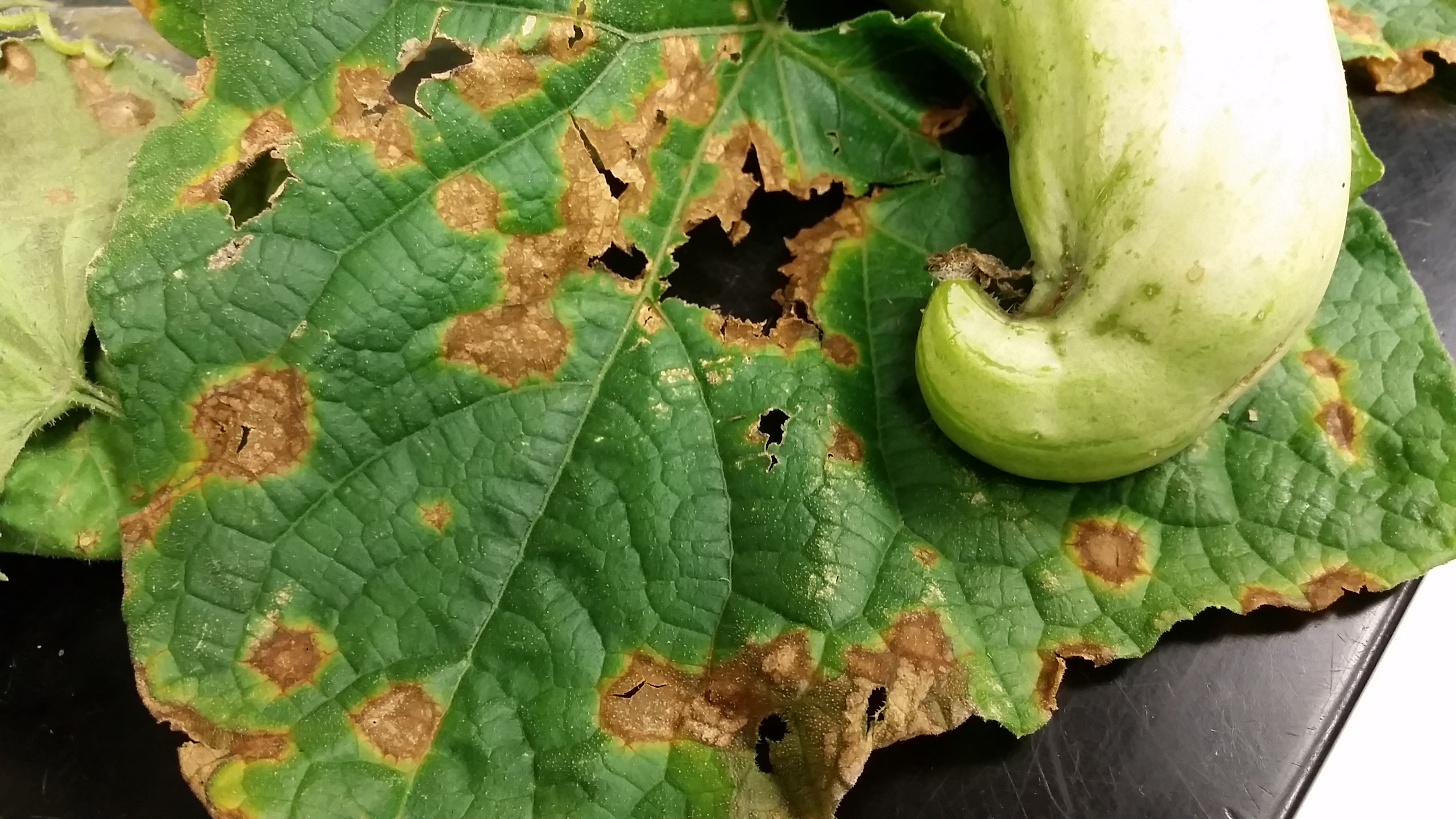
Anthracnose and Alternaria leaf blights are showing up in cucurbit crops. Weather conditions in the region continue to be ideal for disease development across all vegetable crops. The regular rainfall and high humidity that have plagued the region only acts to exacerbate problems. All cucurbit growers should be on high alert for foliar diseases such as anthracnose and Alternaria as well as downy mildew. Anthracnose and Alternaria produce distinct circular spots on infected leaves, and in most cases, symptoms begin on the older leaves.

Symptoms of anthracnose on infected cucumber leaf.

Symptoms of anthracnose on infected cucumber leaf.

With Alternaria, diagnostic concentric black rings will be develop within the spots. With Anthracnose, black setae (hair-like projections) will develop on the veins of infected tissue on the underside of leaves.

Anthracnose and Alternaria are easily controlled with weekly protectant fungicides such as chlorothalonil and mancozeb as long as they are applied prior to the arrival of the pathogen. Control of downy mildew will require downy mildew specific fungicides. As long as these weather conditions persist all growers need to remain on strict weekly protectant fungicide programs and be scouting on a daily basis. Organic growers can apply copper and other labeled products to help suppress development of these diseases.

Complete foliar coverage is critically important for the control these diseases.

For more information on the control of anthracnose and Alternaria leaf blight in cucurbit crops please see the 2015 Commercial Vegetable Production Guide.

Phytophthora Control During Wet Weather

Most of New Jersey has been plagued by heavy rains and pop-up thunderstorms these past few weeks making conditions ideal for pathogens such as Phytophthora blight (P. capsici) on pepper, eggplant, tomato, and cucurbit crops. Unfortunately, Phytophthora blight can be found on most farms in the southern part of the state. Poor crop rotations with susceptible hosts only make matters worse. The pathogen has an increasing host range that also includes snap and lima beans, and all crops, other than a few resistant bell pepper cultivars, lack any resistance to the pathogen. [Read more…]

Veg IPM Update: Week Ending 6/24/15

Sweet Corn

Click to View

Click to View

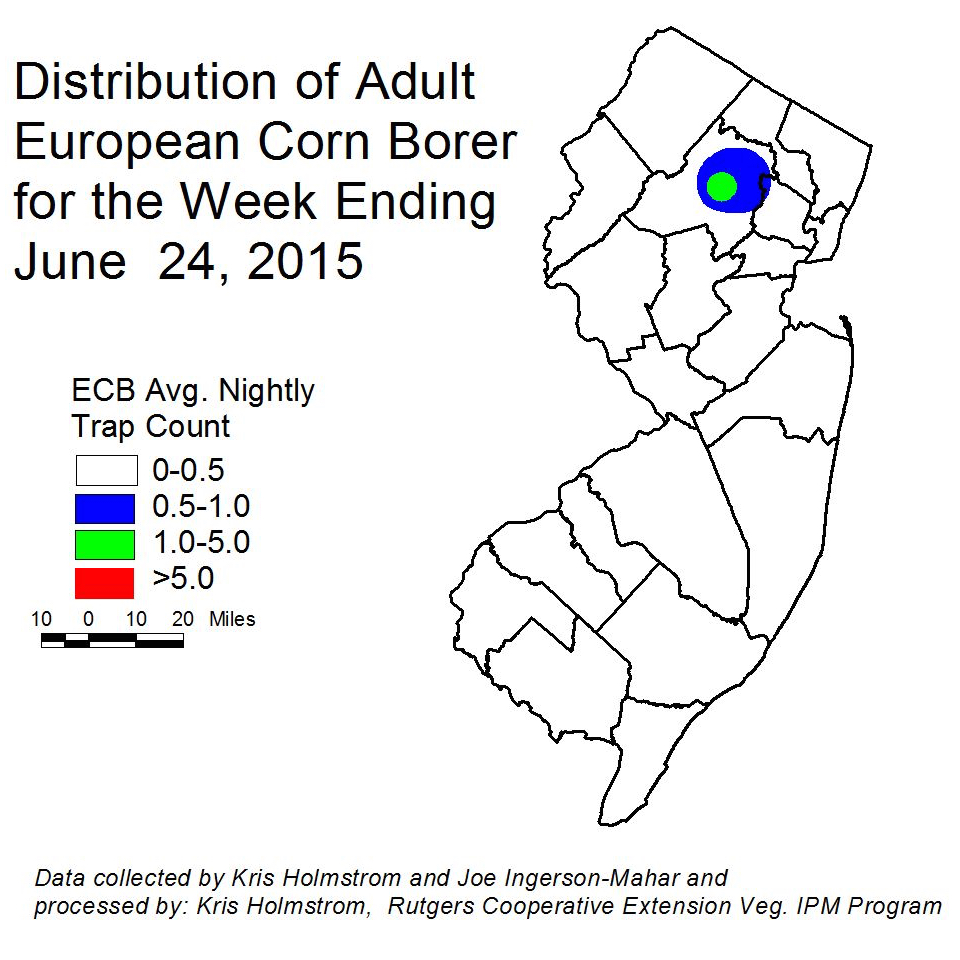
European corn borer (ECB) adult activity is now very low. Only scattered individuals remain in northern NJ, while the activity in the southwestern part of the state has declined to nearly nothing. The first flight is over in most of NJ. Areas of highest activity is in parts of Morris County (see ECB map). ECB infestations are still present in sweet corn plantings. Feeding in pretassle stage plantings in the 30% range has been found in areas where IPM personnel are operating.

Be sure to begin monitoring plantings for ECB feeding while they are still in the whorl stage. Consider treating when the number of infested plants in a 50 plant sample exceeds 12%. Feeding in the whorl stage will appear as numerous small holes (called “shot-hole”) on leaves, with damage present on consecutively younger leaves.
[Read more…]

Veg IPM Update: Week Ending 6/17/15

Sweet Corn

ECB 6-17-15

Click to View

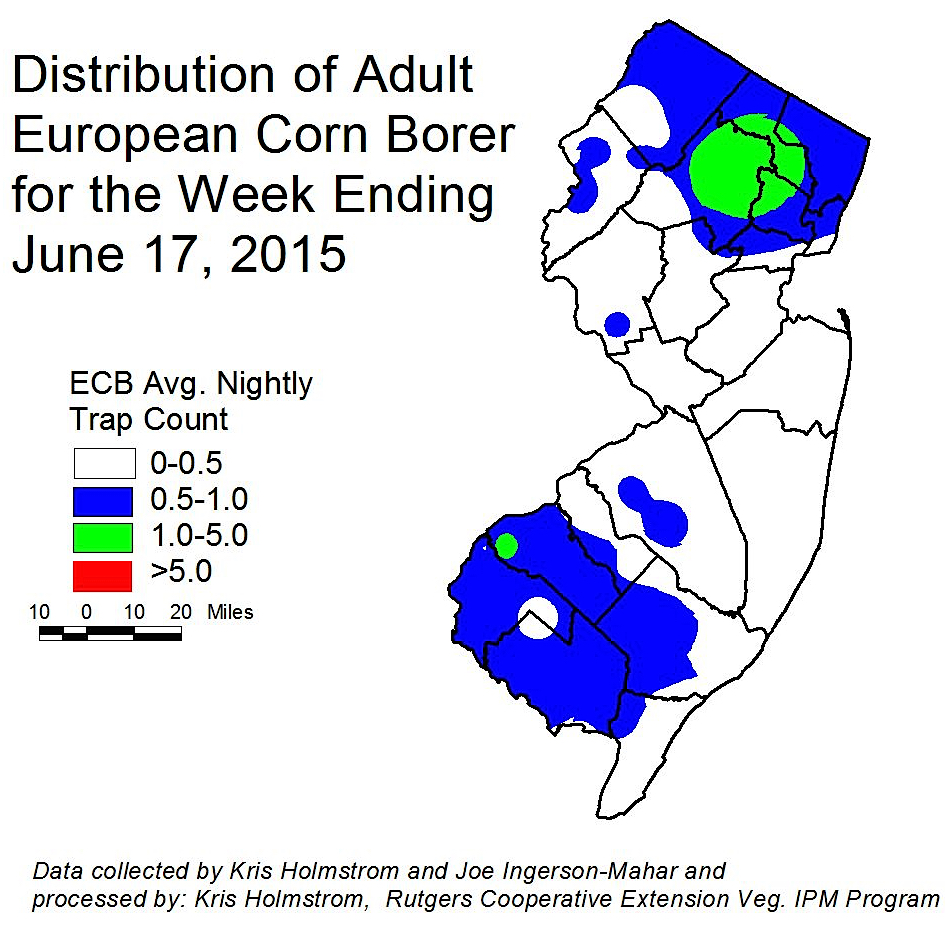
Warmer evening temperatures have resulted in a slight resurgence of European corn borer (ECB) adults in the blacklight network. A residual first generation population remains in northern NJ, while the activity in the southwestern part of the state may represent the beginning of a second flight. The nature of the southern NJ activity should become clear over the next 1-2 weeks. Areas of highest activity include parts of Morris and Gloucester counties (see ECB map). ECB infestations continue to rise in sweet corn plantings. Feeding ranges from single digits to over 50% in areas where IPM personnel are operating.
[Read more…]