After the critically cold temperatures in early April followed by several other nights of below freezing temperatures, NJ peach and apple growers have experienced loss of blossoms and/or fruit set. While the extent of the injury may still be too early to tell for some varieties, the cold weather has not stopped insect pests and where no fruit will be harvested we need to adjust our approach to insect management. This provides an opportunity to use selective materials where possible and allow natural enemy populations to attack some key pests.
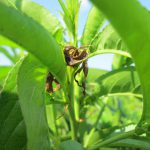
Terminal flagging from Oriental fruit moth egg laying
Oriental Fruit Moth lays its eggs of at least the first and second generation in peach terminals. Due to low or absent fruit loads, the trees will be very flush and provide lots of oviposition sites. Injury to terminals is noticeable by “flagging” of the terminals. If unmanaged, populations will be high in 2017 and could be difficult to control. Thus management of at least the first and second generation OFM needs to occur. I would strongly recommend using mating disruption, such as OFM TT, for unharvestable orchards. This will control all 4 generations and significantly reduce OFM pressure next year without harming beneficial insects. Mating disruption dispensers are placed in the middle of the tree canopy and can be placed now. See label for rate information. Sprayable mating disruption such as Checkmate OFM-F can be applied at 1.32 – 2.93 oz/A applied just prior to adult flight and again during flight. For chemical options, we generally use 5-6 male moths in a trap as a trigger for management. If monitoring traps exceed 5-6, then the use of either Madex HP or a diamide chemistry (ie. Altacor) is recommended. Madex HP is an insect virus that only attacks OFM and codling moth and is very effective in both research and commercial trials in NJ at rates from 1.5 – 3.0 oz/acre. Both Madex and the diamides will have minimal impact on natural enemies but have good control of OFM and should be applied at diamide timing according to the DD model (see NJ Tree Fruit Production Guide or PPA posts from IPM scouting). Codling moth and OFM in apple will likely not require management but should still be monitored. [Read more…]

