- Cucurbit downy mildew has been reported cucumber in Salem County. All cucumber growers are encouraged to scout their fields on a regular basis and to initiate a downy mildew specific fungicide program. This is the first report of CDM in New Jersey this growing season. To track the progress of CDM in the US please visit the CDMpipe forecasting website here.
- There have been no reports of late blight in the region to date. Phytophthora nicotianae was reported on potato on the eastern shore of Virginia a few weeks ago. Symptoms caused by P. nicotianae look similar to late blight. If you suspect late blight on potato or tomato please contact your county Extension office.
- Basil downy mildew has been reported in southern New Jersey on BDM susceptible sweet basil lines. All basil growers are encouraged to initiate a BDM specific fungicide program if not already done so.
- Black leg symptoms have been reported on potato vines. Growers should dig up a few hills with aerial black leg symptoms to see if bacteria has worked its way into developing tubers. If tubers “stink” then traditional black leg is present. If rotten tubers are present and have no smell, please contact your County agent so samples can be collected and tested.
- Bacterial leaf spot has been reported in tomato and pepper.
- Phytophthora blight has been reported in pepper.
- The 2019 Fungicide Resistance Management Guide for Vegetable Crops in the mid-Atlantic Region is now available for FREE online.
- For more information on controlling these and other important diseases please see the 2019 Mid-Atlantic Commercial Vegetable Production Guide. The guide is available for FREE online by following the links on the Plant and Pest Advisory website. Hardcopies of the 2019 guide can be purchased through your local county Extension office.
July 8, 2019 Andy Wyenandt
Vegetable Disease Update – 7/8/19
July 4, 2019 Andy Wyenandt
Cucurbit Downy Mildew Alert – 7/4/19
Cucurbit downy mildew has been reported on cucumber in southern New Jersey (Salem County). This is the first report of CDM this growing season in the state. All cucumber growers are encouraged to scout fields on a daily basis and begin preventative fungicide programs if already not initiated.
July 1, 2019 Andy Wyenandt
Vegetable Disease Update – 7/1/19
- Cucurbit downy mildew has been reported cucumber as far north as Maryland (Carolina Co.) on the Delmarva Peninsula. This is the first report of CDM in the region this growing season. All cucumber growers are encouraged to scout their fields on a regular basis. To track the progress of CDM in the US please visit the CDMpipe forecasting website here.
- There have been no reports of late blight in the region to date. Phytophthora nicotianae was reported on potato on the eastern shore of Virginia last week. Symptoms caused by P. nicotianae look similar to late blight. If you suspect late blight on potato or tomato please contact your county Extension office.
- The 2019 Fungicide Resistance Management Guide for Vegetable Crops in the mid-Atlantic Region is now available for FREE online.
- For more information on controlling these and other important diseases please see the 2019 Mid-Atlantic Commercial Vegetable Production Guide. The guide is available for FREE online by following the links on the Plant and Pest Advisory website. Hardcopies of the 2019 guide can be purchased through your local county Extension office.
June 13, 2019 Andy Wyenandt
Basil downy mildew confirmed in southern New Jersey – ALERT 6/30/20
Basil downy mildew has been confirmed in field-grown basil and sweet basil being sold in ‘box store’ retail establishments in southern New Jersey. All basil growers are encouraged to scout their fields on a daily basis and begin preventative fungicide programs in BDM-susceptible and DMR varieties.
For more information on controlling BDM in the field-grown basil please click here.
For more information on controlling BDM in the greenhouse please click here.
To track the progress of BDM in the US please click here.
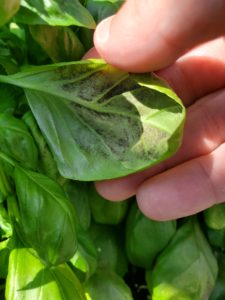
Basil downy mildew sporulating on the underside of an infected leaf.
June 10, 2019 Andy Wyenandt
Vegetable Disease Update – 6/10/19
- Phytophthora blight has been reported on pepper.
- Southern blight was reported on tomato last week in southern New Jersey.
- Bacterial leaf spot has been found on cabbage in southern New Jersey.
- Cucurbit downy mildew has been reported as far north as South Carolina.
- There have been no reports of late blight in the region to date.
- The 2019 Fungicide Resistance Management Guide for Vegetable Crops in the mid-Atlantic Region is now available for FREE online.
- For more information on controlling these and other important diseases please see the 2019 Mid-Atlantic Commercial Vegetable Production Guide. The guide is available for FREE online by following the links on the Plant and Pest Advisory website. Hardcopies of the 2019 guide can be purchased through your local county Extension office.
May 31, 2019 Andy Wyenandt
Phytophthora blight control in wet weather
Most of New Jersey has been plagued by heavy rains and pop-up thunderstorms these past few days making conditions ideal for pathogens such as Phytophthora blight (P. capsici) on pepper, eggplant, tomato, and cucurbit crops. Now that the temperatures are starting to rise the threat of infection will only begin to increase. Unfortunately, Phytophthora blight can be found on most farms in the southern part of the state. Poor crop rotations with susceptible hosts only make matters worse. The pathogen also has an increasing host range that also includes snap and lima beans, and all other crops, other than a few resistant bell pepper cultivars, lack any resistance to the pathogen.
Control of Phytophthora blight is extremely difficult (even with the use of fungicides) in the extremely wet weather conditions that parts of New Jersey. In the past few years a number of new fungicides, with new active ingredients, have become commercially-available for controlling phytophthora on multiple crops. Mefenoxam or metalaxyl, both once widely-used to effectively control Phytophthora blight has been hit by resistance issues around much of Southern New Jersey the past decade. Growers with a known history of mefenoxam-insensitivity on their farm should use Presidio, Previcur Flex, or Ranman plus a Phosphite fungicide in rotation in their drip application programs. Importantly, if mefenoxam has not been used in particular fields on any crop for a number of years (more than 5+) the fungus may revert back to being mefenoxam-sensitive and control with these products may return. Orondis Gold, mefenoxam, metalaxyl, and the phosphites are the most systemic of the group and should readily be taken up the by plant via application through the drip. Presidio has locally systemic and has translaminar activity and offers protection of the root system via drip. Ranman has protectant-like activity and thus will offer root system protection.
For more information on these fungicides and specific crop uses, please see the 2020/2021 Mid-Atlantic Commercial Fungicide Recommendations Guide.
